
At Comic-Con, it was Back To The Future
By Dan Brown Some thoughts about two pieces of news emerging out of San Diego at Comic-Con International last week: *Actor Robert Downey Jr. is returning to Marvel movies. This time, however, he will be playing a villain – Doctor Doom – in a pair of Avengers sequels set for release in 2026 and 2027. RDJ is well-known in a comics context for playing Iron Man from 2008 until 2019, when his character died – a battlefield casualty in the effort to defeat Thanos. How, or even if, Marvel will explain why the same person who played Tony Stark is now the vaguely Eastern European Doom is anybody’s guess, although the multiverse concept gives the producers any number of plot devices to employ. The question that popped into my head when the news broke was: Why would they hire Downey when Doom – as depicted in comics like The Fantastic Four – has a mask welded to his face? Unlike in the Iron Man movies, they won’t be able to show Downey’s head inside the new metal suit, yet presumably they want maximum screen time for the mountain of cash they’re about to pay him. Fan reaction has been mixed. No surprise there. The naysayers complain that bringing Downey in at this point is a sign of a studio in retreat, going back to a talent associated with the glory days of its superhero movies. (I was surprised to learn Cillian Murphy, recently seen in Oppenheimer, is the Doom of choice for a large segment of Marvel fandom.) Fans of RDJ just want more of the magnetic performer, any way they can get him.“New mask, same task,” Downey said when he strode the stage in San Diego. I thought he was a brilliant choice to play Stark, but that was because I had hoped Marvel would adapt the Demon in a Bottle storyline faithfully: Get an addict to play an addict. Then they glossed over that part of Iron Man’s backstory in 2010’s Iron Man 2. Downey has a major acting challenge ahead of him, including making moviegoers forget how recent motion pictures and shows from Marvel were setting up Kang the Conqueror to be the next big baddie on the scene, until actor Jonathan Majors ran into legal trouble. Meanwhile, at the distinguished competition . . . *DC’s new logo is a familiar one. The comic company known for such superheroes as Superman, Batman and Wonder Woman announced in San Diego it will be returning to the same logo it used from 1977 to 2005 on its products. Called the “bullet,” it features a circular design with four stars similar to a compass. It was originally designed by Milton Glaser, who also originated the “I Love NY” logo. “Definitely for me, and many generations of fans, that particular logo defined DC in its heyday,” DC boss Jim Lee said, as reported by The Hollywood Reporter.“I remember during the renaissance of DC in the 1980s, with Watchmen, Dark Knight Returns, The Shadow coming out, that was the DC logo. In the minds of many fans, that is the mark that defined the DC brand. It’s exciting to bring it back.” The old logo is also associated with such high points from DC’s history as the George Perez/Marv Wolfman years on The New Teen Titans, Alan Moore’s tenure on Swamp Thing, and the 1989 Batman film. It’s also linked to Crisis on Infinite Earths, the miniseries that relaunched the DC Universe. The company is now about to attempt the same feat with its stable of movies, wiping the slate clean again. Not to overstate it, but a logo is an important part of branding, as demonstrated by the fact DC has had three different ones since 2005, none of which really stuck. DC is hoping to reconnect with a certain vintage of fan: people like me who were devotees of their characters in the 1980s And how are these two bits of news connected? Both comic companies, in their own way, are going back to the future. Are they smart moves? That’s up to comic fans like you to decide. Dan Brown has covered pop culture for more than 31 years as a journalist and also moderates L.A. Mood’s monthly graphic-novel group.
Gabrielle Drolet’s Rats are the Barbenheimer of My Summer
By Dan Brown Montreal cartoonist Gabrielle Drolet is on holiday. And I’m loving every minute of her European vacation. If you’re a fan of online cartoonists, you may already know Drolet’s work. I found her on Twitter (the platform now known as X) and she posts on Instagram, too. Drolet’s comics have also appeared in mainstream outlets like the Globe and Mail and the New Yorker. She has a simple, expressive style — her work is funny, engaging and thoughtful.Oh yeah, she also likes to draw rats. A lot. At the end of June, Drolet posted that she was heading to the Continent to visit such destinations as Croatia, Hungary, Italy, and Slovenia.. “Leaving Canada for the first time in six years to lie on beaches around Europe,” she tweeted, adding she would be posting periodic cartoon updates. Her short narratives, typically no longer than one page, have been a highlight of my summer. She does them on the fly, often posting a comic that documents that day’s sightseeing. (Full disclosure: Drolet worked several years ago at the Western Gazette, where I mentor young journalists as my day job, although I’ve never met her in real life. And I hope very much to acquire some of her original work.) The young cartoonist is travelling in Europe with a group of friends. In a recent cartoon from Hungary, one of her companions asked the others to take a look at a tick bite on his back that had grown itchy. He turns his back so they can see the wound. They stand there gaping. “I’m calling our health insurance,” says one member of the group. “I”m texting a photo to my doctor girlfriend,” says another. “I’m making a cartoon,” Drolet’s rat self chirps cheerily as she documents the episode. That’s right – her preferred way of depicting herself in the autobiographical comics is as a rat wearing glasses. She draws her friends as turtles, cats, dogs, geese, you name it. Part of the joke is having animals say things humans are hesitant to express. In a Budapest nightclub, for instance, Drolet’s rat boogies with a friendly bunny. Finally, she broaches a delicate topic. “Hey . . . are you gay?” the rat asks. “I don’t know. Maybe!” responds her dancing partner. “I don’t know what to make of that!” “Me neither!” They then go their separate ways. Maybe the truth is I can’t fully explain why the anthropomorphizing is so droll. All I may be able to do is describe my reaction. These cartoons make me laugh and think, which is the highest compliment I can pay any artist. In a comic context, the question about substituting animals for people is always: What is gained? Why bother switching out people for animals that might be their pets? In the 2019 graphic novel Off Season, for instance, veteran graphic novelist James Sturm told the story of one couple’s disintegration amid the rise of Donald Trump on the political scene. In my view, there was absolutely no reason to make the human cast of that book into canines who stand upright and wear clothes. It added nothing. With Drolet, the change makes her characters more innocent. Their emotions, by some strange cartoon alchemy, become more relatable. The over-arching theme of her art – making her way in the world as a young adult – comes through so clearly. One recent cartoon shows how Drolet dresses for travel: linen dress, baseball hat, fanny pack, SPF 50 everywhere. “God, I look like such a tourist,” she says to herself. “Then again, I AM a tourist.”Somehow, those lines are funnier when coming from a human-sized rodent. A few weeks ago, I wrote a column in this space wondering what the Barbenheimer of summer 2024 will be – the cultural event that everyone is talking about and remembers years from now. Maybe when Deadpool & Wolverine lands in theatres at the end of this week that question will be answered for most people. But not me. The Barbenheimer of my summer – the one thing that is getting me more excited than anything else – is the story of one rat’s adventures in Europe. Would it be too much to ask for a comics publisher to collect all of these images and publish them in a graphic-novel format? Drawn & Quarterly, I’m looking at you. Dan Brown has covered pop culture for more than 31 years as a journalist and also moderates L.A. Mood’s monthly graphic-novel group.
Deadpool & Wolverine Isn’t a Sure Bet
The superhero combo may not be able to win over movie goers according to Dan Brown. He explains how movie trends, ratings, and more won't help the studio in this week's column,
Read The Story
Wendy Keeps Turning Bad Decisions Into Funny Art
By Dan BrownThe Wendy Award is the fourth book in Walter Scott’s hilarious Wendy series. How is it different from her previous adventures? In this one, things take a metafictional turn.If you like comics that call attention to their own constructed nature, or you just find the hot mess Wendy and her masked friend Screamo a hoot, check it out.The Wendy Award takes the piss out of arts awards, museums, land acknowledgements, corporate sponsorships, life in the COVID era, addictions, sobriety meds, Gen Z, people who go by one name, and every pretentious panel discussion ever.The premise, such as it is, is that the title character gets nominated for a prestigious art award for her autobiographical comic strip, called Wanda. You follow?It turns out the people in Wendy’s life aren’t happy with how they are portrayed in Wanda. I’ll guess the inspiration for this theme is the way Scott’s previous work has been received by his own peers and acquaintances.The contemporary art prize is sponsored by the national chain Food Hut, whose slogan is “Because you gotta eat sometime!’ The prize includes an exhibition at “the prestigious Art Factory on the Toronto waterfront.” Since I’m more than skeptical about Canada’s arts establishment, I love this kind of comedy.Her fellow nominees include Winona, Octavia, Zima and Moonstone. The last of these is described as a “relentlessly ubiquitous artist of many mediums and collaborations.”Even though she is in line for the big award, this doesn’t mean Wendy’s perennially chaotic day-to-day existence as an aspiring artist is any less turbulent than it was in her previous books. She is still a sucker for wine and cocaine, and at one point takes a side trip to New York to find herself. She’s always trying to find herself.The strip is now in Seinfeld territory – remember the story arc in which the NBC sitcom showed Jerry pitching a sitcom to NBC? The Wanda Award is kinda like that when it bends back in on itself.Wendy crashes at the apartment of her friend Tina, who isn’t happy about the intrusion. “Maybe it’ll end up in your next book!” Tina yells as she tosses our harried heroine out on the street, terminating the tense visit.There are some nice touches here, including an experiment splash page and a panel that’s an homage to the William Burroughs/David Cronenberg acid trip Naked Lunch. While in the Big Apple, Wendy enters a cinema to watch a film in which moments from her own life are being projected on the screen almost in real time, recalling such self-reflexive motion pictures as Woody Allen’s The Purple Rose of Cairo.You can feel Scott pushing the boundaries, trying to stretch himself as a graphic novelist and move the form in new directions.At another point, an upset Wendy even asks for a respite from being the title character in a comic strip. “Can you please cut away to something else for a bit?” she says directly to the reader during a vulnerable moment.Between you and me, I was unsure Wendy would be able to sustain as many books as she has. But Scott has not run out of material and now, I am more than invested in this character, who always feels she is failing at life. The joke is still funny. I am in it to the bitter end, whenever that might come.Speaking of endings, The Wendy Award concludes with a wordless epilogue in which Wendy walks out of the Art Factory, leaving the white cube behind. Is she finally forsaking the world of art for something more substantial that can make her feel whole?I look forward to finding out!! Dan Brown has covered pop culture for more than 31 years as a journalist and also moderates L.A. Mood’s monthly graphic-novel group.
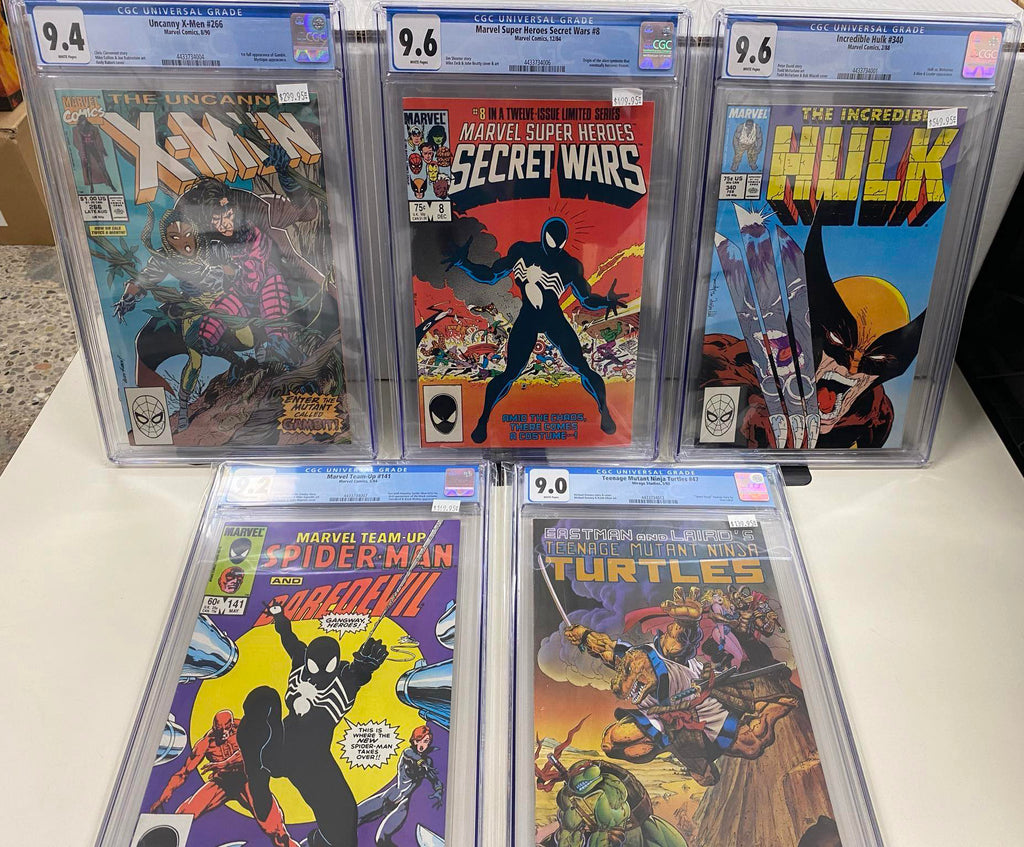
New Comic Collection to be Released In Store Saturday, July 13
This collection includes classic CGC graded and non-graded issues, first appearances, and more.
Read The Story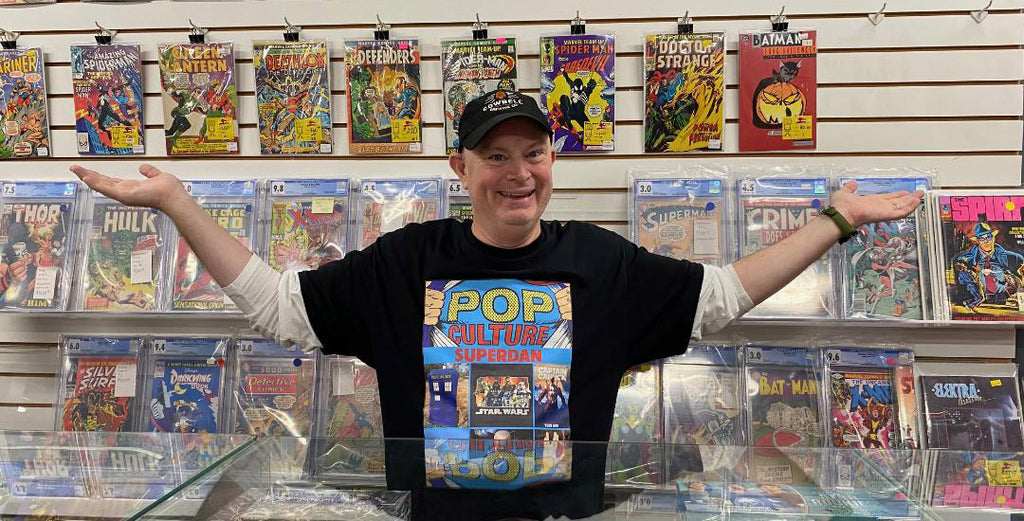
Are New Stamps a Sign We’ve Reached Peak Graphic Novel?
By Dan Brown It’s an honour few receive and fewer deserve. It’s not something young Canadians aspire to, but it’s arguably more prestigious than getting a spot on Canada’s Walk of Fame, having your name on the Stanley Cup, or joining the Order of Canada. It’s reserved for those special individuals who have had a deep impact on this dominion we call home. It’s the literal stamp of approval. And now the literary medium you and I love – graphic novels — has it. That’s right: Last month, Canada Post – the folks who deliver the mail – dedicated a series of postage stamps to Canada’s graphic novelists. Chosen for the honour were Chester Brown, Michel Rabagliati, Seth, and the Tamaki cousins, Jillian and Mariko (these creators also contributed the designs that were used). “All of (them) have made significant contributions to the genre and continue a long line of Canadian storytellers honoured by Canada Post,” the Crown Corporation said in a statement about the four adhesive tokens. Those names were selected for their influence on graphic novels as an art form. It became clear a long time ago the Great White North produces more than its share of brilliant graphic novelists. I would liken their dominance in the field to how Canadians are overrepresented in the world of comedy. “The five novelists honoured on the new stamps pushed the boundaries and elevated the form, leaving a mark on readers around the globe,” Canada Post added. I’m sure we could all find reasons to quibble with Canada Post’s selections. I realize it’s still early days, but doesn’t Kate Beaton merit a stamp? And I gotta stand up for Southwestern Ontario’s own Jeff Lemire. He should get one as well.Other possibilities include Guy Delisle, Joe Ollmann, Bryan Lee O’Malley and Dave Sim. That’s off the top of my head. It’s possible other artists were asked to participate, and declined. Whatever happened, there are clearly enough influential homegrown graphic novelists for similar future stamps. It’s true there have been previous Canada Post issues dedicated to comic characters – such as the superheroes Captain Canuck, Fleur dy Lys and Superman. This is the first time graphic novels have been singled out. “Graphic novels tell rich stories by interweaving words and drawings in comic-book-like panels” is how Canada Post makes the distinction. A far more interesting question to ask is, what does this say about society’s attitude toward comics and graphic novels? Surely despite their origins as cheap reading material for kids, they have now gained mainstream approval as an adult pastime? With its announcement, Canada Post is in essence saying graphic novels are as Canadian as beavers, the flag, hockey, and Donald Sutherland, all featured on past stamps. Could the medium get any more respectable? University courses are taught about graphic novels. Scholars write actual books about comics.. They are included in Canada Reads, and they have been source material for movies and TV shows for decades. My nightmare would be the stamps are a sign graphic novels have peaked. Could Canada Post’s gesture, which was meant as an honour, actually be the kiss of death? Naw. I ain’t worried. After all, rock-and-roll pioneer Elvis Presley had to wait a full 16 years after his death to be honoured by the United States Postal Service with a stamp. And when the USPS offered consumers a choice – did they want a handsome young Elvis on the stamp, or an older, sweaty Elvis in a jumpsuit? – more than a million Americans registered their votes in the pre-internet era early 1990s. Look what’s happened to Elvis since then. He hasn’t faded from the collective memory at all. In fact, there was a major motion picture just two years ago telling his story to an entirely new generation. No one is losing interest. Rather than being an indication graphic novels are on the wane, I choose to believe there are many more Canadian creators who will redefine the medium again and again in the days to come. Oh, and while we’re on this topic, Happy Canada Day! Dan Brown has covered pop culture for more than 31 years as a journalist and also moderates L.A. Mood’s monthly graphic-novel group.