
Why the Paradox of Continuity Fascinates Me
By Dan BrownThis is the kind of thing I think about on a muggy August afternoon . . . Imagine, for a moment, you’re reading a Spider-Man comic book. Doesn’t matter which title. Let’s just say Spidey is battling a bad guy like Doc Ock, as he often does.You’re reading the issue from cover to cover. It’s a good one, combining explosive art with expertly crafted writing. It’s so engrossing, you get wrapped up in the fight scene.You finish the comic and think, “Wow. That one was a cut above, too bad it had to end.” You set the Marvel creation down, sitting there for a moment just basking in the resulting positive vibes. It’s true: There’s nothing like reading a damn good comic.Then something starts nagging at your peaceful mind. You pick the issue up again, flipping through it. Looking at the fight scene a second time, you feel an increasing sense of unease. What could be troubling you?There, you spot it: The battle has been so fierce that there is a big rip in the webhead’s costume. (Remember, Spider-Man’s duds aren’t made of unstable molecules, like the uniforms worn by fellow Marvel heroes the Fantastic Four.) You flip back and forth between early in the skirmish and the end, after the festival of punching and body blows is over. You’re not imagining things. You have noticed a huge inconsistency.In a panel on page 10, the hole is on the right side of the familiar blue-and-red costume. Yet on page 15, it’s on the left. How could the artist, writer, and editors have missed such a glaring detail?This isn’t a minor trifle. Marvel has built its brand on realism, on how their heroes have everyday problems. Unlike the lofty, godlike, emotionally constipated characters in the DC stable, Marvel heroes are more engaging because they are like Marvel readers, who have earthly, common concerns. When Spider-Man isn’t fighting crime, for instance, his time is occupied by mundane pursuits like making sure he doesn’t miss the next rent payment. His costume won’t magically repair itself, so there’s sure to be a panel in the following issue depicting Peter Parking mending the tear by means of a thread and needle.In fact, in its heyday, Marvel even came up with a system for dealing with this kind of blooper when devoted readers would write in to complain about continuity errors. The company’s editors would hand out No-Prizes – which were represented by an empty envelope – to eagle-eyed fans.But here’s the thing. Out of all those letters about the mistake, not a one of them will contain a complaint about the obvious, larger inconsistency: A human being can’t get superpowers from the bite of a radioactive spider.In other words, comic enthusiasts are willing to swallow a big lie (the entire premise of Spidey’s existence), but will choke on a small one (the hard-to-locate gash in his costume).This is the central paradox of continuity, and it fascinates me. It suggests comic readers are more bothered by tiny details than huge, overarching concerns.I define continuity as the expectation in a made-up milieu that the same laws of science and nature that govern our own universe also apply. For instance, as time goes on, we expect Parker to age, to get older as the years pass. And indeed, at one point in the Spider-Man continuity he leaves high school for college. That’s how things would work in the real world, right? Makes sense.The part that captivates me is how fans will make allowances for gigantic diversions from those scientific principles, then jump on relatively minor ones.After all, if you accept that a guy can gain the proportionate strength of a spider after being chomped on by an irradiated insect, then why does every other detail in the story have to be “real?” What does it matter if anything else in the story is consistent?If you have any theories that explain this selective suspension of disbelief, I’d love to hear them! Dan Brown has covered pop culture for 30 years as a journalist and also moderates L.A. Mood’s monthly graphic-novel group.
Comic Book Sale Caused by Superhero Discountman Appearance
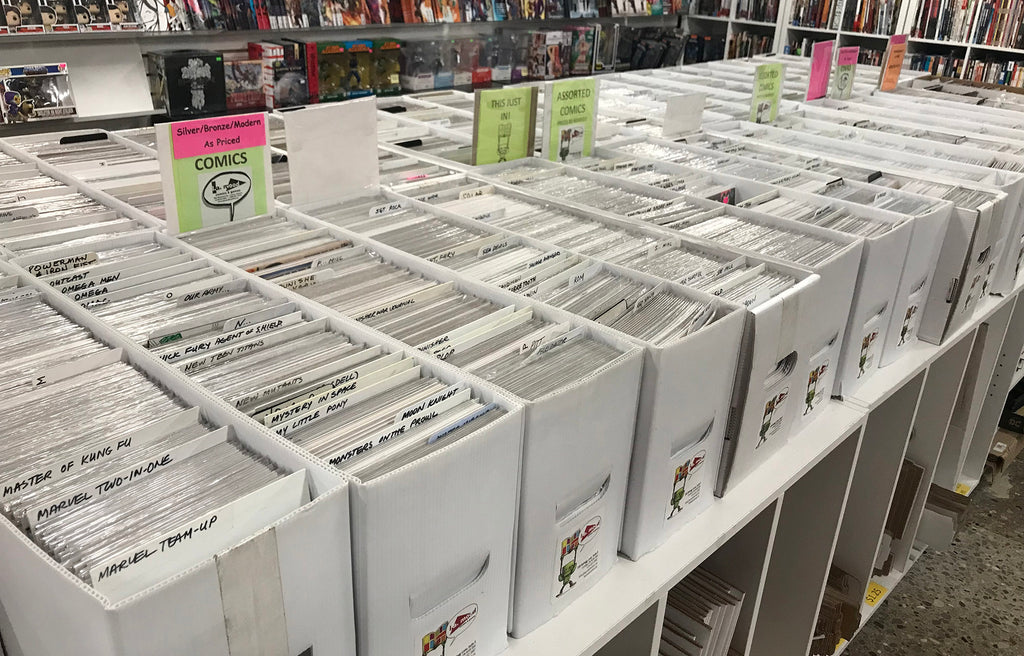
Every once in a while, in the vast universe of comics, a new hero emerges—one that might not fit the traditional mold but resonates with fans nonetheless. At L.A. Mood Comics and Games, such a hero has risen: Discountman! Who Exactly is Discountman? Legends often have humble beginnings. Our enigmatic hero, Discountman, might not have come from a distant planet or been bitten by a mystical creature, but his power is one every comic aficionado cherishes: the power of unbeatable savings. Known in the inner circles as Gord, this unassuming figure is a testament that not all heroes wear capes. This hero, with his gentle demeanor, creates a legacy by making comic dreams more accessible. The Comic World's Best-Kept Secret Every hero has their story. While Discountman's real identity remains shrouded in mystery, what we do know is that his appearances are rare, usually during spectacular comic book sales, and always bring joy to the comic community. He's the unsung sentinel watching over budgets while ensuring fans don't miss out on their favorite reads. Great Comic Discounts From Friday, August 18th to Saturday, September 2nd, Discountman’s magic is palpable across L.A. Mood Comics and Games: 25% off on all wall comics and premium books: Whether you're a seasoned collector or a newcomer to the comic world, this range promises to introduce you to stories that will be cherished for ages, waiting for you at a fraction of the price. 50% off all back issues in white boxes: Thousands of tales await in shaped universes, legendary characters. Now is the time to complete those missing series or discover a new favorite at half the cost! These are perfect for those who love diving deep into the comic world's history and discovering hidden gems. A huge selection of Indie, Marvel, and D.C. comics await. Journey Through L.A. Mood Comics and Games Situated inside 100 Kellogg Lane in London, our store isn't just a commercial space; it’s a journey through time and imagination. With walls adorned by vibrant artwork and tales of heroism, betrayal, love, and camaraderie, L.A. Mood is a testament to the artistry and narrative prowess of comic creators. Digital vs. Tangible: The Unbeatable Charm of Physical Comics In an age of digital consumption, there’s an irreplaceable charm in holding a tangible paper comic. Feeling its weight, smelling the print, and being able to physically turn a page adds layers to the reading experience. This sale, an in-store exclusive, champions this very charm. A Clarion Call to Comic Lovers Heroes, anti-heroes, sidekicks, and even villains—here’s your chance to rally! Step into a realm where each corner holds tales of valor, each shelf introduces you to new worlds, and Discountman ensures your adventure doesn't burn a hole in your wallet. Conclusion Every epoch has its heroes. While the comic world is filled with the likes of Superman, Wonder Woman, Thor, Batman, Wolverine, and Spider-Man, at L.A. Mood Comics and Games, Discountman reigns supreme. As pages turn and stories unfold, remember that this hero ensures you dive deep without financial constraints. Embark on this journey with us, and let's celebrate the legacy of comics together.
R2-D2 and C-3PO Never Did This
By Dan BrownA bunch of robots walk into a bar, but they aren’t the strangest thing about the place.That’s the premise of Robot Comics No. 0, which Bob Burden – famed in comic circles for creating Flaming Carrot and the Mysterymen – published in 1987 as a one-off “cultural oddity,” to use the eccentric creator’s own words.The book describes one crazy night down at the Blind Pig, a bar where a mummy plays banjo in the corner, two guys with axes for heads scuffle, scuba divers float through the air, beans spill out of the pay-phone receiver, and a man walks by, carrying a tombstone in anticipation of his own imminent demise.Welcome to Bob Burden’s imagination. If you’ve ever had a frantic bout of drinking at a dive that didn’t make sense to you in the morning, yet was still a lot of fun, you’ll be able to relate. The whole thing plays like an extended scene out of a Flaming Carrot comic, and indeed, Carrot supporting players like Uncle Billy and the Artless Dodger are part of the watering hole’s crowd.Those readers with long memories and unconventional tastes know Flaming Carrot (and his sometime allies, the Mysterymen) as the blue-collar hero whose mask is, well, a flaming carrot. His secret origin: After reading 5,000 comics in one sitting, the poor wretch suffers brain damage, becoming Palookaville’s B-list protector in the process.So if you’ve read any of the Carrot’s irregularly published exploits, you will grok what Robot Comics No. 0 is all about.As with all of Burden’s work, this slender volume is a riot of invention. This bar could only have come from his fertile, twisted mind, and I was lucky enough to find a copy in the bargain bin at L.A. Mood just before the summer.The surreal comic makes for engrossing reading on a muggy August afternoon.By way of introduction, Burden says he composed the tale decades prior to its publication as an exercise in what he calls “electra-fiction.” The artist/writer says the panels “exploded on the pages with no bounds of reason or any attempt to conform to known standards. It is, in essence, experimental literature guised as a leaking barrelful of rip-snorting, foot-stomping belly laffs.”I call it the cartoon equivalent of jazz. Or a nonsensical salad stocked with one random ingredient after the other.There is no plot, no A to B story, just a profile of an unforgettable night in a drinking establishment whose existence defies logic.If you’re a fan or student of tavern-derived literature, you could also classify it as Burden’s answer to the classic New Yorker piece by Joseph Mitchell, McSorley’s Wonderful Saloon.Indeed, the evening’s events are narrated by a nameless reporter who figures, “As a journalist and an artist, I ought to record it all for posterity.”What does he observe? Harry Lime, from the Third Man, appears in one panel in all his Wellesian glory. The house band’s cover of Neil Diamond’s Cracklin’ Rosie upsets a patron. One of the bar’s many denizens refers to two of the Three Stooges. And then the female (?) robot leaves in the company of a Maytag repairman. Of course, several bodies are buried at the local drive-in theatre following the night’s mayhem.If all of that sounds like your kind of madness, it’s worth hunting down this little-known Bob Burden creation.No wonder his motto is “The wild shall wild remain!”Dan Brown has covered pop culture for 30 years as a journalist and also moderates L.A. Mood’s monthly graphic-novel group.

Visit Strange New Worlds In Byrne Star Trek Omnibus
By Dan BrownFew comic creators do Star Trek as well as industry legend and sometime Canadian John Byrne. That thought entered my head as I was watching a recent episode of Star Trek: Strange New Worlds. Have you been following the show? I think this summer’s second season is much stronger than the first.Indeed, it’s a Golden Age on the small screen for Star Trek fans, who now have several series to choose from, including the workplace comedy Lower Decks, the recently concluded third season of Picard, the just-axed Prodigy, and the unwatched-by-me Discovery.SNW, which features doomed Captain Christopher Pike, offers a fresh twist on established Trek continuity. As we know from the original series, Pike has a tragedy waiting for him in his future, but SNW sets that premise on its ear by positing that Pike knows he is in for a world of hurt.One of the other characters from SNW – the Enterprise’s Number One – is fleshed out in an anthology published in 2014 by IDW, which contains four interconnected stories Byrne drew and wrote. If Star Trek excites you, I recommend you hunt it down.I would put Star Trek: The John Byrne Collection at the top of the heap as far as Trek comic adaptations – of which there have been many over the decades – go.My suspicion is that Byrne, famed for his work on Uncanny X-Men, Fantastic Four and Superman, had very specific stories in mind for his stint at IDW. (I honestly don’t know if he approached the publisher with a pitch, or if IDW asked the illustrator/writer to create the comics that make up this collection.) Reading the hefty volume, I get the sense Byrne is a huge Star Trek fan and knew exactly what he wanted to do, including putting the spotlight on Pike’s second-in-command. And, for the record, the Number One in SNW follows an entirely different path from the comic character, so I doubt the show’s creators read the Byrne compilation before SNW launched, which is fine by me since I can’t get enough of her in either medium.The Byrne treasury also offers an intriguing look at another minor character from the original show, Gary Seven. If I remember my Gene Roddenberry lore correctly, he aimed to have the mysterious and powerful Seven star in his own show. Byrne offers a tantalizing glimpse at what such a program might have looked like, had Roddenberry’s ambitions been realized. Byrne also sheds light on the inner workings of the Romulan homeworld, where the spheres of politics and romance are indistinguishable. And what Trek fan could resist a storyline with the title Leonard McCoy: Frontier Doctor? Being just a humble country doctor doesn’t make his adventures in deep space any less compelling. Another anthology I read this summer is 2009’s Star Trek: Mission’s End. I prefer Byrne’s clean lines to Steven Molnar’s art, but the real reason to grab this trade paperback is the writing by Canada’s own Ty Templeton, who was given the daunting task of bridging the gap between the original series and Star Trek: The Motion Picture.In other words, Templeton had to explain why Kirk takes the desk assignment as an admiral that he is so ambivalent about at the beginning of the first Trek movie, why McCoy quits the Enterprise (you’ll recall he has to be drafted by Starfleet to join Kirk before they investigate V’Ger’s march toward Earth), and what led Spock to depart for Vulcan to get more in touch with his logical side. One other item on my summer reading list is Star Trek: The Enterprise Logs Volume One and Two, which harken back to the very earliest era of Star Trek in comics form back in the Gold Key days. I think it’s fair to say these earliest imaginings of Trek on the page are, well, a mixed bag. Sure, each issue was about Kirk and company, but I’m pretty sure they were written and drawn by individuals who hadn’t actually seen the show on TV. This leads to some inadvertent comedy, as when Scottish Enterprise engineer Montgomery Scott is depicted as having blond hair.Heck, the artist or artists (Gold Key had a policy of not including credits in these comics) didn’t even put the Starfleet logo on the crew’s uniforms!Dan Brown has covered pop culture for 30 years as a journalist and also moderates L.A. Mood’s monthly graphic-novel group.

Too Many Marvel Shows, True, but Comics Subsidiary Looks Good On Disney’s Balance Sheet
By Dan Brown Bob Iger spoke for many of us last week when he said, in essence, there’s too damn much Marvel content. The question is: How is this pronouncement by the Disney boss – and his plan to scale back spending by the corporation— going to affect the comics arm of the company? During an interview with CNBC, Iger, Disney’s CEO, said the sheer volume of Marvel streaming series and movies has reached the point where the audience has been “diluted,” meaning that Marvel fans haven’t been as excited about recent big-screen releases like this February’s Quantumania as they were back in the days of Endgame four years ago. And no wonder. The third instalment in the Ant-Man series is, for those keeping score at home, the 30th film set in the Marvel Cinematic Universe following 2008’s Iron Man. I mean, I love Paul Rudd as much as the next straight guy, but at some point even I have had my fill of his brand of non-threatening charm. Deciphering Iger’s ire, he appeared to be putting the blame on the avalanche of shows that were released by his Disney+ streaming service during the pandemic. And he’s got a point. I don’t know about you, but there are no longer a lot of people in my life who get excited whenever a new superhero show materializes on the small screen. No sooner had I finished watching 2021’s WandaVision than we were drowning in Marvel characters: the Falcon and the Winter Soldier, Loki, Hawkeye, Moon Knight, Ms. Marvel, She-Hulk, and they keep coming. They are making shows about characters I don’t even care about, which is saying something – I was raised on Marvel heroes in the 1970s and 1980s! Ah, the comics. I’m sure Marvel’s comics division won’t be spared from the billions of dollars in cuts that Iger signaled are in the offing, but there’s a simple fact of balance sheets that should shield it from excess financial pain. Simply stated, a comics company that is a subsidiary of a multibillion-dollar enterprise is going to appear on the financial statement as a cost-effective proposition because, compared with the investment required to make a movie, the cost of making a comic book or graphic novel is almost nothing – and the payoff is off the charts. As I’ve written elsewhere, my theory is that the purpose of Marvel’s comics is to serve as a kind of test kitchen where ideas can be thrown at the wall to see what sticks. Whether it’s Tony Stark donning a suit of armour for the first time, or a set of cosmic jewels that gives their possessor infinite power over reality, or a civil war pitting superhero allies against one another – those things all happened first in the pages of the comics. Groot. Thanos. Peter Parker. There are decades of stories about these characters to be mined by the writers of Marvel movies and shows. (There are so many comic and other adaptations coming out of Hollywood, it’s enough to make you wonder, in these days of a strike by movie writers, just exactly what Tinseltown scribes do, apart from plundering existing properties.) Another way of saying it is, Guardians of the Galaxy director James Gunn didn’t have to invent the Infinity Stones because artist/writer Jim Starlin did the hard part for him five decades ago. Perhaps I’m deluding myself, but I feel as though the cheapest talent working for Disney – those artists and writers who come up with the concepts that percolate upward into movies and TV shows – are going to be just fine. Or think about it this way: Freelance comic creator Jack Kirby, who arguably invented more characters and concepts than any other figure in comics history, in all the decades he toiled for Marvel (and DC), never had health insurance. Even years after Kirby’s death, I’d say Disney is getting its money’s worth out of him. Dan Brown has covered pop culture for 30 years as a journalist and also moderates L.A. Mood’s monthly graphic-novel group.

Why Didn’t Comics Version of Indiana Jones Set The World On Fire?
By Dan Brown All readers want from comics, I’ve said before, is compelling characters in interesting situations. Well, Indiana Jones – featured in the Dial of Destiny, which is in theatres now – is certainly a compelling character as played by Harrison Ford. And the makers of the Indy films have certainly been able to place him in some interesting (and deadly) situations. So how come the daring archeologist has never been able to sustain a comic title for long? I’m not saying Jones is a total washout as the headliner of a monthly series, but compared to adjacent properties, like Star Wars, he’s only been a blip in the grand sweep of comics history. Inspired by the success of 1981’s Raiders of the Lost Ark, It’s true Marvel Comics did publish more than 30 issues of The Further Adventures of Indiana Jones starting in 1983. Remember, those were the days when there wasn’t a property Marvel didn’t try to plunder. The gang from the bullpen attempted to cash in on every new fad, trend, craze and sensation that came along. How ridiculous did it get? This was the era when even the rock band KISS ended up in the pages of Marvel Comics. That’s right – for a brief moment, Gene Simmons was a Marvel protagonist, along with Spider-Man, the Hulk, Wolverine and the rest. I’m guessing an Indy comic seemed like a no-brainer. As it turned out, that first series would pale beside the Star Wars monthly, which ran 107 issues from 1977 to 1986 and is credited by some with keeping the House of Ideas afloat during lean economic times. And those Star Wars comics were . . . fine. They weren’t the worst stories in the world, although I would argue Russ Manning was doing far more interesting things in the same universe in the pages of daily newspapers with the Star Wars comic strip. And Marvel certainly invested in the venture, attaching talents like Howard Chaykin, Walt Simonson and John Byrne to bring Jones to life on the page. Yet the Further Adventures of Indiana Jones fizzled even before the original Indy trilogy wrapped up in 1989 with the Last Crusade. Here’s another comparison: Conan, Robert E. Howard’s pulp barbarian character, was also a Marvel Comics property during roughly the same period, and has been in the hands of one publishing house or another for decades since. Who knows how many Conan comic adaptations there have been to date? It’s also true Dark Horse Comics licenced Indiana Jones and his bullwhip in the 1990s for several more adventures. But those stories are only half-remembered now, if at all. So despite his enduring appeal on the big screen, why was Indy a comparative dud in comics form? I don’t have an all-encompassing answer, but the fact is some properties just don’t translate to other media. Some books don’t make good TV shows. Some movies don’t make good comics. Very few plays make for interesting films. (This is where I should also note that the Young Indiana Jones Chronicles, the network version of the character, barely lasted two seasons on ABC, so there may be something about the archeologist that just doesn’t work in other media.) Or perhaps it’s because the Indy films are the end product of pop culture, not the beginning. What I mean is, it was newspaper strips and adventure comics, along with silver-screen serials, that moved George Lucas and Steve Spielberg to come up with Indy in the first place. And maybe it just ends there: Dr. Jones was intended to be a creature of the big screen, so he is doomed never to transcend its limits. Dan Brown has covered pop culture for 30 years as a journalist and also moderates L.A. Mood’s monthly graphic-novel group.