
Monster of the Abyss artist Eric Olcsvary visits with GNG
By Dan Brown SPOILER WARNING: This column contains plot details. If you value surprise, stop reading now. You’ve been warned! The L.A. Mood Graphic-Novel Group met Saturday, April 11, and had a special guest, Tillsonburg artist Eric Olcsvary. This is a brief outline of our discussion with him during our hour-long meeting. The book: The first two issues of Monster of the Abyss, written by Scott Wojcik, and illustrated by Olcsvary. The discussion: Eric gave us a look into his creative process, his background, and his partnership with Wojcik, who is also a local creator. Olcsvary says Wojcik is an idea machine! Wojcik’s kids Ashton and Hayden helped the writer come up with the story for Monster of the Abyss. This comic series follows the adventures of Sleepy Joe, who is a “magical and unique” stuffy brought home from a store in the “Eatons Mall.” Over the two issues he undergoes a drastic transformation, and Olcsvary said Joe being able to think but not talk (his mouth is stitched shut) is a key part of the character’s personality. Oh, and although many readers have asked the creative team about this, Sleepy Joe is not a reference to former U.S. president Joe Biden! By issue No. 2, Sleepy Joe has become Creepy Joe after being pulled into the underworld and having his persona changed. L.A. Mood co-owner and GNG member Gord Mood said the entity that forcibly transforms Joe, the Gloom King, is a Nietzschean kind of being. “Even the strong-willed can be broken, their resolve crushed,” it tells the toy. “Friendship is a lie, when darkness rises they’ll leave you to rot. You’re better off embracing your true nature. You are a creature of fear, destined for darkness.” If you haven’t guessed by now, Monster of the Abyss is a horror story. Olcsvary explained to the group’s members that although he is a metalhead when it comes to music, he is not a big horror guy – he just keeps getting offers to draw horror books! The part of the book where Joe is in the black pit also prompted a digression among the group about brainwashing. To what extent can a person (or even a fabric toy) be induced to do things that are outside their normal moral sphere? We had wide-ranging opinions. Another point we spent a decent chunk of time talking about is the colouring of the book. The first printing of Monster of the Abyss No. 1 was in black and white, which was followed by a colour version with colours by Payton Atkinson. We agreed as a group that we enjoyed the coloured version more. Olcsvary has described his own lines as a “bouncy, ink-heavy art style full of movement and unique composition.” He told us on Saturday that inking is his favourite part of the comic-making process! You can find Monster of the Abyss on the rack reserved for work by local comic creators. L.A. Mood’s Graphic-Novel Group meets the second Saturday of every month. Next month’s selection is Mouse Guard: Dawn of the Black Axe by David Petersen and Gabriel Rodriguez. Be warned, I am a HUGE Mouse Guard fan! We’re set to meet May 9 at the gaming tables in the store at 11 a.m. All are welcome to join the discussion! Dan Brown has covered pop culture for more than 33 years as a journalist and also moderates L.A. Mood’s monthly Graphic-Novel Group.
I’m the Odd Man Out as GNG Takes on Roaming
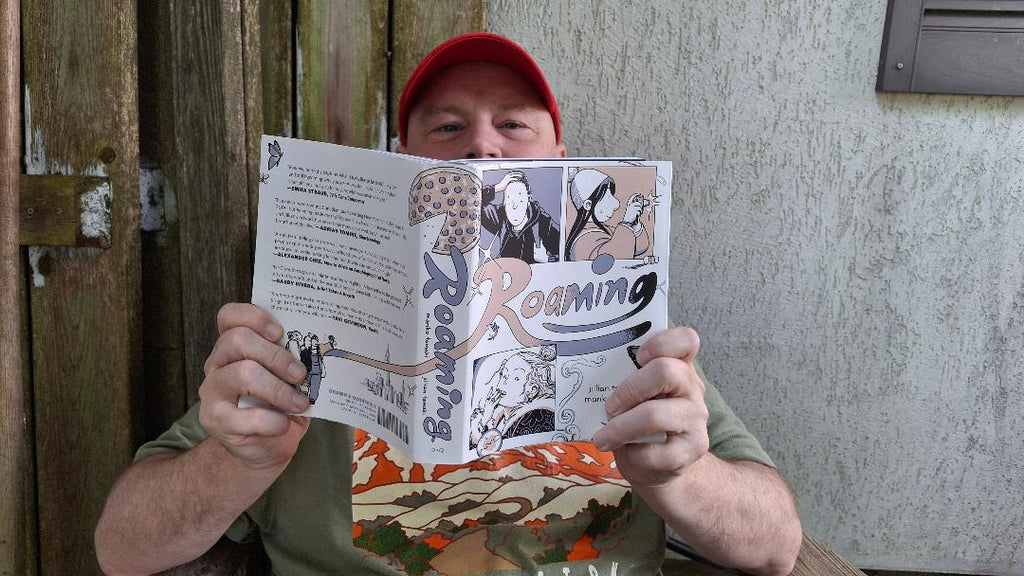
By Dan Brown SPOILER WARNING: This column contains details from the graphic novel Roaming, so if you value surprise stop reading right now! Here’s the rundown on the most recent meeting of the L.A. Mood Graphic-Novel Group, which was held Saturday, July 12. The book: Jillian and Mariko Tamaki’s Roaming, which follows three Canadian first-year university students on a five-day trip to New York City. The discussion: In short, I was in the minority as the only GNG member who really enjoyed the book. Odd man out, as usual! GNG has a custom of choosing a Canadian comic for our July meeting, so we honoured that tradition with this selection. (By sheer coincidence, it comes on the heels of two other books by Canadian creators in May and June.) I, along with one other member of the group, pitched Roaming back in January. While I love everything by the Tamakis, other members of the group strongly disliked Roaming, including someone who couldn’t even finish the thing. The thick volume centres on Dani, Fiona, and Zoe, three university students who take a trip to New York for a brief holiday from their studies. It’s very much a story about the problems of young people, which I think is where most of the antipathy comes from. No one at the table said it wasn’t a realistic portrayal of characters in their late teens/early twenties – in fact, the problem seemed to be it was too accurate. Carol Vandenberg, co-owner of L.A. Mood, said Roaming didn’t work for her because it isn’t leavened with humour. The trio of characters see Big Apple sights, go to bars, get coffee, eat pizza, and of course there’s a drama because Fiona is an interloper who threatens Dani and Zoe’s friendship. Spats ensue. Carol made the point that if you’re going to tell a story about young people, a better approach would have been the one John Hughes adopted with the movie Ferris Bueller’s Day Off: Play the foibles of youth for laughs. Gord Mood, L.A. Mood’s other owner, echoed that sentiment, adding the example of another funny coming-of-age comedy, Dazed and Confused. Several elements prevented GNG members from enjoying the travel tale including the ending, which doesn’t wrap anything up. Other members said the art was prosaic, and that a flashback scene – in which we observe Dani and Zoe at a high-school party – wasn’t introduced in a way the reader could understand. Why do I feel differently? Part of my reason for pitching the book was how the character of Fiona is a huge drama queen. Very early in the book, there are signals to readers to treat anything she says with skepticism. The question in my own mind was, “Can we appreciate this book even if one of the leads is an awful person?” After all, if an artist and writer can create a comic with a character who turns you off, isn’t the fact you reacted to a fictional character like you would to a real person a sign the creative team has done a good job? (Would be interested in any opinions on this question in the comment box below.) I also believe there’s something darkly funny about a group of friends whose relationship revolves around avoiding roaming charges on their cellphones. As it turned out, Fiona was just one of the reasons GNG members didn’t enjoy the book, although someone suggested a comic depicting the same characters once they are out of school and taking on careers might make for a better read. Further reading: If you aren’t daunted by now, two other graphic novels by the Tamakis come to mind – Skim (it follows high-school friends) and This One Summer (which features a tween lead). L.A. Mood’s Graphic-Novel Group meets the second Saturday of each month. Next month’s selection is I Am Stan, Tom Scioli’s graphic biography of the one-time Marvel Comics editor-in-chief. You might have heard of Lee before! We will reconvene August 9 at the gaming tables in the store at 11 a.m. You are invited to come join the discussion! Dan Brown has covered pop culture for more than 32 years as a journalist and also moderates L.A. Mood’s monthly graphic-novel group.
Take A Graphic Trip Across Canada
By Dan Brown In honour of our national holiday, and as a way to protest the tariffs from our southern neighbours, many Canadians are travelling in their own backyard this summer. But what if you aren’t in a position to make the trek? Then take a trip across Canada – in graphic-novel form. That’s right, you can go from coast to coast to coast by reading the work produced by our dominion’s many talented comic creators. So here are suggestions for how to acquaint yourself with the regions of this great nation by looking through the comics set in those places. The East Coast: No trip to the Maritimes would be complete without a shipwreck, so let’s start our journey with Call Me Bill by London graphic novelist Lynette Richards. It’s a mystery, it’s an adventure story, it’s a reclaiming of an LGBTQ figure from the past – and it all begins with a maritime disaster off Nova Scotia, where Beal Art grad Richards lives in Terence Bay. I also recommend D.Boyd’s Denniveniquity and Chicken Rising, which cover Boyd’s formative years in Saint John, which is the city in New Brunswick – the one in Newfoundland and Labrador is St. John’s. Got it? La Belle Province: My first suggestion is Michel Rabagliati’s Paul Up North, part of which takes place during a snowstorm in Laurentian cottage country. And of course, the title character didn’t wear his winter jacket: There is no more Canadian predicament than that! As for the Montreal portion of our cross-Canada tour, I’m proposing Are You Willing to Die For the Cause?, which recounts the early years of the FLQ’s reign of error (the would-be liberators targeted Canada Post mailboxes with their homemade bombs). It was drawn and written by publishing house Drawn & Quarterly founder Chris Oliveros. Ontario outside Toronto: First stop, Jeff Lemire’s Essex County, which lovingly recreates the evocative landscape and taciturn people of Southwestern Ontario. Also recommended is Walter Scott’s Wendy, Master of Art, which is set in Hell, a small Ontario city that has an awful lot in common with Guelph. Toronto: Yes, I agree with you, there are way too many graphic novels set in Canada’s largest city. So instead of inundating you with a long list of options, I urge you to hunt down Matthew Blackett’s Wide Collar Crimes, a collection of comic strips that were published in Eye Weekly in the early 2000s. No other comic evokes the absurdities of life in Toronto like Blackett’s work does. The Prairies: So there’s Shelterbelts, set in a rural Mennonite community in Manitoba, as well as Chester Brown’s Louis Riel, which likewise attempts to capture the vastness of the landscape. I know this might be a stretch, but for Saskatchewan I recommend any Superboy adventure pencilled by artist Tom Grummet in the 1990s – in an interview at that time, he told me the wheat fields he drew near Smallville were patterned after the farms outside the window of his Saskatchewan home. Alberta: Since the tar sands are so important to Canada’s economy, you will want to check out Ducks, Kate Beaton’s account of her two years working in Northern Alberta’s oil patch. This story is not for the faint of heart, so definitely not suitable for young readers. British Columbia: Worth hunting down is the New Yorker’s cartoon edition from Dec. 28, 2020. That issue features the short graphic story Junban from Jillian Tamaki, and is adapted from her grandfather’s notes. The six-page reminiscence covers the same themes as George Takei’s They Called Us Enemy, and achingly calls to mind the Fraser River of the past. The North: Finally, we come to the land of the ice and snow! You may have an easier time getting a hold of Scott Chantler’s Northwest Passage – set in Rupert’s Land – than the anthology of Nelvana of the Northern Lights stories put out by Hope Richardson and Rachel Richey in 2014, but it’s worth it. Taken together, these two selections offer bookends of Canadian comic-book culture, starting in the Second World War with the Canadian whites and moving up to the current day with talents such as Chantler. Yes, this list is incomplete! That’s by necessity. That’s also why I’m looking for suggestions from readers like you in the comment box below. What books would you add to the list? Let’s hear them, as well as a brief description of the parts of this country they represent. And happy Canada Day! Dan Brown has covered pop culture for more than 32 years as a journalist and also moderates L.A. Mood’s monthly graphic-novel group.