
DC Experiments with Size of its Comics
By Dan Brown In the comic industry in 2026, it’s all about the format. I don’t mean e-comics versus paper ones, I mean the many different sizes that printed superhero tales come in today. Gone are one-size-fits-all comics. The point is to make stories available to readers in a format that suits their lifestyle and budget. DC, in particular, has been leading the charge as far as alternative formats go. Surprise, the Distinguished Competition is actually doing something smart! I’ve reviewed the company’s Compact Comics editions in this space, and I noted that for a classic book like Watchmen, the reduction in size doesn’t affect the reading experience as much as the cheaper paper used in mini-editions. That said, I understand Compact Comics now account for a significant chunk of DC’s sales. Apparently, readers love them (and the lower price point). I’ve bought a handful, and I’m not a DC guy by nature. How small can comics get? Maybe you remember the mini-digests of Archie comics that were a staple offering at supermarkets back in the day. But Archie stories were so anodyne, it never mattered how big or tiny a page they appeared on. At the opposite end of the size spectrum, DC is also coming on strong with its larger, magazine-shaped digests. They typically centre on one character and contain classic stories taken from different stages in DC’s history. I recently read Batman: Three Acclaimed Comic Book Stories. I appreciate how DC blows up ordinary comics pages because for my feeble fiftysomething eyes, it makes the action pop. DC also leavens the panels with painstakingly positioned circular trivia bubbles, like the one that informs readers, “Batman’s origin story was first told in Detective Comics No. 33. The murder of Bruce Wayne’s parents, and how it motivated him to become a superhero, was covered in a two-page sequence.” Another one talks about the Dark Knight’s screen legacy, noting the character’s first appearance at the movies came in 1943 in the form of a 13-part serial. So what you get is a reading experience akin to watching Pop-Up Video, the VH1 series that dressed up old music videos with trivia and gossip. None of the factoids will come as a surprise to longtime DC fans, but that’s not the target audience for these magazines, which are chock-a-block with ads for other Batman graphic novels. The goal is to create news fans. There’s even some correcting of the historical record with an admission in the magazine’s introduction that Bob Kane, “long considered the sole creator of Batman,” didn’t work alone. Kane collaborated with Bill Finger, the company admits. Now if only Marvel would follow DC’s lead by acknowledging Jack Kirby’s writing contributions to such company staples as The Fantastic Four! That would be a positive development, in any format. Dan Brown has covered pop culture for more than 34 years as a journalist and also moderates L.A. Mood’s monthly Graphic-Novel Group book club.
Local Mini-comics Are Where It’s At!
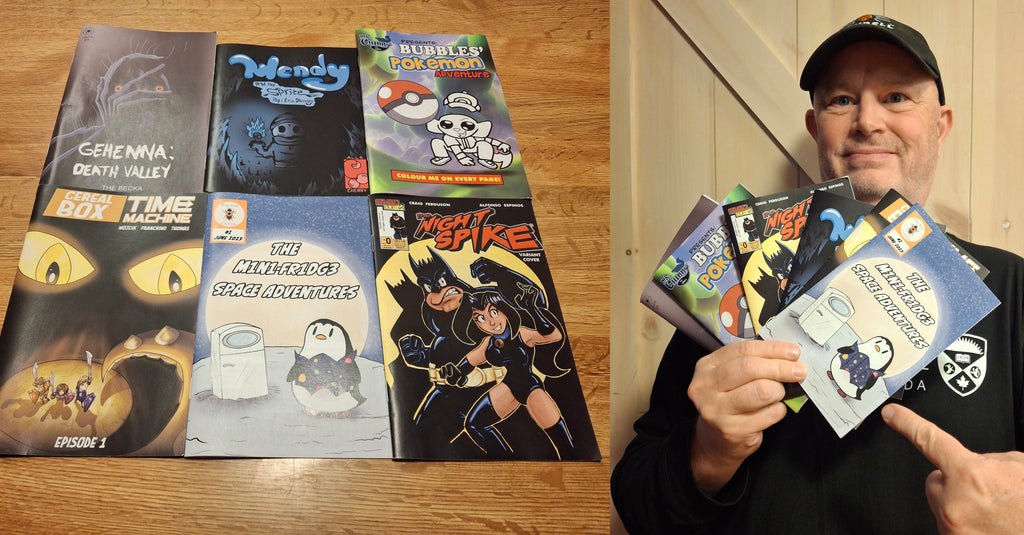
By Dan Brown It’s been a month since Free Comic Book Day. So the time is right to go over the freebies handed out at local comic stores like L.A. Mood on May 2 to put a spotlight on the ones that stand out. What really jumped out at me this year are the mini-comics from local creators, more on that in a moment. There were more than 40 titles in all, with something for members of every fandom. Such heroes as the Hulk, Spider-Man, Judge Dredd, Archie, the Thundercats and the Transformers show up. Publishers from Dark Horse to IDW to Image to Boom! are represented. Off the bat, I noticed how Titan Comics extended its streak for having the best cover of the FCBD lot, with the Scourge of the Serpent preview featuring a Roberto De La Torre rendering of everyone’s favourite barbarian, Conan, almost being swallowed by a giant snake. It’s a dynamic image and recalls the glory days of the Cimmerian over at Marvel, when he was drawn by John Buscema. And no surprise, Marvel put out a Fantastic Four sampler – the new FF movie, First Steps, comes out July 25, so expect lots more hype. The story concerns a group of bored teenage aliens who summon Marvel’s First Family by occult/scientific means. The Thing even gets to bellow, “It’s clobberin’ time!” but I’m not a fan of Johnny Storm’s handlebar moustache. (Nor Pedro Pascal’s, as regular readers of this column are aware.) There is a symbolic passing of the torch in I Hate Fairyland, with Byron illustrator Derek Laufman taking over art duties from Skottie Young. You can’t help but dig the four-page splash section Laufman supplies, including a glimpse at Hellicorn – his spoof of a certain demonic anti-hero. London/L.A. writer Sam Maggs is also part of the local contingent, handling script duties on Critical Role: The Mighty Nein Origins. The backup story is a Black Hammer prologue written by another Southwestern Ontario comic creator, Jeff Lemire. Now, about those mini-comics . . . They are not to be missed! Many of them were published by Kitchener’s Studio Comix. There’s a horror offering from Becka Kinzie titled Gehenna: Death Valley in which the characters recognize they are not acting wisely: “This is the stuff from horror movies! Stupid people doing stupid things!” one proclaims when they ignore warnings not to trespass In Wendy and the Sprite, Eric Olscvary sets himself the challenge of writing and drawing a comic about . . . a pile of snow. He more than rises to the occasion. Craig Ferguson and Alfonso Espinos offer readers a tale of the Night Spike, which has a Spy vs. Spy flavour and is also self-aware. At one point, after some back story is related, the Night Spike’s sidekick admits she embellished saying the duo had fought in the Secret Wars: “Well, I just said that to make the flashback a bit more dramatic!” I greatly enjoyed Scott Wojcik’s Cereal Box Time Machine, which tells the story of a trio of young siblings who get their hands on an all-powerful magic wand. They wish for a time machine – in the form of a cereal box – and are transported to a magical setting where they must rid a far-off land from a dragon who looks suspiciously like an overgrown version of their own cat. And I was utterly charmed by The Mini-Fridge Space Adventures from Roxy Reed Creations. It features a spaceship in the shape of a kitchen appliance with a penguin piloting the craft. The whole thing reminded me of Bob Burden’s Flaming Carrot. It also appears the mini-fridge of the title is larger on the inside. Hey, if it worked for a police call box, then why not? Dan Brown has covered pop culture for more than 32 years as a journalist and also moderates L.A. Mood’s monthly graphic-novel group.