
The Modern Comic Industry Began in 1986
By Dan Brown I wouldn’t be doing my job as a graphic-novel columnist if I let 2026 pass without noting it was 40 years ago that the modern comics industry was born. I can guess what you’re thinking: “Wait a minute, Dan, don’t comic books have a history that stretches back until at least the 1930s, with some proto-comics appearing even in the late 1800s?” You’re right. You got me. But I’m not talking about the Golden Age or anything like that. I’m talking about what I call the modern era, the four decades following the publication of three landmark comics – a sequential troika that shapes our expectations of what comics will be in 2026. Readers with long memories remember a time before Frank Miller’s Dark Knight Returns, Art Spiegelman’s Maus, and Alan Moore’s Watchmen. And I can say with confidence that the industry hasn’t been the same since. The industry had been struggling in the 1970s. Some historians even credit a single title, Star Wars, for saving Marvel Comics on its own. Then, in the 1980s, events like Marvel’s Secret Wars and DC’s Crisis on Infinite Earths were helping shore up the Big Two Comics Houses. Alternative publishers such as Dark Horse Comics were still embryonic. Drawn and written by Miller, Dark Knight Returns ushered in a dark and gritty form of storytelling that can still be seen on the stands of comic stores today. Its bleak depiction of Gotham was so scary that readers were willing to look past Batman’s fascist tendencies in his bid to bring order to his hometown. Printed on slick paper, its vivid art still excites me 40 years later. Miller famously said in an interview with Rolling Stone at the time he wanted to produce a comic book that a businessman wouldn’t be ashamed to be seen reading on an airplane. Comics weren’t kids’ stuff anymore. Miller followed the miniseries with Batman: Year One, which re-told the character’s origin in a Gotham that existed in a strange, timeless setting. Maus, which Spiegelman wrapped in 1986, told the story of his father’s concentration-camp experiences in the form of a cartoon-animal tale. It demonstrated that comics were a serious medium and could be put to other uses apart from glorifying the exploits of superheroes. Watchmen, meanwhile, is ostensibly a murder mystery answering the question of “Who killed the Comedian?” but is so much more. Set in an alternate 1980s in which Richard Nixon is serving his fourth term, the backdrop is a Cold War about to turn hot. Among other issues, it grapples with the consequences of having a real-life Superman (in the form of Doctor Manhattan) striding the Earth like a giant. How would that make the average person feel? Out of the three, my favourite is likely Dark Knight Returns – it took an existing comic character and tried to square how he would operate in the real world. It is at once a satire of, and a tribute to, the Caped Crusader. Sequels to Dark Knight Returns and Watchmen have failed to live up to the books that spawned them, likely because they set such a high standard for sequential storytelling. Without those three comics, we wouldn’t have comics as they exist today. But who knows – there may be creators out there who are poised to re-shape comics again. It would be entirely cool for some smart artist or writer to revolutionize our thinking about the form once again. If you have any guesses on who that might be, or which comics are changing the industry right now, let me know in the comments! Dan Brown has covered pop culture for more than 33 years as a journalist and also moderates L.A. Mood’s monthly graphic-novel group.

Are Comics At A Turning Point?
By Dan Brown Two comics-related announcements jumped out at me last week. They are both about the current state of the industry. What to make of them? I honestly don’t know. At this point, I’ve got more questions than answers. So I’m going to lay the two statements out for you, along with some thoughts, in hopes some kind of meaning will emerge. The first was a speech delivered by DC Comics President Jim Lee to comic-store owners at New York Comic Con, in which he said the company will never use artificial intelligence, so long as he’s the boss. “DC Comics will not support AI-generated storytelling or artwork. Not now, not ever, as long as I am in charge,” he promised the crowd. “Because what we do and why we do it is rooted in our humanity. It's that fragile, beautiful connection between imagination and emotion that fuels our media, the stuff that makes our universe come alive. It's the imperfect mind, the creative risk, the hand-drawn gesture that no algorithm can replicate.” “And when I draw, I make mistakes, a lot of them. But that's the point. The smudge, the rough line, the hesitation. That's me in the work. That's my journey. That's what makes it come alive. It's the product of true effort, of inspiration, and perspiration. Fans know this. They sense this.” “They can feel when something was made with care, when it cost the artist time, energy, heart, and effort. People have an instinctive reaction to what feels authentic. We recoil from what feels fake. That's why human creativity matters. AI doesn't dream. It doesn't feel. It doesn't make art. It aggregates it. Our job as creators, as storytellers, and as publishers is to make people feel something real. That's why we create, and that's why we're still here." That’s about as passionate a defence of the human element in comics-making I’ve ever heard. And, cards on the table, I have no interest in reading comics or graphic novels that aren’t created by human hands. But what if that’s what the market wants? What if young fans, who don’t have the same sentimental connection to comics history that I and my peers share, demand AI comics? Doesn’t DC have an obligation to serve the needs of those readers? I ask because, for instance, there’s an entire segment of fandom that don’t want to read about characters like Batman – they want to be Batman, which they can do via online gaming. I’m not sure those fans care who (or what) is rendering their favourite characters. The second thing I noticed last week was a social-media post (I saw it on Facebook) from legendary comic writer Gail Simone, who has penned stories featuring heroes from Superman to Batgirl to Deadpool to her own creator-owned characters. “It's been a really weird time for comics, there's no question about that,” she wrote.“But I've spoken with the very biggest of wigs at three of the top five publishers in the last six weeks and they all said the same thing: Comic sales are up, a lot.” “One also said there is a definite trend towards specifically physical things, particularly a subset, newish physical things, that people want to purchase. The message seems to be that different formats and variants and specialty items are growing in sales in a big way, while digital sales remain flat. It is honestly the most excited I have seen these companies in years.” “This is going on through the pandemic and the election and inflation and tariffs and the distribution nightmare that retailers have to deal with. All those challenges, and comics are up and rising. I'm talking physical sales from U.S. publishers. In spite of all that stuff. And several companies have produced some genuine banging hits requiring multiple printings.” “Not everything is rosey, but I think that's pretty exciting. I know there are caveats but without strong sales, nothing else matters, nothing is fixable without people getting the books. There's a lot of people who wouldn't give up . . . creators, publishers, retailers, and I'm thankful because you guys, I love this artform more than just about anything. But it all starts with readers. SO THANK YOU, READERS!” Simone’s comments echo news coming out of the same gathering where Lee spoke, New York Comic Con. A report by Heidi MacDonald of Publishers Weekly quoted numbers showing sales are up by 27 per cent at many comic shops in the U.S. “despite looming threats from tariffs, recessions, book bans, and the turmoil generated by the Diamond Comic Distributors bankruptcy.” That all sounds like good news to me. And maybe an indication AI may not be as much of a threat as some think. Dan Brown has covered pop culture for more than 33 years as a journalist and also moderates L.A. Mood’s monthly graphic-novel group.
Derek Laufman Takes on Fairyland
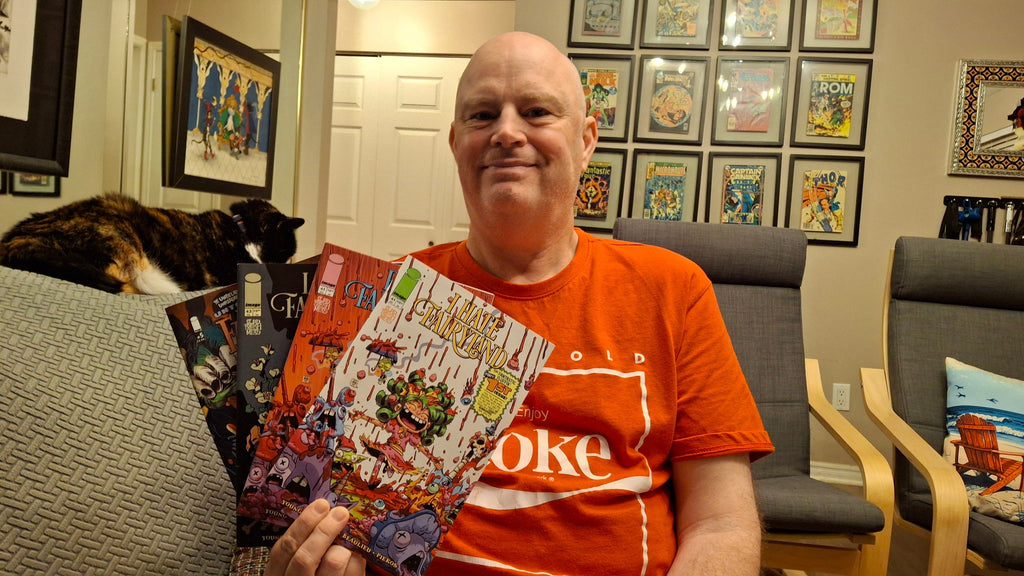
By Dan Brown Derek Laufman’s work is, above all else, fun. The Byron-based comic creator took over as the artist for the Image series I Hate Fairyland with its 41st issue. Created and written by Skottie Young, the cartoony comic stars Gert – a green-haired, foul-mouthed moppet – who yearns to return to the real world. And no one is going to get in her way. I don’t know a lot about I Hate Fairyland so I recently checked out issues 41 and 42, plus an anthology comic (Untold Tales of Fairyland No. 5) that includes a Laufman-created story. I am now of the opinion that this series is the perfect showcase for his style of art. Laufman does all-ages work. He does more adult-oriented work. And I Hate Fairyland combines both strands in one unserious, fantastical, outrageous platform. With a yellow ribbon in her curls, Gert may appear to be a cute child. But she knows how to swing the double-bladed ax she carries around, the edges of which always seem to be coated in green ichor. There is something heedless, unhinged, and funny about Laufman’s outlandish characters. Gert is always accompanied on her adventures by Larry, the wide-eyed bug who is her Jiminy Cricket figure. In a move that could never happen in a modern Marvel Comic, Laufman depicts Larry with a stogie in his mouth – heaven forfend that comic fans should be able to look at pictures of tobacco products. There’s also a tattooed pink walrus who tends bar at a dragon-themed pub, a sentient golden harp that talks like a demented cherub, and a living forest with two eyes and a mouth on each tree trunk. Shades of John Byrne, who is famous for inserting cameos of himself into the comics he draws, there’s even a bearded illustrator in one bar scene who may just be Laufman himself. Gert is always drooling. Her nose is perpetually dripping. And in one scene, she identifies the steps of an invisible bridge by barfing on each one to reveal the path over a chasm. Slmon! Slurry! Slart! Sleating! Stoo! These are the sound effects as Gert stuffs her face before hurling. “That was an epic regurgitation,” she tells her sidekick with satisfaction after they have crossed safely to the other side. I Hate Fairyland No. 42 introduces a new character into the mix – the Hellicorn, who is an homage to Mike Mignola’s demonic Hellboy. Clad in a trenchcoat but no shirt, armed to the teeth, and sporting a purple pompadour, the Hellicorn journeys through a land populated by fairy-tale characters like the Old Woman in the Shoe, wreaking havoc as he shoots mud zombies, then battles with Mary (whose Little Lamb is not so small) before passing by the corpses of Jack and Jill. And yes, clenched between the brooding Hellicorn’s teeth is – a fat cigar. For more of Laufman’s art, check out his all-ages books like Bot 9 and The Witch of Wickerson, suitable reading for children. His dungeon-plundering title for mature readers is Crimson Fall. He has also done work for DC and Marvel, as well as such toy companies as Hasbro and Mattel. Laufman can tell you all about it in person when he appears on Nov. 2 at this year’s edition of Forest City Comicon, taking place at the Lamplighter Inn. I may just be first in line! Dan Brown has covered pop culture for more than 33 years as a journalist and also moderates L.A. Mood’s monthly graphic-novel group.
GNG Assembles to Talk Mister X
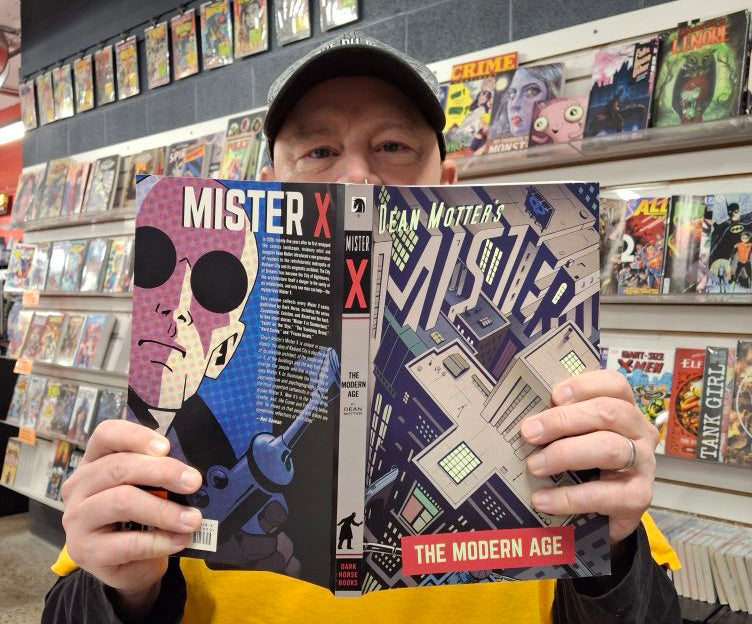
By Dan Brown SPOILER WARNING: This column contains plot details from Dean Motter’s Mister X: The Modern Age, so stop reading right now if you value surprise! Here’s the lowdown on the most recent meeting of the L.A. Mood Graphic-Novel Group, which was held Saturday, June 14. The book: Dean Motter’s Mister X: The Modern Age, which collects all of the Mister X stories published by Dark Horse Comics. The discussion: The full range of opinions was represented around the table. There were people, like me, who love the book. There were others who felt meh – who didn’t give the book a thumb up or down, but a sideways thumb. And there were some who didn’t even feel motivated enough to finish reading the 360-page tome. Gord Mood, L.A. Mood’s co-owner, argued for including Mister X on the 2025 reading list at our January pitch meeting. He is among those who love it. Gord also brought some examples of Motter’s early work from Media 5 when he was a student at Fanshawe College. (Late Town Crier Bill Paul published that sci-fi fan publication.) I knew very little about the character beforehand. Knowing it had been praised for blending film noir, Art Deco and German Expressionism, I was expecting something ponderous and pretentious. Wrong! In my view, it’s an amazing graphic novel. DC can only wish that Batman were as cool as Mister X! It takes place in Radiant City, where it always seems to be 4 a.m. Its nickname is Somnopolis, because of the large number of residents who can’t sleep. The title character is possibly one of the original architects who founded Radiant City, it’s never made clear. The closest he gets to revealing his identity is when he states, “I want to fix my city. I want it to run as designed.” The problem? The city’s architecture is driving its residents insane. None of this, of course, is meant to be taken literally – which Gord’s business partner Carol Vandenberg touched on when she mentioned the humour of the book. The key, for me, was to not take anything in the book at face value. I appreciated how Mister X is a riot of invention. Some members of the group pointed out the many references in the story. For example, one robot who shows up is an homage to Gort from The Day The Earth Stood Still. 1984 is referenced, as well as CanCon icon Nash the Slash. The characters have the clipped speech of detectives in films from the 1940s: “You’re the man without a name,” an interrogator tells Mister X. “That’s what I’m called,” the mystery man replies. Even better, Motter adds his own creative touches, elevating The Modern Age to a level above a mashup. Mister X is an insomnalin addict, meaning if he doesn’t feed his habit, and falls asleep, he will automatically die. There are insomnatoriums on each block. Zombycillin is a drug that can bring the dead to life. Pscychetecture describes the style of buildings in Radiant City and how they torture the human mind. Further reading: Instead of reading, I would say watch Blade Runner or episodes from Batman: The Animated Series, as well as Tim Burton’s 1989 Batman movie. L.A. Mood’s Graphic-Novel Group meets the second Saturday of each month. Next month’s selection is Roaming, by cousin creators Jilliam and Mariko Tamaki. We continue our streak of Canadian books established in recent months! We’ll reconvene July 12 at the gaming tables in the store at 11 a.m. All are invited to come join the discussion! Dan Brown has covered pop culture for more than 32 years as a journalist and also moderates L.A. Mood’s monthly graphic-novel group.
Local Mini-comics Are Where It’s At!
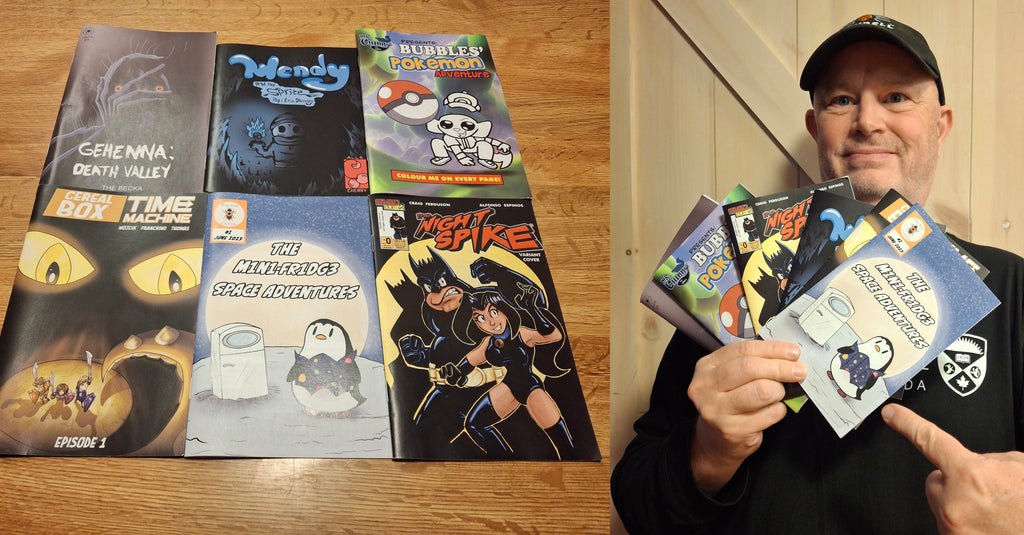
By Dan Brown It’s been a month since Free Comic Book Day. So the time is right to go over the freebies handed out at local comic stores like L.A. Mood on May 2 to put a spotlight on the ones that stand out. What really jumped out at me this year are the mini-comics from local creators, more on that in a moment. There were more than 40 titles in all, with something for members of every fandom. Such heroes as the Hulk, Spider-Man, Judge Dredd, Archie, the Thundercats and the Transformers show up. Publishers from Dark Horse to IDW to Image to Boom! are represented. Off the bat, I noticed how Titan Comics extended its streak for having the best cover of the FCBD lot, with the Scourge of the Serpent preview featuring a Roberto De La Torre rendering of everyone’s favourite barbarian, Conan, almost being swallowed by a giant snake. It’s a dynamic image and recalls the glory days of the Cimmerian over at Marvel, when he was drawn by John Buscema. And no surprise, Marvel put out a Fantastic Four sampler – the new FF movie, First Steps, comes out July 25, so expect lots more hype. The story concerns a group of bored teenage aliens who summon Marvel’s First Family by occult/scientific means. The Thing even gets to bellow, “It’s clobberin’ time!” but I’m not a fan of Johnny Storm’s handlebar moustache. (Nor Pedro Pascal’s, as regular readers of this column are aware.) There is a symbolic passing of the torch in I Hate Fairyland, with Byron illustrator Derek Laufman taking over art duties from Skottie Young. You can’t help but dig the four-page splash section Laufman supplies, including a glimpse at Hellicorn – his spoof of a certain demonic anti-hero. London/L.A. writer Sam Maggs is also part of the local contingent, handling script duties on Critical Role: The Mighty Nein Origins. The backup story is a Black Hammer prologue written by another Southwestern Ontario comic creator, Jeff Lemire. Now, about those mini-comics . . . They are not to be missed! Many of them were published by Kitchener’s Studio Comix. There’s a horror offering from Becka Kinzie titled Gehenna: Death Valley in which the characters recognize they are not acting wisely: “This is the stuff from horror movies! Stupid people doing stupid things!” one proclaims when they ignore warnings not to trespass In Wendy and the Sprite, Eric Olscvary sets himself the challenge of writing and drawing a comic about . . . a pile of snow. He more than rises to the occasion. Craig Ferguson and Alfonso Espinos offer readers a tale of the Night Spike, which has a Spy vs. Spy flavour and is also self-aware. At one point, after some back story is related, the Night Spike’s sidekick admits she embellished saying the duo had fought in the Secret Wars: “Well, I just said that to make the flashback a bit more dramatic!” I greatly enjoyed Scott Wojcik’s Cereal Box Time Machine, which tells the story of a trio of young siblings who get their hands on an all-powerful magic wand. They wish for a time machine – in the form of a cereal box – and are transported to a magical setting where they must rid a far-off land from a dragon who looks suspiciously like an overgrown version of their own cat. And I was utterly charmed by The Mini-Fridge Space Adventures from Roxy Reed Creations. It features a spaceship in the shape of a kitchen appliance with a penguin piloting the craft. The whole thing reminded me of Bob Burden’s Flaming Carrot. It also appears the mini-fridge of the title is larger on the inside. Hey, if it worked for a police call box, then why not? Dan Brown has covered pop culture for more than 32 years as a journalist and also moderates L.A. Mood’s monthly graphic-novel group.
Here’s a Bunch of Mini-Reviews
By Dan Brown Here’s the lowdown on a stack of comics I bought recently. There’s no logic to the choices, other than each cover struck my fancy while I was browsing the new-releases wall at L.A. Mood. Fantastic Four No. 29: Perhaps I have a case here to sue Marvel for bait-and-switch. I picked this one based on the cover, which promises an out-of-continuity tale answering the question, “What if . . . Mickey & friends became the Fantastic Four?” I was intrigued by the idea of Goofy switching places with the ever-loving Thing. As it turns out, it was a variant cover. Instead, I got a Ryan North/Cory Smith joint titled The Dream Team about Doctor Doom taking over . . . everything. This looks to be Marvel’s event series this summer, One World Under Doom, and I applaud the House of Ideas for taking this one on, if only because they are going to get so much blowback from Trump fans claiming it’s a metaphor for the current situation in the U.S. The FF goes to bat for the downtrodden . . . who in this case are vampires left over from the previous event series. Doctor Doom & Rocket Raccoon No. 1: I love the movie Rocket more than the comic Rocket, so in my mind I read his dialogue in Bradley Cooper’s voice. I haven’t read a J. Michael Straczynski-penned story in a long time, and this one is long on philosophy, short on action. Doom partners with the genetically engineered rodent to help him delve into the origins of . . . everything. Essentially, the Latverian ruler wants to travel back in time to a time before time. That is, before the Big Bang. I give Doom props for recognizing that a lowly raccoon is almost his mental equal. And one page features a Jack Kirby-esque collage, which is a bonus. What do they discover in preshistory? “The purpose of the universe is to understand the purpose of the universe.” It’s one of them paradoxes. Godzilla vs. Fantastic Four No. 1: This is easily the best-illustrated issue among my purchases, featuring John Romita Jr. art based on a Ryan North script. Marvel takes the existing Marvel continuity and fuses it with the Toho storyline, as happened with the original Marvel series about the fire-breathing unfrozen dinosaur. Reed even tips his hat to Dr. Daisuke Serizawa’s oxygen destroyer in the opening panels. One cool concept in this issue sees Godzilla foe King Ghidorah taking on the power cosmic in his role of herald of Galactus. And yes, it’s all leading up to an eventual battle between the Tokyo-demolisher and the world-devourer. Godzilla Heist No. 1: If you’re a fan of Godzila, this is truly an awesome time to be alive because you can read about him in more than one company’s comics. This IDW-published series reads sort of like what would happen if Quentin Tarantino directed a kaiju flick. As powerful as Godzilla is, here his rampages are just a massive distraction for a ring of human thieves who, naturally, don’t know which one of them might betray the others.The story begins with the big G destroying a casino, which is certainly one way to make sure the authorities don’t pay attention to your scheme to plunder their treasures. Godzilla vs. Chicago One Shot: As part of the Godzilla vs. America series, local creators get a stab at fitting Godzilla into their own community’s neighbourhoods, politics, and culture. Also part of IDW’s current offerings, it’s really just an excuse to pay tribute to old-school comic sound effects such as:Dong donk!Zang!Zong!Choom!Fwomp! Fwooosh! Shreeonk!What can I say? I know what I like. Daring the Sun No. 2 by Forest City creator Scott Brian Woods: Called Crash Down, this tale of an astronaut traveling through the heart of a sun is “inspired by imagination comics of the past, science fiction, and a deep love of old-school adventure, sci-fi fantasy space operas.” The Kirby Crackle on the opening splash page jumped out at me, and the drawing on the back cover shows the pilot in a Flash Gordon-esque outfit with an old-school raygun. Somehow, he is connected to a warrior named Vala, who fends off dinosaur-like aliens in a barren landscape. If you like classic George Lucas intercutting, you will love the structure of this piece, ending naturally with a cliffhanger. Moon Girl and Devil Dinosaur 10th Anniversary Special No. 1: I don’t know how, exactly, Lunell Lafayette got a hold of the ultimate nullifier, but it’s one of the items she brings to her surprise 10th birthday party in New York. A back-of-the-book story flashes forward to when Moon Girl has grown into Moon Woman, and she visits Earth from the orbiting satellite. Senior Marvel Editor Mark Paniciccia says the series has lasted a decade because “it’s inspired young readers to embrace their individuality and believe in their potential.” Or maybe they just really like to groove on the blood-red T-Rex who is Moon Girl’s constant companion. What comics or graphic novels have you been reading lately? I’d love to hear about it in the comment box below! Dan Brown has covered pop culture for more than 32 years as a journalist and also moderates L.A. Mood’s monthly graphic-novel group.