
POP-CULTURE COLUMN: Disclosure Day better be a CE3K sequel
By Dan Brown They say there are too damn many sequels. I don’t agree – in at least one case. If Disclosure Day isn’t a sequel to Close Encounters of the Third Kind, I’m gonna be pissed. The new Steven Spielberg-directed motion picture about aliens is set to land in theatres on June 12, and I so want it to be the second part of 1977’s Close Encounters. CE3K was the first Spielberg movie I saw in a movie theatre. It blew my nine-year-old brain. Although UFOs were a big deal in the 1970s, it was about more than that: The mystery of the unknown, obsession, belonging, asserting the right of the individual to leave their family. I was sold. So I’ll take a Close Encounters sequel any way I can get it. It doesn’t even have to be a particularly great movie! You may be wondering: How come Dan doesn’t know if Disclosure Day is a sequel or not? You would think, since its debut is only a few days away, I – along with the general public – would understand that much about the plot. But the team behind Disclosure Day is being cagey. No one has said it’s a direct sequel to Close Encounters. However, we do know from the trailers it’s about aliens coming to Earth in flying saucers. And some people connected with the film have been dropping enticing hints. “There are definitely questions posed by Close Encounters that are answered in Disclosure Day,” Emily Blunt told the movie magazine Empire. Blunt, by the way, has been getting positive advance notices for her performance as a TV weather girl who gets up in an unraveling conspiracy. Also, there’s at least two shots in the Disclosure Day trailer that evoke Close Encounters. One has a UFO emerging from a bank of clouds hat, to me, looks like an homage to the climax of CE3K, when the giant mothership descends in full view on Devil’s Tower in Wyoming. There’s also a white house in the woods that looks an awful lot like the one where the little boy gets abducted in Close Encounters. Some are speculating that Disclosure Day is a spiritual sequel – in the same way 1982’s E.T. the Extra-Terrestrial was a spiritual sequel to Close Encounters itself. But that’s not enough for me. You may recall how Star Wars hit theatres about six months before Close Encounters back in the 1970s. I was so jazzed by the combination of these two event movies in close proximity, the combined impact literally changed my life. But looking back, I realize just CE3K on its own would have been a game-changer for me. It sparked my imagination. The characters were so compelling. It made me fall deeper in love with movies. It felt plausible. And it made me . . . optimistic. The message that aliens were here to help us, not hurt us, ran counter to every other alien flick I’d seen by that point. I see more movies at home these days than in the theatres. But a Spielberg film about aliens is a premise I'm not able to resist – and if it’s a sequel, my prayers will have been answered. Dan Brown has covered pop culture for more than 33 years as a journalist and also moderates L.A. Mood’s monthly graphic-novel group.

Welcome to the Age of the Spiritual Sequel
Welcome to the age of the spiritual sequel By Dan Brown There’s been much discussion in recent days about the trailer for the new Steven Spielberg film Disclosure Day. Spielberg is being cagey about the new film’s relationship to his 1977 UFO classic Close Encounters of the Third Kind. Is Disclosure Day a sequel to Close Encounters? Is it a standalone film? The online debate rages on. Of course, there is one other possibility: It could be set in the same world, but not directly follow the events of Close Encounters. In other words, it could be a spiritual sequel. Which wouldn’t be surprising, since this is the age of the spiritual sequel. There appear to be more and more of them all the time. When the mockumentary series The Paper debuted last year, many reviewers pointed out how it was set in the same world as The Office. It even shared at least one character with its predecessor series. The Creed trilogy follows the six Rocky movies, but the central character is not Balboa himself, but the son of his frenemy Apollo Creed. The Texas college comedy Everybody Wants Some takes place in 1980, four years after Dazed and Confused, which is set in 1976 on the last day of high school. But EWS focuses on a different set of students; you don’t need to have seen the original to understand it. And the Exorcist, which stars Scarlett Johannson, is set for release a year from this March and is not a remake of or direct sequel to the 1973 horror classic, although it is set in the same imaginative universe. Spiritual sequels – which in television were always called spinoffs – make a lot of sense. Pretty much every sequel you can think of has already been made, so billing a movie as a spiritual successor gives studio marketing departments a way to promote a motion picture while also giving directors and producers creative room to manoeuvre. Are they better than direct sequels or prequels? There may be too little information at this point to make a definitive conclusion on that question. It’s probably much harder for filmmakers to capture the “flavour” of a popular motion picture while also creating a story that can stand on its own for those viewers who have no knowledge or memory of the first one. One suspects we are going to see even more of them – look at the Star Wars movies and shows all set in the same galaxy. Having a consistent milieu makes it easier for storytellers to find a launching point they can exploit, a logical entry point into a setting that already feels familiar to fans. Me, I have reason to believe Disclosure Day may be more of a direct sequel to Close Encounters than we’ve been led to believe. When a new trailer dropped during the Super Bowl, there were at least two images that look mighty familiar to me, including a spaceship shrouded in clouds and an isolated white house situated perfectly for an alien abduction. We’ll all find out for sure on June 12, when Spielberg's latest lands in theatres. Dan Brown has covered pop culture for more than 33 years as a journalist and also moderates L.A. Mood’s monthly graphic-novel group.
Jaws is a Classic Because Spielberg was Powerless
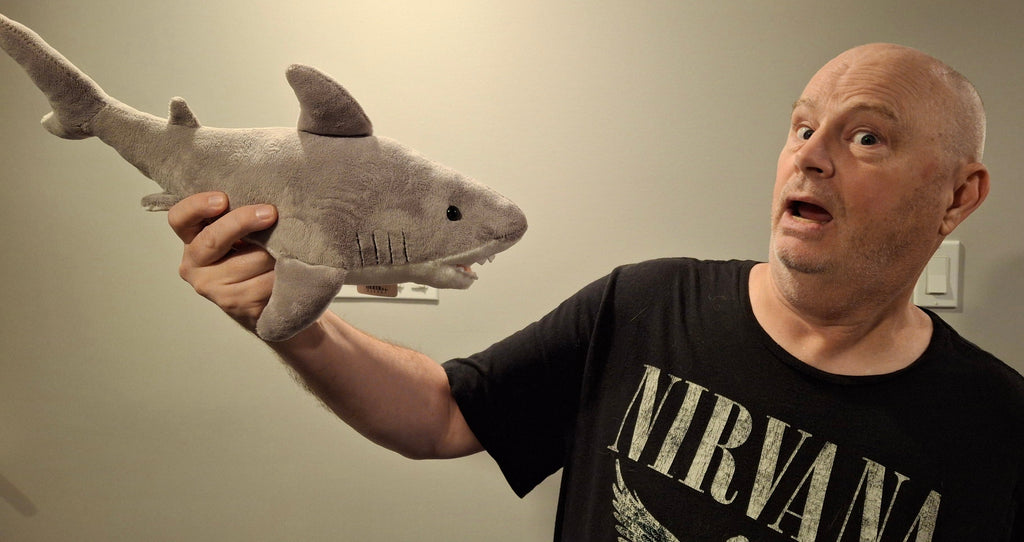
By Dan Brown As you may have already heard, this summer marks 50 years since the release of Steven Spielberg’s Jaws, the motion picture that ushered in the age of the blockbuster. It was in 1975 that the great white shark of the title started his long career of gnawing on skinny dippers, water skiers, power cables and even a helicopter. Luckily for us movie fans, the original Jaws was made by Spielberg back when he had no power in Hollywood. The limits placed on him by the constraints of the studio system boxed him in, and indirectly made the movie a commercial and critical success. Moviegoers couldn’t get enough of Jaws that summer. It would eventually spawn three sequels. This lack of freedom forced the then-young filmmaker to make some daring creative choices. Sure, during the troubled shoot on Martha’s Vineyard he had a fancy mechanical shark to play the part of the monster. But the primitive robot proved unreliable. What Spielberg did in response flew in the face of moviemaking logic. Instead of using the rubbery-looking faux fish in the attack scenes, he took a page from Alfred Hitchcock’s bag of tricks and shot around the shark, intending to rely on the power of suggestion. Those who had seen the shower scene in Hitchcock’s 1960 thriller Psycho swore that they had been witness to a knifing in which flesh was violently ripped open; the truth was that no such shots existed – based on the rapid shower montage, the brains of viewers supplied the missing visual information, and they thought they saw a blade tearing through skin. Spielberg followed suit, aiming to achieve the same effect. What you have to bear in mind is that, back in the 1970s, the standard practice in Hollywood was to give ticket buyers a good look at the monster, putting the full special-effects budget on the screen in front of them. That’s the way things were done. What Spielberg didn’t have was a realistic shark (which becomes apparent in the film’s third act aboard Quint’s boat) but the special effect he did have was the minimalist score written by John Williams. Two notes. That’s all Spielberg had going for him. Added to the suggestive footage in which the shark didn’t appear, it worked. Spielberg’s audacious decision to hide the undersea attacker was a masterstroke. The suspense of not seeing the shark but being overpowered by the Williams score led to a lot of real anxiety – people in 1975 really were afraid to go in the water, even if it was a body where sharks don’t reside, like the backyard swimming pool. Viewers saw it again and again. It’s true Universal Pictures upped Spielberg’s budget as the hell shoot dragged on, and the gamble paid off handsomely for the company. But his hands were tied in so many other ways, a consequence of working within Old Hollywood. Studios didn’t like to take chances. And there was a real sense of shame if a filmmaker made an ostentatious flop, which Spielberg experienced when his disastrous 1941 was released four years later. (Late-career George Lucas is a telling counterpoint to early-career Spielberg. Lucas earned all the power he wanted to make films his own way, cutting the studios out of the power dynamic, and the result was . . . Jar-Jar Binks. Lucas made his best movies within the studio system.) The wheels falls off Jaws in the last half-hour or so, when the shark wriggles up onto the deck of the Orca. It was a laughable moment, and it’s a testament to the power of the film up to that point that the audience didn't hold it against Spielberg. Quint’s powerful monologue was clearly still echoing in their minds when Bruce is revealed. Some critics argue Jaws also tapped into the post-Watergate disenchantment of the times. The Amity mayor who ignores Brody’s entreaties in the first film to close the town’s beach is still mayor in Jaws 2, launching a million jokes about the importance of voting in municipal elections. All of which brings up the obvious question: Are there any movies from the summer of 2025 that will be celebrated a half-century from now, as Jaws was feted this summer? It feels like that’s a long shot. Instead of grassroots word-of-mouth, which propelled Jaws, the practice now seems to be for a studio to give even a half-baked release a $100 million marketing budget with the goal of winning the opening weekend before word gets around on social media, killing a mediocre picture’s earning potential. Dan Brown has covered pop culture for more than 32 years as a journalist and also moderates L.A. Mood’s monthly graphic-novel group.