
May the Spidey Sense Be with You
By Dan Brown I knew this day would come. The Marvel and Star Wars universes are finally converging. January will see the release of Hope Assembles, a five-part comic series in which the good guys and bad guys from each franchise team up. You’ll be able to see Wolverine, for example, joining forces with Han Solo and Chewbacca. Darth Vader gets a new ally in the form of Doctor Doom. Luke Skywalker and Captain America fight side-by-side. This is the first time this has happened. Naturally, fans are losing their heads. Some are calling the crossover awesome, some absurd, some an act of desperation. After it was announced last week, one internet pundit called the exercise “mashing the action figures together” for its own sake, not because the creative team has a story to tell. In other words, it’s the kind of thing a child would do while playing in his bedroom, not something that a serious comic publisher would actually attempt. Details about the plot are scarce at this point. Kevin Smith is writing the series, with David Marquez providing the art. What is known is the Star Wars cast of characters from 1977 will be drawn to Earth-616, the main Marvel Universe, by means of “a reality-shattering spell.” In keeping with crossover tradition, the tale will take place outside the regular continuity of both worlds. While alternative universes have been a staple of Marvel Comics for decades, they’re not a Star Wars thing. The event is part of parent company Disney’s plans to mark the 50th anniversary of the release of Star Wars next year. And it’s impossible to ignore the wider context. On the comic side, Marvel has lost its market-leading position to DC’s Absolute line of titles. The last Star Wars movie, the Mandalorian and Grogu, was a dud at the box office. Disney needs for these underperforming subsidiaries to generate some magic. The announcement last week billed Hope Assembles as Smith’s love letter to Star Wars. “Lifelong lovers of both Star Wars and Marvel have a lot to look forward to as we finally bring the characters together in ways fans have been dreaming about for decades!” Marvel Editor-in-Chief Stephen Wacker enthused. Does Smith have a story he’s been burning to tell, or is this just a case of squeezing merch from two different properties into the same box? And don’t forget, big-event crossovers featuring heroes from different universes have a checkered history. When Superman boxed Muhammad Ali in the 1970s, for example, the catch was that the Man of Steel was prevented from using his superpowers while fighting the champion pugilist. That kind of hokey plot device has been at the heart of a lot of these teamups. But let’s suppose Hope Assembles moves lots of units. Where does Disney go from there? Is this series the preliminary first step leading down the road to a combined animated series, or even a live-action motion picture? No one knows for sure. All I can tell you is, I feel a disturbance in the Force. Dan Brown has covered pop culture for more than 33 years as a journalist and also moderates L.A. Mood’s monthly Graphic-Novel Group book club.

Comic Back Issue Collection Release: Saturday, February 21st
Hey comic book fans! We’re so excited to tell you that a big comic book collection will be hitting the sales floor at L.A. Mood on Saturday February 21st at 10am! Samples of the collection are below. Hope to see you there! This collection will be available in store and the following week select comics will be added online. Visit early for best selection!

My Favourite Bad Guy
By Dan Brown It was a turning point in my thinking about pop culture. I was eight years old when Star Wars came out in 1977. My friends and I lived, breathed, played, talked about that movie all the time in the schoolyard. Once, when discussing our favourite characters, one friend – who was two years older – mentioned something that rocked my world. He said his favourite Star Wars character was Darth Vader. I had trouble wrapping my head around his answer. Wait a second, he likes . . . . the villain? Did I hear that right? It had never occurred to boyhood me that you could side with the dark side. It had never entered my mind that you could judge a movie bad guy to be cooler than the good guy. I mean, Luke Skywalker is the hero, right? So what is this talk about Darth Vader being awesome? I mean, he’s out to get Luke and stop the galactic rebellion. Vader is the one who strangles people – with his hands or with the Force. He’s the guy who defeats Ben Kenobi. He tries to shoot Luke down in the Death Star trench. He wears black, for crying out loud! How could you dig somebody like that? So you can see how this would have been a revolutionary idea at the time. One of the reasons for the success of Star Wars in 1977 was how, in the shadow of Watergate and the Vietnam War, it brought back clearly defined heroes and villains. Even a morally grey figure like Han Solo has a change of heart and forsakes his mercenary ways at the end of the film, revealing his inner goodness. In 2025, of course, this is not at all a crazy idea. We long ago gave up expecting our heroes and those who opposed them to be inherently good or evil. One of the biggest Star Wars fan groups is the 501st Legion, who dress up as stormtroopers, the foot soldiers who carry out Vader’s diabolical plans. So my childhood friend is not the only person who’s into the Empire. And I can admit my friend is right: Darth Vader is more interesting than Luke, who turns out to be his son. What my older friend said back then shaped my thinking about villains. So when the second movie in the trilogy came out in 1980, I was astounded at how cool the Imperials walkers were. My friend had expanded my horizons. He had given me permission to think about all the characters and where they were coming from. My black-and-white world was now in full colour. Dan Brown has covered pop culture for more than 33 years as a journalist and also moderates L.A. Mood’s monthly graphic-novel group.
New Star Wars Series Aimed at Fans
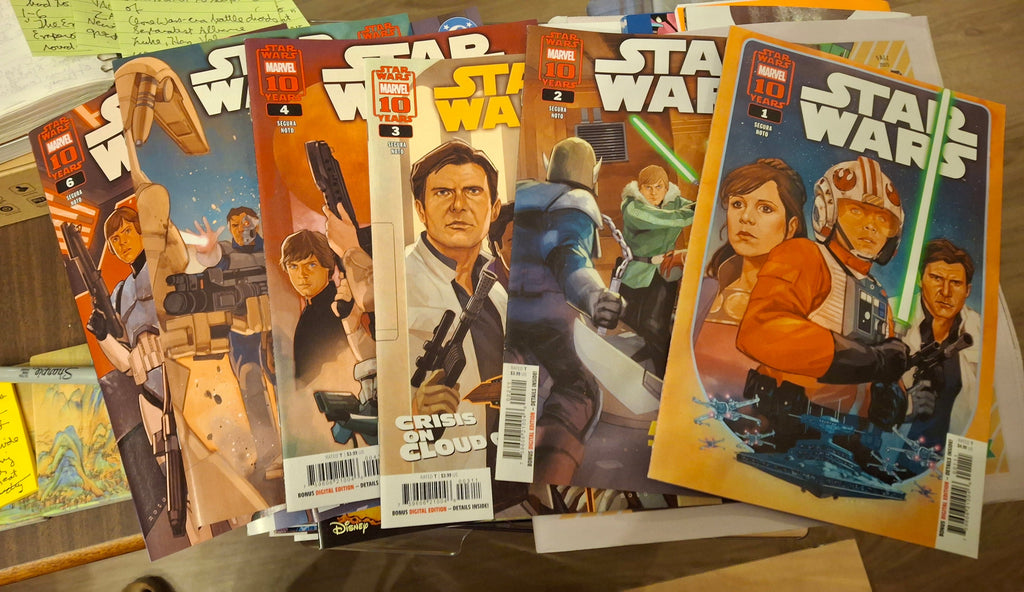
By Dan Brown Dedicated fans will get the most of out Marvel’s ongoing Star Wars title featuring Luke Skywalker, Han Solo, and Princess Leia. I would say I’m a fan of Star Wars, the Empire Strikes Back, and the first third of Return of the Jedi, so I enjoyed it just fine. This series – I looked at the first six issues – takes place in the timeline after the end of Return of the Jedi, with the Empire in tatters and our plucky bunch of heroes attempting to bolster the fledgling New Republic. There are all the usual trappings: blasters firing, lightsabres slicing, spaceships exploding, treaties being negotiated. (No one gets choked, though, which happens a lot in those original movies.) What will jump out at fans is how characters show up who have never been featured in a Star Wars movie. So the story – which revolves around Princess Leia wooing a system of planets to join her incipient interstellar government – has Solo teaming up with Valance, a bounty hunter who made his debut in Star Wars comics way back in 1978. Shades of Darth Vader, he was a self-loathing cyborg. Here, after he and Solo escape from a tight spot, the pair of rogues enjoy drinks at an alien-infested tavern. This is when Valance gives the Corellian a hard time for becoming part of the rebel establishment. “Things are different now, Valance. I can’t just hop in the (Millennium) Falcon and fly off on an adventure whenever I like,” the one-time smuggler and now married man explains. “The old days are gone.” What will also stand out for longtime fans is how the characters actually resemble the actors who portrayed them in the original trilogy — so Solo looks like Harrison Ford, Skywalker like Mark Hamill, and so on. Back in the day, the licence Marvel had with Lucasfilm stipulated that they couldn’t do this, in case George Lucas ever needed to re-cast any of the roles. What fans of those original comics got were bland, anonymous characters who had roughly the same hairstyle as the ensemble that made the movies such a sensation. It’s unclear how much of the interregnum between Return of the Jedi and The Force Awakens will be covered in the new series. And that’s part of the problem: Because there is so much plot infrastructure already in place, there’s only so many directions writer Alex Segura and artist Phil Noto can go. The result: The creative team is constrained in bringing real change to the existing universe (these comics are billed as canon, though). They can’t kill off a main character, for instance. Still, Luke does get to Force-shove some baddies out his way and fire up his laser sword. Solo does get to shoot his way back to his hunk of junk spaceship through a crowd of villains. And Leia does get hot-headed during some palace intrigue. If that sounds like fun, this is the series for you. By the way, I’m also a fan of the Last Jedi, the Mandalorian, Rogue One, Andor, and the standalone Solo movie. Now there’s an idea – since Solo: A Star Wars Story is unlikely to ever get a sequel on the big screen, why not have a comic series that details what happens to Han and Chewie in the decade before they meet Luke and Ben Kenobi on Tatooine? That would be something I could really get behind! Dan Brown has covered pop culture for more than 33 years as a journalist and also moderates L.A. Mood’s monthly graphic-novel group.
New Star Wars Comic for Fans Only
By Dan Brown Although it’s well-made, Star Wars: A New Legacy No. 1 will likely appeal mostly to diehard fans of the interstellar epic. If you’re a devotee of characters like Valance, Black Krrsantan and Doctor Aphra, this is the comic for you. The presence of heroes from the movies – Luke Skywalker, Princess Leia, Han Solo – is felt here, but those old favourites aren’t actually part of the action. Instead, this comic contains a trio of tales which were created as vehicles for minor players in Marvel’s Star Wars universe. As Marvel begins a new phase of its Star Wars offerings, they’ve been promoted. Some members of this introductory issue’s cast have a long history. Valance, for instance, originated way back in 1978 in Star Wars No. 16. He was introduced as a self-loathing cyborg, which seemed to be a Marvel specialty back then – the publisher also had Deathlok on its roster in those days. This was years before Star Wars fans got a peek under Darth Vader’s helmet in The Empire Strikes Back. However, there’s no sign of Jaxxon, the giant green alien rabbit, who has gone from being a bad joke to beloved by fans. Hey, if people today can openly express their love for Jar-Jar Binks, then anything’s possible. Marvel got the rights to print Star Wars comics when the original movie debuted in 1977. It was an astute move, as some observers credit that title alone for keeping the company solvent in a financially precarious era. It’s hard to believe now, but over the decades the space fantasy’s appeal faded, so Dark Horse Comics eventually became the official headquarters for Star Wars comics. When Disney brought Marvel under its corporate umbrella, the licence soon reverted back to the House of Ideas. In the first section of A New Legacy, Valance appears on the trail of Doctor Aphra.For years, I wanted to see a Disney+ series featuring Aphra, but my prediction that the gonk droid would get a show before the rogue archeologist seems less and less like hyperbole as Aphra continues to go unloved by the Star Wars brain trust. Even one of her sidekicks, the wookiee called Black Krrsantan, made the leap to the small screen in the Book of Boba Fett without Aphra. She also appears in the back-of-the-book section in a story that inverts the old saying about letting the wookiee win at holographic chess. It turns out that advice doesn’t apply when one of the big, shaggy aliens is playing against a murder robot: “Let the droid win.” Sandwiched between those two stories is a narrative about the Empire’s Scar Squadron, who are also known as Task Force 99. This tale has a slight flavour of the Wild Bunch in that these stormtroopers are men out of time – they embody everything Imperial at a moment when the Rebellion is on the rise. They can’t understand why the crowds that used to cheer them want to rise up at the urging of rebel scum they consider terrorists. “We bring order, while all they have to offer this galaxy is chaos,” their sergeant laments in his inner monologue. This means the white-armoured soldiers – who operate on the outer rim of the outer rim – are on their way to becoming like the U.S. commander in Vietnam who famously said, “It became necessary to destroy the town to save it.” These grunts are on their way to setting fire to the universe so they can preserve it.Every Star Wars buff has their own favourite obscure characters from the vast universe created by George Lucas. If the one’s I’ve mentioned here are among yours, then you’ll enjoy A New Legacy. If not, you’ll want to give it a miss. Dan Brown has covered pop culture for more than 32 years as a journalist and also moderates L.A. Mood’s monthly graphic-novel group.