
Superman Takes on Spider-Man
By Dan Brown Who would win in a fight between Superman and Spider-Man? That question for the ages, surely argued over by many a comic fan, was settled in 1976. That’s when DC and Marvel joined forces to publish the first of what would grow into a long line of industry crossovers that continues to this day. Superman vs. The Amazing Spider-Man was a landmark comic. And now the fans of 50 years later – many of whom weren’t around in the 1970s – can re-live that moment in comics history by purchasing a reprint of the special issue, which came in giant treasury size and has the two heroes squaring off above the Manhattan skyline on the cover. Even though I’ve got a worn copy of the 1976 original, I picked up the reprint last weekend at L.A. Mood. The version I got features a painted variant of the famed Ross Andru cover. Andru also did the interior art, which looks crisp in the newly published version. The two companies did a really good job of making the story look fresh again. Stalwart Gerry Conway was assigned writing duties. The opening splash – which stretches over two huge pages and depicts a giant robot plowing through buildings in downtown Metropolis – pulses with energy. Printing has come a long way in the last five decades, the paper here is white, not the dingy brown of yesteryear’s newsprint. The continuity it takes place within echoed the timeline of each company at that moment in world history. So in this story Clark Kent is not a Daily Planet reporter anymore, but a TV anchor about to cover the national political conventions of 1976. Peter Parker, meanwhile, is about to graduate from college while freelancing for J. Jonah Jameson. After they meet in prison, Lex Luthor and Doctor Octopus embark on a partnership to ransom the Earth’s environment for $10 billion, which is of course peanuts these days. Cue your best impression of Mike Myers as Dr. Evil not grasping the implications of decades of inflation. By means of a frickin’ laser mounted on an ultra-secret satellite, Luthor is able to kick the planet’s ecology out of balance, finally creating a 200-mile-wide tsunami that threatens to destroy the East Coast. What I love about this retro comic is how it includes devices you don’t see in modern mainstream comics, such as thought bubbles and sound effects: RIPP! KRONG! THOOM! And now, a word about the superhero battle of the century. Any comic fan worth their salt knows the answer to who would win in a tussle between the title characters. There is an obvious power imbalance, and even with the proportionate powers or a spider, Spidey wouldn’t last a minute against Superman. It’s not even close. There is, of course, a ham-fisted way the creative team gets around this fact. Unknown to either party, Luthor infuses the wall-crawler with red-sun radiation, which in DC lore can rob the Man of Steel of his invulnerability, thus making it a fair fight. But if Superman’s nemesis can do such a thing, why doesn’t he ever do it over in the regular DC Universe? Such are the exigent plot devices of DC-Marvel crossovers! Dan Brown has covered pop culture for more than 33 years as a journalist and also moderates L.A. Mood’s monthly graphic-novel group.
Will New Crossovers Keep It Fresh?
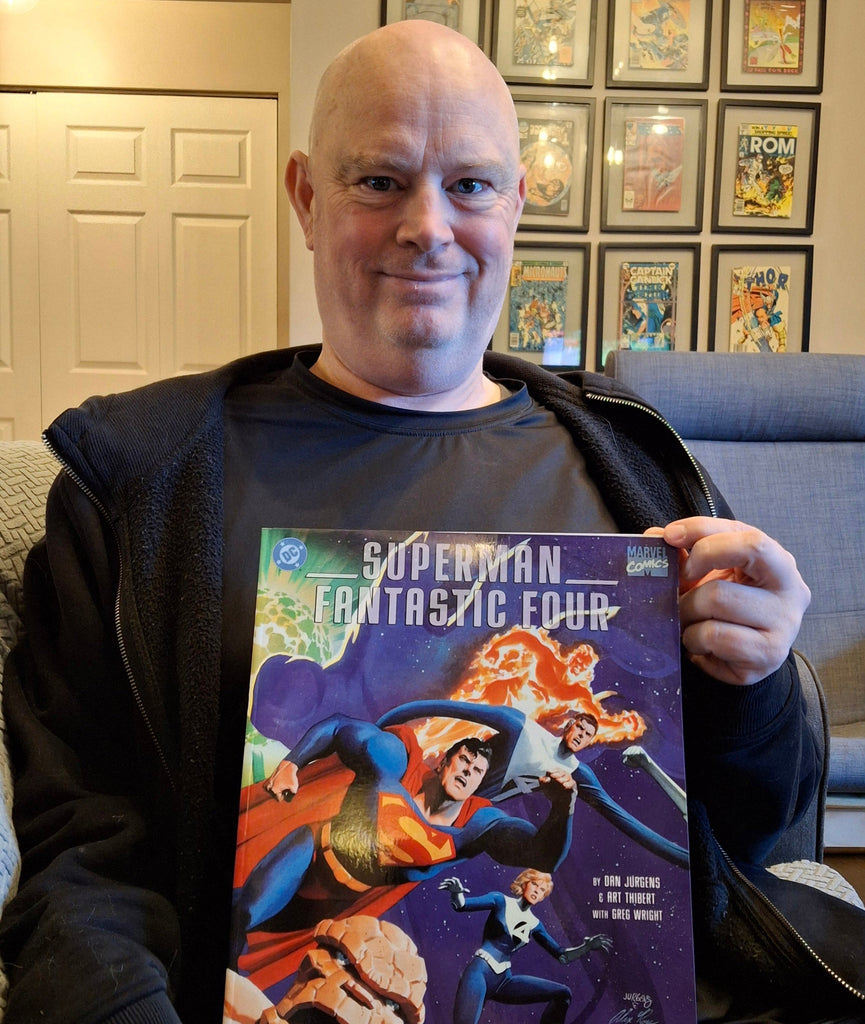
By Dan Brown Incoming! A new batch of DC/Marvel collaborations begins landing in comic stores this month. As old comic fans like me well know, crossovers are an age-old marketing tradition. The question is: Can the combined talent of comicdom’s two industry leaders make them feel fresh and exciting in 2025? The collabs, one published by each company, were announced in February. L.A. Mood’s Matt Finch alerted me they were in the pipeline because he knew I would remember the ones from the 1970s and onward. Those stories take place out of regular continuity. That allows the legal wall between DC and Marvel to be torn down, the result being Superman can team up with Spider-Man, the New Teen Titans with the X-Men, Batman with the Hulk, and so on. Crossovers were once rare, momentous events. When I cast my mind back to the 1970s, I still remember being stunned at the sight of the Man of Steel and Spidey squaring off on the cover of the same comic. Although I was just a dumb kid, I understood this was something special that didn’t happen every month. That’s probably why I grabbed every crossover – typically printed in a larger format – that came my way. Since these special issues sold so well, they quickly evolved into a cottage industry within the larger comics business, and as more independent publishers popped up, those new players tried to grab a piece of the action. Batman has co-starred with Judge Dredd. Archie met the Predator once. The Teenage Mutant Ninja Turtles have taken on Flaming Carrot. Flash-forward to this year, and Godzilla seems to be omnipresent in comics, breathing fire and stomping skyscrapers in every publisher’s imaginative universe. Crossovers represent an extension of the idea of continuity: If every Marvel superhero exists in the same metaverse together, why can’t they exist alongside DC’s stable of stars as well, at least temporarily? The first of the new books will see Deadpool face off against the Dark Knight, with backup stories combining Daredevil and Wonder Woman, and Krypto and Jeff the Land Shark, in the same volume. Along those lines, this summer I found an old Wizard magazine from 1994 in a second-hand bookstore. Among the then-current industry news was a brief touting an upcoming Batman/Punisher outing. That’s how ubiquitous they became. It was from those earlier crossovers that I was first introduced to such characters as the Jack Kirby-created baddie Darkseid. (Lord knows I love Walter Simonson’s art, but how did George Perez not get the assignment when the Titans met the X-Men in 1982?) So that particular volume was instrumental in introducing each company’s fans to the other’s lineup of characters. Crossovers became a way of cross-pollinating different fandoms. Those who loved both of this summer’s big-screen superhero outings – Superman and The Fantastic Four: First Steps – may be surprised to learn that Supes was, like the Silver Surfer, once a herald of Marvel planet-eater Galactus. Yep, it happened in 1999’s Superman/Fantastic Four: The Infinite Destruction, one of the best dual efforts from back in the day. Speaking of the movies, if it’s really true that audiences are finally tiring of superhero stories, how long will it be before one of the big brains in Hollywood suggests using the same strategy on the silver screen that has worked in comics? Isn’t that the logical next step – putting unlikely heroes beside each other to sell movie tickets? I’m betting it’s only a matter of time. If the Alien and the Predator can slug it out, why not put DC heroes and Marvel’s finest beside one another in a motion picture? Indeed, how long until a single mega-company – think Disney – assembles all the characters it owns from different media in the same movie adventure? Admit it: You love the idea of Luke Skywalker partnering with Tony Stark to fight the combined villainy of Darth Vader and Doctor Doom! Dan Brown has covered pop culture for more than 33 years as a journalist and also moderates L.A. Mood’s monthly graphic-novel group.