
What I read on my Christmas break
By Dan Brown I’m one of the lucky ones who got some days off at Christmas. It won’t surprise you to learn I spent much of my time away from work reading graphic novels. Here’s the rundown on the books I finished while going through my TBR pile. Ginseng Roots by Craig Thompson: You may know Thompson as the American comic creator behind the landmark book Blankets, in which he chronicled his turning away from religion as a teen. In this new volume, published last year, he again covers his youth, but this time he uses his childhood jobs on Wisconsin farms as the launching point for telling the story of ginseng. I will be honest with you, I wondered how the writer/artist would be able to fill 448 pages with details about a single plant. That didn’t sound like a workable premise to me. Surprisingly, he pulls it off wonderfully. I found the thick graphic novel engrossing. His lines are lush and this is the kind of book that reviewers call “expansive.” His scope is wide – really, it’s not about farming, it’s about life. Thompson is clearly at the peak of his storytelling powers. Drinking at the Movies by Julia Wertz: New York cartoonist Wertz relates how she came to live in the Big Apple after leaving her childhood home in San Francisco. Her autobiographical mini-stories revolve around Wertz’s struggle to understand her own motivations as she enters young adulthood. If Mimi Pond is among the comic creators you enjoy, you should check this one out. Based on this collection of Wertz’s strips, I plan to read more of her comics. Various by Jeff Lemire: I’ve been meaning to do a deep dive on the Southwestern Ontario creator, and finally got a chance over the holidays. I read stuff he wrote and drew himself (Fishflies, Minor Arcana Volume One) as well as titles on which he wrote and collaborated with another artist (Plutona, Primordial, Phantom Road Volume One). I would say the highlights for me were Plutona and Phantom Road. The former is about a group of school kids finding the body of a superhero (shades of the movie Stand By Me), the latter about a long-haul trucker who is transported to an alternate dimension where zombie-type monsters roam the landscape. As always, I don’t recommend Lemire for those who want pat explanations like you might get in a mainstream Marvel or DC comic. He likes to keep things mysterious for his readers. Ashes by Alvaro Ortiz: This thin volume is akin to a road movie in which a group of friends reunites after many years to carry out the wishes of a departed buddy who has been cremated. It has a fairy-tale quality to it, and I enjoyed the sweet ending. DC: The New Frontier by Darwyn Cooke: This Compact Edition, featuring almost all of DC’s roster , didn’t move the needle for me. I think that’s because I don’t know enough about the DC universe to understand the significance of how its heroes behave here. It seemed derivative of previous comics, such as Frank Miller’s Dark Knight Returns, and borrowed elements from movies like 2001: A Space Odyssey. What can I say? I grew up a Marvel fan. Batman: The Long Halloween by Jeph Loeb and Tim Sale: I understand this book is much loved by DC fans. The art is evocative, and it was a cool take on the origin of Two Face. Again, I read the Compact Edition. Did you get any time to read over the holidays? Did you get any graphic novels as gifts? I would love to hear about it in the comments! Dan Brown has covered pop culture for more than 33 years as a journalist and also moderates L.A. Mood’s monthly graphic-novel group.
It’s Easy To Beat Up On Graphic Novels
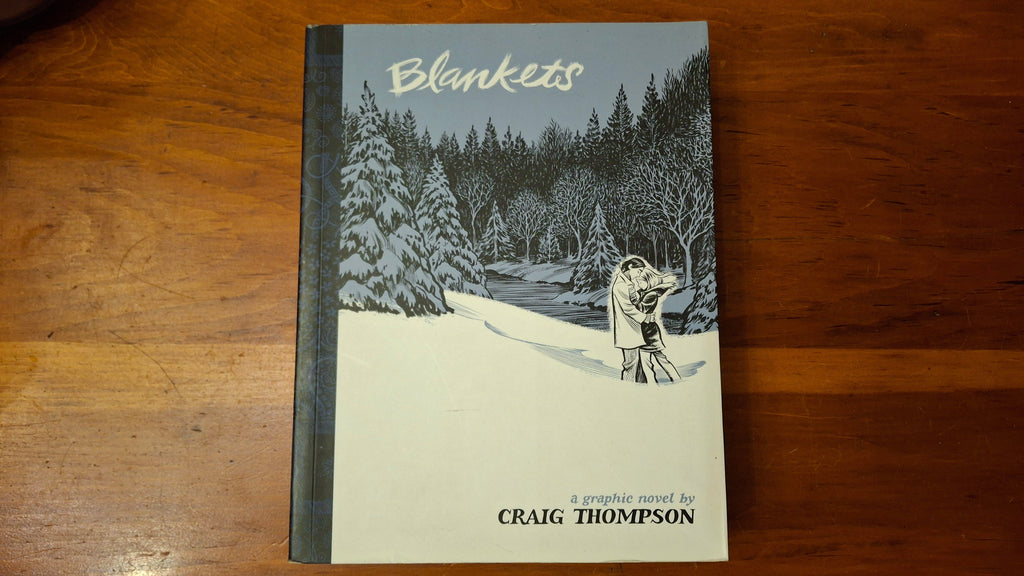
By Dan Brown Who will stand up for comic books? I’m thinking about this question after Alberta Premier Danielle Smith ordered school libraries in that province to pull books with pictures of “pornography” in them (her word). “What we are trying to remove are graphic images that young children should not be having a look at,” Smith added after the original ministerial order from her government blew up in her face. From what I’ve read, there are four specific graphic novels that have raised Smith’s ire: Craig Thompson’s Blankets, Alison Bechdel’s Fun Home, Mike Curao’s Flamer, and Maia Kobabe’s Gender Queer. I’ve read only one of those books, Blankets, and I recall it as an earnest attempt by Thompson to describe his struggles growing up in a fundamentalist Christian home. Perhaps Smith doesn’t like it because – spoiler warning – it ends with Thompson leaving the church. The other three books have one thing in common: The sex they depict isn’t between a man and a woman, but same-sex partners. Of course, Smith isn’t the first person to pick on comic books. Hating on comics is a tradition that goes back decades, extending back to the era when the audience for comics actually was children. These days, the typical Marvel or DC reader is a dude in his forties or fifties. You may have heard of Fredric Wertham, the notorious crank psychiatrist who campaigned against comics in the 1950s. It’s hard to believe now, but there were actual Congressional hearings in the U.S. into how comics were unfit for America’s kids. There were also comic-book burnings. Among his complaints with comics was Wertham’s feeling they were too violent, thus making young kids into juvenile delinquents. He also thought they turned straight kids into gay ones. Wertham hinted there was something going on between Batman and Robin between the panels, and even wrote a book detailing his research, which was thoroughly debunked years ago. But Seduction of the Innocent did have a major impact, with the comic industry opting for self-censorship in the form of the Comics Code, which lasted until 2011. How ridiculous was the self-censorship regime? A comic was once rejected by the Comics Code Authority censor on the basis of writer Marv Wolfman’s last name being in the credits, since the Code forbade mentions of the occult like, you know, wolfmen. Will anyone stand up for comics in Alberta this time around? I don’t know. I do know it’s easy to score political points by attacking comics and graphic novels, since there are so few organizations set up to champion them, at least in Canada. We do not have an equivalent to the U.S. Comic Book Legal Defense Fund, which supports creators, retailers, and educators. That said, I was encouraged to see that the Toronto Comics Art Festival spoke out against Smith’s lunacy. “We cannot stand by while governments and school boards strip these stories from bookshelves,” the organization’s board said in a statement early this month. “This fight is about the freedom to read. It’s about whose stories we allow to be told, and whose stories we try to silence.” I’m hoping others will follow TCAF’s example. At a time when there is a global information source containing easy access to all kinds of actual hardcore pornography, it seems odd to single out graphic novels that young Albertans likely aren’t all that interested in reading in the first place. They’d rather be playing on their phones. Dan Brown has covered pop culture for more than 33 years as a journalist and also moderates L.A. Mood’s monthly graphic-novel group.