
GRAPHIC-NOVEL COLUMN: Some No. 1s Are Different Than Others
By Dan Brown I call it the Spinner Rack of Your Dreams. It’s a second-hand comic rack that sits at home in my basement, which I have dubbed not the Man Cave, but the Dan Cave. My wife spraypainted it silver before I set the display up. It looks fantastic, but still lacks a topper – you know, the metal box that has “Hey kids! Comics!” painted on the sides. For the last several years I’ve been stocking it with the No. 1 issues that come into my comic collection. Why do I have a spinner rack in my basement? Because it makes the space feel like a comic store, and comic stores are my happy place. Many times when I’m downstairs I will add a comic or two to the issues on display, which I rotate in and out of the most prominent spot at the front of each individual plastic display case. Reflecting my tastes, two sides are devoted to Marvel No. 1s, one to DC debut issues and one to comics from independent publishers like Dark Horse, Eclipse, Image, and Pacific Comics. Most of the books are from the 1970s and 1980s. You see, I don’t collect old comics for their value, but the way they make me feel like a kid again. Stored on the rack are a few, I suppose, that are worth something. There’s a Moon Knight No. 1 from 1980. The copy of Black Panther No. 1 I have likely went up in value after the first Marvel movie of the same name came out. There’s Ms. Marvel, Nova and Spider-Woman, as well as Red Sonja. The most-represented comic creator is Jacky Kirby, who did the No. 1 covers for titles like the Eternals, Destroyer Duck, Kamandi, and Sandman. I have the Todd McFarlane-drawn Spider-Man No. 1, which I include on the display as a joke – after Marvel flooded the market in 1990 with that book, the issue plunged in value to the point of worthlessness. There are sentimental favourites, like my copy of Alpha Flight, Marvel’s Canadian superhero team. Also by John Byrne, one of my favourite artist/writers, is Doomsday+1 No. 1 from Charlton. And yes, I have the requisite copy of Watchmen No. 1 I have No. 1s of both the Savage She-Hulk and the Sensational She-Hulk. I’ve got the Thing No. 1 and Marvel Two-in-One No. 1, Ben Grimm being my favourite superhero. I don’t have to tell diehard comic fans how collectors fall into different categories. Some collect to make money, even if comics aren’t a surefire way to get a good return on investment. Some don’t care about the condition of their comics, they want to read them over and over. Some people love them as objets d’art. I probably fall into that category. I also realize, one No. 1 is not the same as another. They were not all created equal. I hate how Marvel, I guess to attract speculators, has been putting out a new No. 1 anytime a different creative team takes over a long-running title. Maybe it makes for a slight sales bump, but they are also devaluing the currency of all No. 1s since the upshot is that inaugural issues are becoming ubiquitous. In any given month, the so-called House of Ideas puts out a truckload of No. 1s, which disturbs the purist in me. Things really were different when I was young. Also, let’s not forget that a No. 1 from back in the day is usually not the best issue from that series, nor does it always contain the origin story of the title character. In Captain Canuck No. 1, for instance, you won’t find any mention of Tom Evans gaining the strength of two ordinary men after he was blasted with an alien ray because that detail wasn’t revealed until he had a few adventures under his belt. But as long as it has a No. 1 on the front, it’s fair game for the Spinner Rack of Your Dreams! I don’t make the rules . . . oh, wait, yes I do. Would love to hear your take. What’s your favourite No. 1? And while you’re at it, let me know the reasons why YOU collect comic books! Dan Brown has covered pop culture for more than 33 years as a journalist and also moderates L.A. Mood’s monthly graphic-novel group.

The Modern Comic Industry Began in 1986
By Dan Brown I wouldn’t be doing my job as a graphic-novel columnist if I let 2026 pass without noting it was 40 years ago that the modern comics industry was born. I can guess what you’re thinking: “Wait a minute, Dan, don’t comic books have a history that stretches back until at least the 1930s, with some proto-comics appearing even in the late 1800s?” You’re right. You got me. But I’m not talking about the Golden Age or anything like that. I’m talking about what I call the modern era, the four decades following the publication of three landmark comics – a sequential troika that shapes our expectations of what comics will be in 2026. Readers with long memories remember a time before Frank Miller’s Dark Knight Returns, Art Spiegelman’s Maus, and Alan Moore’s Watchmen. And I can say with confidence that the industry hasn’t been the same since. The industry had been struggling in the 1970s. Some historians even credit a single title, Star Wars, for saving Marvel Comics on its own. Then, in the 1980s, events like Marvel’s Secret Wars and DC’s Crisis on Infinite Earths were helping shore up the Big Two Comics Houses. Alternative publishers such as Dark Horse Comics were still embryonic. Drawn and written by Miller, Dark Knight Returns ushered in a dark and gritty form of storytelling that can still be seen on the stands of comic stores today. Its bleak depiction of Gotham was so scary that readers were willing to look past Batman’s fascist tendencies in his bid to bring order to his hometown. Printed on slick paper, its vivid art still excites me 40 years later. Miller famously said in an interview with Rolling Stone at the time he wanted to produce a comic book that a businessman wouldn’t be ashamed to be seen reading on an airplane. Comics weren’t kids’ stuff anymore. Miller followed the miniseries with Batman: Year One, which re-told the character’s origin in a Gotham that existed in a strange, timeless setting. Maus, which Spiegelman wrapped in 1986, told the story of his father’s concentration-camp experiences in the form of a cartoon-animal tale. It demonstrated that comics were a serious medium and could be put to other uses apart from glorifying the exploits of superheroes. Watchmen, meanwhile, is ostensibly a murder mystery answering the question of “Who killed the Comedian?” but is so much more. Set in an alternate 1980s in which Richard Nixon is serving his fourth term, the backdrop is a Cold War about to turn hot. Among other issues, it grapples with the consequences of having a real-life Superman (in the form of Doctor Manhattan) striding the Earth like a giant. How would that make the average person feel? Out of the three, my favourite is likely Dark Knight Returns – it took an existing comic character and tried to square how he would operate in the real world. It is at once a satire of, and a tribute to, the Caped Crusader. Sequels to Dark Knight Returns and Watchmen have failed to live up to the books that spawned them, likely because they set such a high standard for sequential storytelling. Without those three comics, we wouldn’t have comics as they exist today. But who knows – there may be creators out there who are poised to re-shape comics again. It would be entirely cool for some smart artist or writer to revolutionize our thinking about the form once again. If you have any guesses on who that might be, or which comics are changing the industry right now, let me know in the comments! Dan Brown has covered pop culture for more than 33 years as a journalist and also moderates L.A. Mood’s monthly graphic-novel group.

Graphic-novel Gift Guide
By Dan Brown I love giving (and getting) graphic novels and comics at Christmas! As you’re shopping for family and friends this festive season, I’ve got some suggestions on which books to get the different people who made your list. Check it out! For the newbie graphic-novel reader: I would recommend a starter pack of Watchmen, The Dark Knight Returns and Maus. Released at roughly the same moment in the 1980s, these are the foundational graphic novels – along with Will Eisner’s A Contract With God – that showed comics could be taken seriously. For the superhero fan: I would give this person Irredeemable from Boom! Studios. Written by Mark Waid, it takes a look at what happens when an all-powerful hero in the mold of Superman goes off the rails. For the fan of Canadiana: Maurice Vellekoop’s I’m So Glad We Had This Time Together is a gay coming-of-age story set in Toronto and includes a lot of history about the queer community in the Big Smoke. There’s also Kate Beaton’s Ducks: Two Years in the Oil Sands, set in Alberta’s Oil Patch. For the fan of local talent: Derek Laufman has books like Bot 9 and The Witch of Wickerson for kids, plus titles such as Crimson Fall: The Shore Tower for mature readers. He recently published the first issue of The Rats of Ironwood and has taken over art duties on Skottie Young’s I Hate Fairyland series. A Byron resident, Laufman is as local (and as good a creator) as it gets. For the fan of overlooked gems: Get this person on your list anything Mouse Guard, Londoner Bryan Lee O’Malley’s Seconds, or Southwestern Ontario native Jeff Lemire’s The Nobody, the latter of the three being a re-telling of the H.G. Wells novel The Invisible Man in a small town. For the history buff: Maybe I’m in the minority, but I had not heard of Eadweard Muybridge, the pioneering photographer who was also involved in one of the most notorious murder trials of the 1800s, until Quebec graphic novelist Guy Delisle published this biography. A fascinating character whose story is told in a fascinating way. You could also try Scott Chanter’s Two Generals, about the D-Day invasion told from the perspective of two Canadian grunts. For the political buff: Are You Willing to Die for the Cause? is the first of a two-volume history of the FLQ, the separatist terrorists who are portrayed by veteran cartoonist Chris Oliveros as a bunch of stumblebums. For the art lover: I came relatively late to Dean Motter’s Mister X. Check out Mister X: The Archives or Mister X: The Modern Age, with its glorious retro look, billed as “a fusion of film noir, Art Deco and German Expressionism.” All of those elements combine to make a comic that will live in your imagination for a long time. And Los Bros Hernandez worked on some of the early issues of this Canadian classic! For the lover of the printed word: Anything, really, by Hamilton’s Joe Ollmann. If you want a starting point, try some of his short graphica, for instance Happy Stories About Well-Adjusted People. If you like what you read, move on to Fictional Father and The Abominable Mr. Seabrook. Don’t get me wrong, I love Joe’s art, too, but there are few comic creators whose voice comes through as clearly as Ollmann’s does. For the one who loved this summer’s Superman movies: The James Gunn film was based on a number of storylines, including All-Star Superman, Superman For All Seasons and Superman: Birthright. If you can find a compilation of John Byrne’s 1980s run on Superman, this person on your list will likely enjoy that one, too. For the one who loved The Fantastic Four: First Steps this summer: The Essential Fantastic Four Volumes 1-5 were the source material for this movie, with its retro-futuristic look. The new motion picture was dedicated to artist Jack Kirby, and these five volumes contain his entire influential run on the title with Stan Lee. For the one who is looking forward to Avengers: Doomsday next year: See my Fantastic Four recommendations. Also the Essential Super-Villain Team-Up Volume 1 and the individual issue The Invincible Iron Man No. 150 – in which Doctor Doom faces off against Iron Man. For the music fan: Scott Chantler’s Bix, Rush: The Making of a Farewell to Kings and David Collier’s Topp: Promoter Gary Topp Brought us the World. For the person who’s impossible to buy for: Why, a gift certificate, of course! So that’s it for my suggestions for this year. Are there any graphic novels/comics you are giving this year, or hoping to see under the tree? Let me know in the comments! Dan Brown has covered pop culture for more than 32 years as a journalist and also moderates L.A. Mood’s monthly graphic-novel group.
Compact Edition Not Quite Watchmen Babies
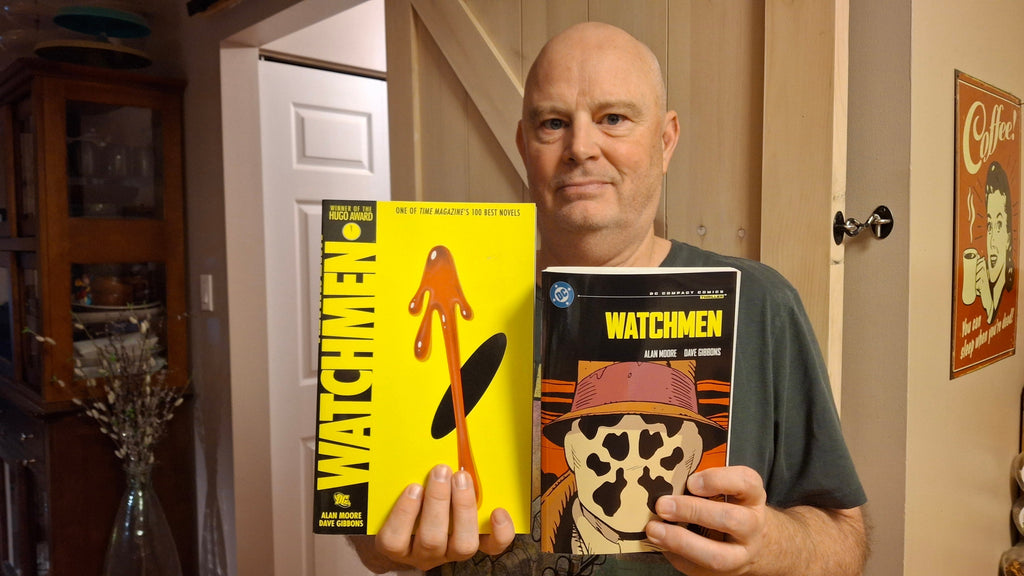
By Dan Brown When it comes to comics, size matters. But not as much as paper quality. That’s my conclusion after checking out a mini-edition of the classic Alan Moore/Dave Gibbons graphic novel Watchmen. Published under the DC Compact Comics banner, the smaller reprint contains all 12 issues of the 1986 tale about a superhero murder in an alternate America teetering on the edge of nuclear war with Russia. I found the compact edition didn’t suffer for the reduction in size. Powerful scenes, like when Doctor Manhattan zaps Rorschach into oblivion, still pack a powerful punch. I have feeble middle-aged eyes, but I could still read the dialogue without straining. All that said, I still prefer the original edition. The only real advantage the compact version has is its portability. If I was taking Watchmen to read on a beach on a hot summer day, I’d reach for the smaller one. (Of course, if I took Watchmen to the beach, I’d be a deeply weird individual.) How much smaller are we talking? The Compact Comics edition measures 5.5 by 8.5 inches and has a cover price of $13.50. Compare that to the regular size, which measures 6.75 by 10.25 inches, and set me back $22.99 when I picked it up a number of years ago. (Both of them are paperbacks.) If you’re thinking “Don’t odd-size comics have a long history?” you’d be right. Growing up in the 1970s and going to the grocery store with my Mom, I’d see mini-digests of Archie comics at every checkout. I never bought even a single one. I suspect even today, it doesn’t matter much what size Archie comic you buy, the characters and stories likely land the same. But also in the Seventies, if a comic was momentous enough, it would be published in a huge oversize treasury edition (10.5 by 13.5 inches). Those ones were reserved for “event” stories, as when Superman fought Spider-Man in the first DC/Marvel crossover. When Superman squared off against Muhammad Ali in the boxing ring, that story also got the oversize treatment. Naturally, those bigger comics came with a premium price. The one shame about the tiny Watchmen book was the cheaper paper DC used, which diminishes the effect of its colour scheme. Colour artist John Higgins is the unsung hero of Watchmen, and his powerful colouring doesn’t get the props it deserves as an essential part of the Watchmen reading experience. He specifically chose a non-traditional superhero palette, and the story’s impact is lessened with the switch. Doc Manhattan, to name one example, just isn’t as otherworldly when the luminescent blue covering his body is toned down on the duller paper. Watchmen remains one of the best-selling comics of all time. It continues to top sales charts decades after it was published, first as a monthly comic, then a collected graphic novel. So my bottom line is, if a smaller version helps comic stores to move product, then it’s a good thing. If it turns newbies onto Watchmen, or even turns people into fans of the medium in general, then I’m all for it. I’m sure Alan Moore would have something angry to say. Dan Brown has covered pop culture for more than 33 years as a journalist and also moderates L.A. Mood’s monthly graphic-novel group.