
The Modern Comic Industry Began in 1986
By Dan Brown I wouldn’t be doing my job as a graphic-novel columnist if I let 2026 pass without noting it was 40 years ago that the modern comics industry was born. I can guess what you’re thinking: “Wait a minute, Dan, don’t comic books have a history that stretches back until at least the 1930s, with some proto-comics appearing even in the late 1800s?” You’re right. You got me. But I’m not talking about the Golden Age or anything like that. I’m talking about what I call the modern era, the four decades following the publication of three landmark comics – a sequential troika that shapes our expectations of what comics will be in 2026. Readers with long memories remember a time before Frank Miller’s Dark Knight Returns, Art Spiegelman’s Maus, and Alan Moore’s Watchmen. And I can say with confidence that the industry hasn’t been the same since. The industry had been struggling in the 1970s. Some historians even credit a single title, Star Wars, for saving Marvel Comics on its own. Then, in the 1980s, events like Marvel’s Secret Wars and DC’s Crisis on Infinite Earths were helping shore up the Big Two Comics Houses. Alternative publishers such as Dark Horse Comics were still embryonic. Drawn and written by Miller, Dark Knight Returns ushered in a dark and gritty form of storytelling that can still be seen on the stands of comic stores today. Its bleak depiction of Gotham was so scary that readers were willing to look past Batman’s fascist tendencies in his bid to bring order to his hometown. Printed on slick paper, its vivid art still excites me 40 years later. Miller famously said in an interview with Rolling Stone at the time he wanted to produce a comic book that a businessman wouldn’t be ashamed to be seen reading on an airplane. Comics weren’t kids’ stuff anymore. Miller followed the miniseries with Batman: Year One, which re-told the character’s origin in a Gotham that existed in a strange, timeless setting. Maus, which Spiegelman wrapped in 1986, told the story of his father’s concentration-camp experiences in the form of a cartoon-animal tale. It demonstrated that comics were a serious medium and could be put to other uses apart from glorifying the exploits of superheroes. Watchmen, meanwhile, is ostensibly a murder mystery answering the question of “Who killed the Comedian?” but is so much more. Set in an alternate 1980s in which Richard Nixon is serving his fourth term, the backdrop is a Cold War about to turn hot. Among other issues, it grapples with the consequences of having a real-life Superman (in the form of Doctor Manhattan) striding the Earth like a giant. How would that make the average person feel? Out of the three, my favourite is likely Dark Knight Returns – it took an existing comic character and tried to square how he would operate in the real world. It is at once a satire of, and a tribute to, the Caped Crusader. Sequels to Dark Knight Returns and Watchmen have failed to live up to the books that spawned them, likely because they set such a high standard for sequential storytelling. Without those three comics, we wouldn’t have comics as they exist today. But who knows – there may be creators out there who are poised to re-shape comics again. It would be entirely cool for some smart artist or writer to revolutionize our thinking about the form once again. If you have any guesses on who that might be, or which comics are changing the industry right now, let me know in the comments! Dan Brown has covered pop culture for more than 33 years as a journalist and also moderates L.A. Mood’s monthly graphic-novel group.
Compact Edition Not Quite Watchmen Babies
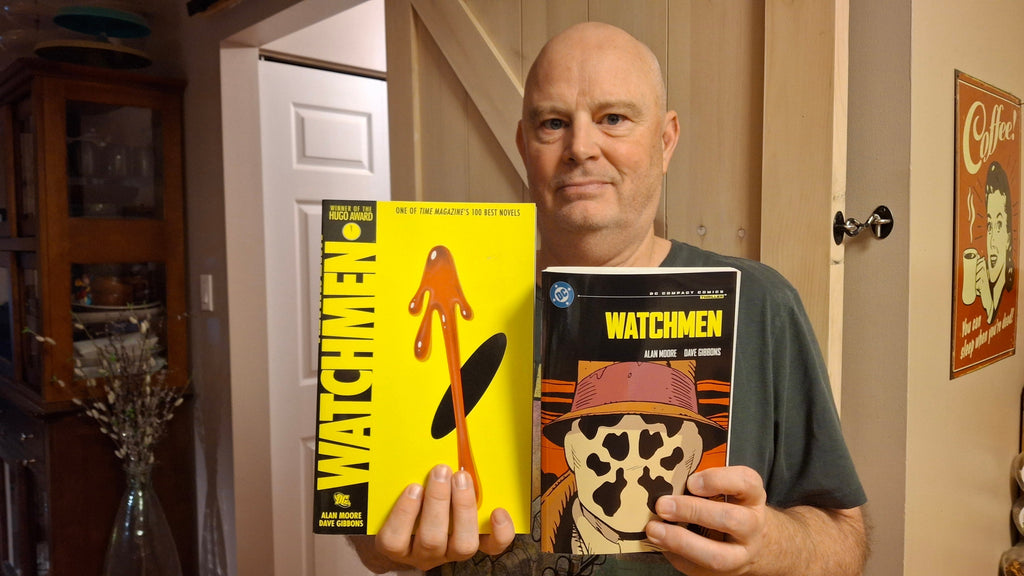
By Dan Brown When it comes to comics, size matters. But not as much as paper quality. That’s my conclusion after checking out a mini-edition of the classic Alan Moore/Dave Gibbons graphic novel Watchmen. Published under the DC Compact Comics banner, the smaller reprint contains all 12 issues of the 1986 tale about a superhero murder in an alternate America teetering on the edge of nuclear war with Russia. I found the compact edition didn’t suffer for the reduction in size. Powerful scenes, like when Doctor Manhattan zaps Rorschach into oblivion, still pack a powerful punch. I have feeble middle-aged eyes, but I could still read the dialogue without straining. All that said, I still prefer the original edition. The only real advantage the compact version has is its portability. If I was taking Watchmen to read on a beach on a hot summer day, I’d reach for the smaller one. (Of course, if I took Watchmen to the beach, I’d be a deeply weird individual.) How much smaller are we talking? The Compact Comics edition measures 5.5 by 8.5 inches and has a cover price of $13.50. Compare that to the regular size, which measures 6.75 by 10.25 inches, and set me back $22.99 when I picked it up a number of years ago. (Both of them are paperbacks.) If you’re thinking “Don’t odd-size comics have a long history?” you’d be right. Growing up in the 1970s and going to the grocery store with my Mom, I’d see mini-digests of Archie comics at every checkout. I never bought even a single one. I suspect even today, it doesn’t matter much what size Archie comic you buy, the characters and stories likely land the same. But also in the Seventies, if a comic was momentous enough, it would be published in a huge oversize treasury edition (10.5 by 13.5 inches). Those ones were reserved for “event” stories, as when Superman fought Spider-Man in the first DC/Marvel crossover. When Superman squared off against Muhammad Ali in the boxing ring, that story also got the oversize treatment. Naturally, those bigger comics came with a premium price. The one shame about the tiny Watchmen book was the cheaper paper DC used, which diminishes the effect of its colour scheme. Colour artist John Higgins is the unsung hero of Watchmen, and his powerful colouring doesn’t get the props it deserves as an essential part of the Watchmen reading experience. He specifically chose a non-traditional superhero palette, and the story’s impact is lessened with the switch. Doc Manhattan, to name one example, just isn’t as otherworldly when the luminescent blue covering his body is toned down on the duller paper. Watchmen remains one of the best-selling comics of all time. It continues to top sales charts decades after it was published, first as a monthly comic, then a collected graphic novel. So my bottom line is, if a smaller version helps comic stores to move product, then it’s a good thing. If it turns newbies onto Watchmen, or even turns people into fans of the medium in general, then I’m all for it. I’m sure Alan Moore would have something angry to say. Dan Brown has covered pop culture for more than 33 years as a journalist and also moderates L.A. Mood’s monthly graphic-novel group.