
Dawn of the Black Axe is Amazing
Dawn of the Black Axe is amazing By Dan Brown David Petersen’s Mouse Guard: Dawn of the Black Axe is a superlative series that will make for a must-read graphic novel come January. The three-issue title debuted and wrapped from March to June this year. The collected version lands on store shelves January 20. Do yourself a favour and pre-order your copy now. Although I initially felt trepidation that another comic creator – Gabriel Rodriguez – handled art duties, instead of Petersen, my skepticism soon melted away when I got a closer look at the individual issues, which are gorgeous. As Mouse Guard fans know, Petersen is the Michigan writer/artist who originated the idea of a medieval mouse society protected by the members of the Guard, forest rangers who serve to keep the far-flung mouse communities safe. Petersen’s art in the main title is amazing, which is what I’m used to. But Rodriguez’s lines are just as expressive, in their own way. There are fantasy/sorcery elements to the story – mostly in the form of a ghostly elk, who guides Bardick, the first-ever bearer of the black axe, in his quest to kill five giant snakes who are tightening their grip on mouse territory by raiding villages and breeding more young. The blade itself was fashioned by the blacksmith Farrer, whose own wife and children were slain by one of the serpents. “I’ll take all the pain forged in this weapon and protect mouse kind,” Bardick vows, perhaps not realizing he will be in the forest for many a season before he can rest. I was able to enjoy Rodriguez’s art on its own terms. He can do action just as well as he can render scenes in which the characters are static. He is also so good at evoking a sense of time – the reader sees Bardick grow weary as his adventures drag on over years. And that mysterious ghost elk is ethereal, except when he’s material, in one panel helping Bardick ford a stream. Each image rewards repeated attention, as the reader absorbs more detail and is drawn deeper into the Mouse Guard world. Nor is it a foregone conclusion that the slithering death threatening mouse communities will be vanquished. Bardick lives to see some of the mice thrive, but Petersen has a twist up his sleeve that will force readers to re-think what they thought they knew about the enemies of the mice, who have a “seething fury . . . boiling in their collective cold hearts.” What I know for sure about Mouse Guard is how Petersen is not interested in telling the same old stories. In a previous adventure, some mice rebelled against the mouse matriarch – but instead of taking the side of the rebels, a tale we’re all familiar with, he told it from the vantage of those trying to keep order. Another way of saying it is, Mouse Guard comics remind me of the spirit of the 2000 film Crouching Tiger, Hidden Dragon, as well as the Lord of the Rings books and the best Star Wars movies/TV shows. I’m already excited for 2026. Dan Brown has covered pop culture for more than 33 years as a journalist and also moderates L.A. Mood’s monthly graphic-novel group.
Fantasy List Incomplete Without Morgaine
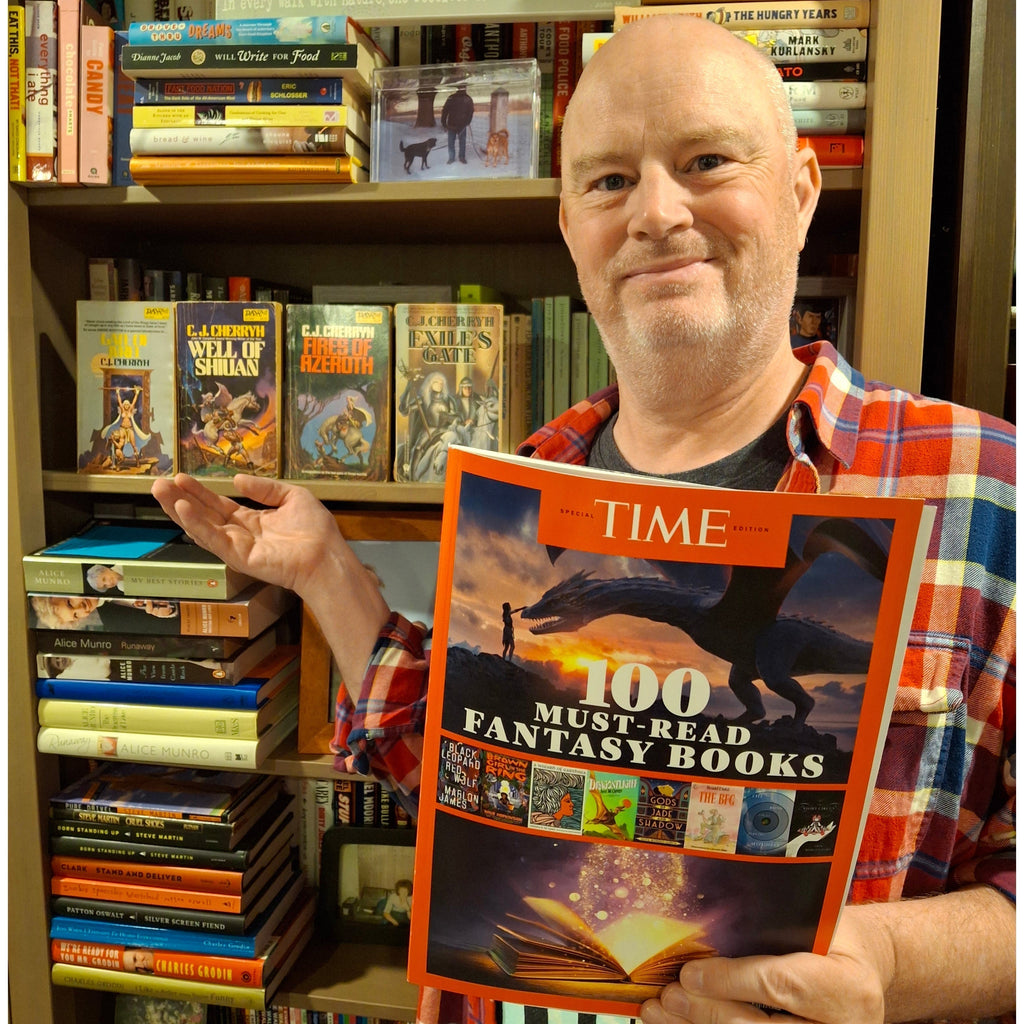
By Dan Brown So TIME magazine has come out with a 100 Must-Read Fantasy Books special edition and I’m unimpressed. I know the list isn’t meant to be the final world on the topic. However, there’s one omission I just can’t forgive: C.J. Cherryh’s greatest heroine, Morgaine. There are the usual suspects – books by Tolkien, Lewis Carroll, C.S. Lewis made the cut – as well as a number of contemporary works chosen with an eye to diversity. But to not include Morgaine – featured in four of Cherryh’s many novels – feels like a slight to fantasy fans. It left me wondering how young the big brains are who drew up the magazine’s list, because judging from their choices, they seem to think there weren’t any powerful women in fantasy fiction before about the year 2000. I first encountered Morgaine a few years after 1976’s Gate of Ivrel was published. I read her adventures on the front porch of the Baptist parsonage in Poplar Hill during grade-school summers, and she made an immediate, deep impression on my developing imagination. Not because she stood out. The truth is, I was already familiar with many kick-butt female characters. I got my notions of how women leaders should be portrayed from Carrie Fisher’s Princess Leia in Star Wars and the likes of Thundra in Marvel’s Fantastic Four comics – Thundra could go toe-to-toe with the Thing! Morgaine was just so . . . cool. Eerie. Mysterious. Dangerous. If you haven’t read the tetralogy in which she stars, treat yourself. She’s the last surviving member of a team charged with sealing a series of gates connecting a crumbling interplanetary empire. She’s like Batman in the sense that her mission is to create a universe in which she is obsolete. The gates transport people not only between places, but also eras. So things like this can happen: A foe can use a gate minutes before Morgaine rides through on her war horse. When she exits, she is on a different world hundred of years later, where the descendants of her enemy regard her as a long-lost legend. Morgaine is utterly committed to her quest, and wields a sword called Changeling, which has a gate at its tip. She uses the high-powered blade to send entire armies into the void of space, her conscience seemingly untroubled by the mass killing. Her frost-white hair marks her as possibly a member of the evil race that originally invented the gates. The foil Cherryh uses as the reader’s point of entry into the story is Morgaine’s servant/bestie/possible love interest, Vanye, who is always urging her to be compassionate, which doesn’t come easily for Morgaine. Like I said, Morgaine wasn’t an exception in my mind. She was a big part of the template for me, showing how women characters could be multi-faceted and exciting. Which is why I soon read other Cherryh novels, such as the Pride of Chanur series. It was only later in life I looked back and said, “Oh, hey, all of those stories feature women as the central character. Cool.” If the purpose of TIME’s fantasy special edition was to spur debate, then it will fulfill its mandate. But contrary to what TIME’s editors might have readers believe, pop-culture fans have been grooving on strong female characters for some decades now. By the way, next year marks 50 years since Morgaine’s first appearance. Wouldn’t it be awesome if a streaming platform (say, Netflix) honoured the anniversary by adapting Cherryh’s work into a TV series? It would be a whole lot cooler if they did. (If you have any must-read fantasy novels you’d like to recommend, I’d love to hear about them in the comment box below!) Dan Brown has covered pop culture for more than 32 years as a journalist and also moderates L.A. Mood’s monthly graphic-novel group.