Dan Brown's Graphic-novel Gift Guide
By Dan BrownThe holidays are looming, and you’ve been racking your brains for ideas of what gifts to get your family and friends, but coming up short.Well, you’ve come to the right place.We are now at the point where there is a graphic novel for everyone on your list, so please consider the following suggestions as you do your Christmas shopping.For your husband/boyfriend: Any Tintin adventure by HergeFor your wife/girlfriend: Jillian Tamaki’s Super Mutant Magic AcademyFor your dad: Giant by MikaelFor your mom: Any collection of Peanuts comic strips by Charles SchulzFor your brother: Essex County by Jeff LemireFor your sister: Jonathan Dyck’s ShelterbeltsFor your young son: Any Geronimo Stilton graphic novel by Elisabetta DamiFor your young daughter: The Bad Guys Book 1 by Aaron BlabeyFor your best friend: Petals by Gustavo BorgesFor the Marvel fan in your life: Origins of Marvel Comics (the 2024 Deluxe Edition)For the DC fan: Irredeemable by Mark Waid, Peter Krause and Diego BarretoFor the person in your life who loves superhero movies: Robot Dreams by Sara VaronFor the person who hates superhero movies: Ghost World by Daniel ClowesFor the music fan in your life: Leonard Cohen: On a Wire by Philippe Girard For the history buff in your life: Fax From Sarajevo by Joe KubertFor the hockey fan in your life: Essex County by Jeff LemireFor the journalist in your life: Ten Days in a Mad-House: A Graphic Adaptation by Brad RiccaFor the photographer in your life: Weegee from Wauter Mannaert and Max de Radigues For the comics historian in your life: Brian Doherty’s Dirty Pictures (it’s prose)For the lover of newspaper cartoons: Joe Ollmann’s Fictional FatherFor the fan of CanCon: Are You Willing to Die for the Cause? by Chris Oliveros For the grad student in your life: Any of the Wendy titles from Walter ScottFor the theatre lover: Kill Shakespeare by Conor McCreery, Anthony Del Col and Andy Belanger For the lover of literature: Slaughterhouse-Five: The Graphic Novel adapted by Ryan North and Albert MonteysFor the fan of the 1970s: Mimi Pond’s Over EasyFor the fan of the 1980s: Duran Duran, Imelda Marcos and Me by Lorina MapaFor the fan of AI: The Wild Robot by Peter BrownFor the deep thinker in your life: Leslie Stein’s I Know You RiderFor the Muppet fan in your life: A Tale of Sand from Jim Henson and Ramon PerezFor the comics newbie: Either The Dark Knight Returns (Frank Miller) Watchmen (Alan Moore and Dave Gibbons) or The Complete Maus (Art Spiegelman)For just about everyone: Oh, the Places You’ll Go! by Dr. SeussIf you have any of your own gift suggestions, I’d love to hear them in the comment box below! Alternatively, what titles are you asking Santa Claus to leave under your tree? Dan Brown has covered pop culture for more than 32 years as a journalist and also moderates L.A. Mood’s monthly graphic-novel group.
Is There Product Placement in Comics?
By Dan BrownMaybe it’s because I’m a naive fool, but I don’t ever remember seeing an instance of flagrant product placement in a comic book.I’m talking about the classic kind of product placement, the same type you see in movies or on TV where products are written into the plot of the show in return for brand exposure.(I’ll get to advertising partnerships in comics in a minute. They are a different animal.)For example, in an old episode of Big Bang Theory Raj gets a new iPhone. We know it’s an iPhone because after he and Howard unwrap the device, Raj has a conversation with Siri, Apple’s digital assistant. Not very subtle.Product placement like this would in theory be easy to do in comics. The reference could be written into a comic’s script and then the brand’s product would be drawn by the penciller.We all know Wolverine – being Canadian – loves beer, right? So in a scene in which the deadly mutant walks into a bar, he could order a Budweiser or other brand, and the artist could reproduce the label on the bottle or can in Logan’s hand. Easy-peasy, providing you can get the creative team on board with the idea.As straightforward as the process would be, it doesn’t seem to happen much. Maybe I’ve got feeble eyes, but I don’t recall much along those lines taking place in Marvel or DC Comics. There are opportunities aplenty, it’s true.Batman’s alter ego, Bruce Wayne, might prefer a certain make of sports car. Ben Grimm could make his preferences known for a specific type of cigar. Photographers love to talk about the equipment they favour, so why would Peter Parker be any different?The argument in favour of product placement in comics might go something like this: “We live in a world of brands, so superheroes having brand preferences would make them and their milieu seem more realistic. If advertisers want the exposure, publishers could use the extra revenue.”I’m talking solely about comics here. I know there’s plenty of product placement in motion pictures that feature the same superheroes. That’s a whole other column.Nor am I talking about the advertising partnerships comic publishers occasionally embark on, which are embarrassing because they’re so blatant.For example, Marvel characters such as the Hulk and Spidey were loaned out to Hostess in the 1970s to go on adventures in which the villains were all defeated or distracted the same way: By being fed Twinkies. These appeared as clearly marked ads, not part of a comic's storyline.Likewise, about a decade ago, motorcycle maker Harley Davidson signed a deal with Marvel to feature their fine wares in a series of one-shot issues. This led to odd situations in which the Avengers, instead of using the full range of their powers, including that of flight, would ride Hogs to do battle with evildoers.I did once read a Hawkeye storyline set in Madripoor in which a specific brand of credit card was name-dropped, but I can’t recall having seen anything like it since. And I can't say for sure it was the result of a deal.Perhaps the reason for the dearth of product placement in comics is publishers might have to share the fee with creators. Or maybe comic creators who consider themselves "artists" feel they’re above crass product placement.Or maybe it goes back to the traditional perception of comics being stuff for children, and therefore product placement being viewed as unfairly taking advantage of kids. Of course, both you and I know the average comic reader today is in their 40s or 50s so that argument no longer holds water.Dan Brown has covered pop culture for more than 32 years as a journalist and also moderates L.A. Mood’s monthly graphic-novel group.
Alien: Romulus Comic Short, but Intriguing
How the Alien: Romulus comic fills in Alien franchise story gaps and more reasons to read the comic explained in columnist's Dan Brown's comic book review.
Read The Story
Recommended Remembrance Day Reading
By Dan BrownIf you ask me, Remembrance Day should be a statutory holiday – I believe this country ought to grind to a halt out of respect for those who gave their lives so the rest of us could live in peace.And in no way do I think reading a comic or graphic novel can come anywhere close to recreating the brutality of combat. So I mean no disrespect by offering these ideas for Remembrance Day reading. Please consider these suggestions a starting point, and nothing more.Two Generals: Created by Southwestern Ontario’s own Scott Chantler, this moving book gives a grunt’s-eye-view of the D-Day landings. It’s based on Chantler’s own family history and his crisp lines don’t diminish the horrors of war. Jack Kirby: The Epic Life of the King of Comics: Not only did Jack Kirby draw many war comics, but he was also an actual U.S. soldier who landed at Normandy (in a subsequent wave). I recommend Tom Scioli’s biography because it helped me visualize Kirby’s contribution to the war effort. All Quiet on the Western Front: Wayne Vansant’s graphic adaptation of the classic Erich Maria Remarque novel pulls no punches with its detailed account of trench warfare and forays into No Man’s Land as told from the German side. Vansant is himself a veteran of the Vietnam War.The Canadian Whites: These were the wartime comics that flourished in Canada during the Second World War due to restrictions the government put on imports. Hard to believe, but our dominion had a thriving homegrown comic industry in those years. I would suggest you start with Nelvana of the Northern Lights, a collection about a female goddess who fought Nazis and also beat Wonder Woman to market.Berlin: This expansive volume by Jason Lutes depicts what was going on in the German city between the wars. The cast combines historical figures like Hitler with fictional characters and was years in the making. It opened my eyes.They Called Us Enemy: Inspired by the true story of Star Trek actor George Takei’s family, this tale of the homefront describes how Japanese Americans were sent to internment camps during the Second World War. This, after their possessions were confiscated and their businesses liquidated. There are echoes of this experience in the short comic Junban by Toronto creator Jillian Tamaki. It first appeared in the New Yorker and describes her grandfather’s parallel experience in British Columbia.Sgt. Fury and His Howling Commandos: Long before he was an agent of SHIELD, Fury – the comic one, not the one played by Samuel L. Jackson – was fighting Nazis in the pages of Marvel Comics. Any introductory collection will do, and yes, I know these comics were meant more as entertainment for boys than a serious record of how World War Two unfolded. Captain America’s earliest adventures are likewise worth a read – Cap was punching Hitler in the face before the U.S. had even been drawn into the war.Sgt. Rock: A DC anthology like Archives Volume One will give you the idea. The highlight here is Joe Kubert’s gorgeous art, which was also featured in another World War Two title from DC, the Unknown Soldier.Please consider these recommendations in the spirit they're offered. Every one of us has to begin learning about war somewhere, and for me it was in the pages of comics like these.Dan Brown has covered pop culture for more than 32 years as a journalist and also moderates L.A. Mood’s monthly graphic-novel group.
Now This is a Fun Godzilla
By Dan BrownAs you may have heard, this Saturday (November 2) is Godzilla Day at L.A. Mood Comics & Games. It’s the store’s way of celebrating the giant lizard’s 70th anniversary on the silver screen.So here’s my two cents.Godzilla has appeared in a lot of comics over the decades, but few are as fun as the Essential Godzilla: King of the Monsters, which collects all 24 issues of Marvel’s 1970s series featuring He-Who-Stomps-Tokyo.Marvel jumped on just about every bandwagon in those days. Does anyone remember Dazzler, the mutant who had all the powers of . . . a glitter ball? The thinking was, if disco music or Alice Cooper or kung-fu movies or the Human Fly are a sensation in pop culture, then surely a comic featuring the same trend du jour will be a hit.Those comics – generally done on the cheap – are the ones that defined my childhood. And the fact this Godzilla series lasted two years is a testament to how popular it must have been.The first issue appeared in 1977 (the same year Star Wars, and the ensuing Marvel adaptation, took off) and within the first few pages the book’s creative team (artist Herb Trimpe and writer Doug Moench) effectively meld Toho Productions continuity with that of the Marvel Universe. Surprise! It turns out Godzilla was always in the same world as Spider-Man, the Avengers, and the Fantastic Four! That opens up a lot of possibilities.The challenge for the creators was in having a central character who is kind of like another big G, Galactus, except not as talkative. Godzilla is a force of nature, so he doesn’t really speak a lot, unless utterances like these count as dialogue:– Shreeaww– Hrahhh– Graww– Mraww– Reeaww– MeeawrrMan, I love old-timey sound effects! I’m sure Trimpe and Moench had a ball coming up with them.And as with Galactus, there is a running debate in this series about Godzilla’s essential nature. Is he like a snowstorm, and therefore beyond morality? Or is his trampling of landmarks like the Hoover Dam proof of malevolence? Is he driven solely by animal instincts, is Godzilla – as one character exclaims – an “overgrown gila monster”? Could there even be a noble heart under that scaly hide?So, back to those Marvel guest stars.Nah, they didn’t use them to full advantage.I’m guessing the editors who were in charge of other Marvel heroes at the time didn’t want to loan out their A-list characters. The ostensible human star of the Godzilla comic is Dum-Dum Dugan, who is in charge of SHIELD’s Godzilla capture team. Yeah, they couldn’t even get Nick Fury.You know Dugan as the Second World War veteran with a bowler hat and walrus moustache who was somehow still wah-hoooing 30 years later. At least with Fury Marvel's writers made up some story about a de-aging formula making him immortal (or something). And where Dugan was on the winning side in the battle against the Nazis, he is forever being bested by Godzilla. You will also recognize Dugan because he says things like “Looks like it’s time for old Dum-Dum to bail outta the jaws o’ death. Never could stand bad breath,” the latter being a reference to Godzilla’s ability to spew nuclear fire.Later, some bigger stars do appear, but funny thing: I never remember Spidey or Mister Fantastic or the Vision referring to Godzilla in their own titles. You’d think, because he was a menace to all of North America in this series, word would have gotten out to the larger Marvel Universe. But does Godzilla fight other monsters, you ask. You bet. Among his foes are Batragon, Centipor, Ghilaron, and Lepiraz, any of which could easily pass as the brand name for a depression or weight-loss medications. Next up: Godzilla takes on Ozempic!While Godzilla’s Marvel days may have lasted a rollicking two years, the comic version of that other movie from 1977, Star Wars, helped Marvel stay afloat back in the day. In fact, the company continues to produce Star Wars content to this day, proving that if even just one trend-inspired comic series pans out, it can be a boost to a publisher’s bottom line for a long time.And if comic books aren’t your thing, just take a look around L.A. Mood on Saturday as Godzilla Day unfolds. The friendly staff will have whatever merch you crave! Dan Brown has covered pop culture for more than 31 years as a journalist and also moderates L.A. Mood’s monthly graphic-novel group.
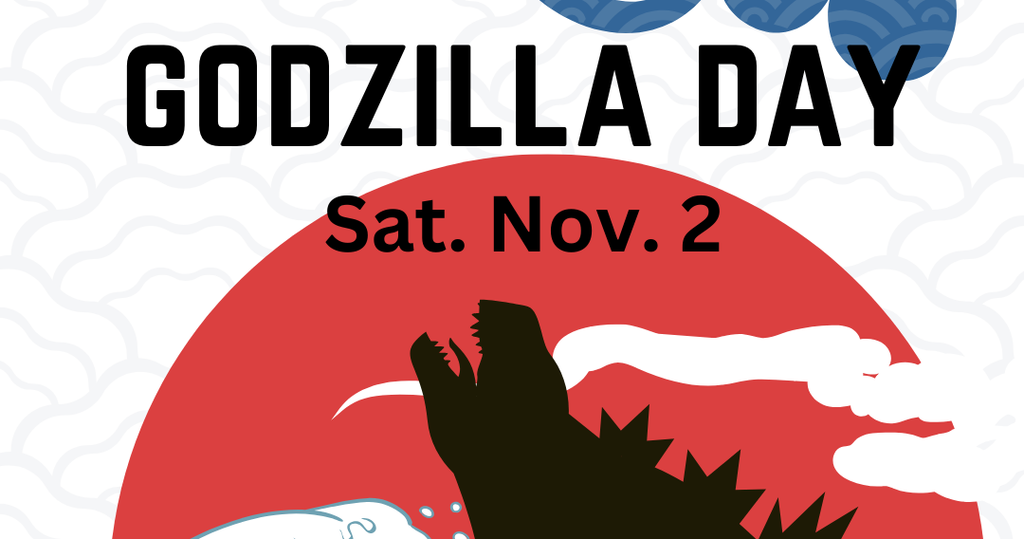
Celebrate 70 Years of Godzilla with Us (Godzilla Day London Ontario) Nov 2
Join the fun at this monstrous 70th anniversary event!We are excited to have a human size Godzilla cosplay guest on site. Tristan Domay is one of Canada's premiere Godzilla cosplayers. He has been building and performing as monstrous characters for over 15 years. An award winning artist and filmmaker, he is a longtime contributor to the kaiju and tokusatsu fandoms. Working annually with Dojo Studios since 2010, he has helped to bring Western Godzilla fans unique experiences usually unseen outside of Japan, including live stage shows, special effects demonstrations, as well as academic panels on costuming and the history of the kaiju genre. In his spare time he moonlights as a late night horror host and lover of all things macabre.Don’t miss out! We will be open Saturday November 2 from 10 am till 7 pm.Come on by L.A. Mood at 100 Kellogg Lane, suite 5, London.