New Comic Back Issue Collection Available Starting Saturday, March 8
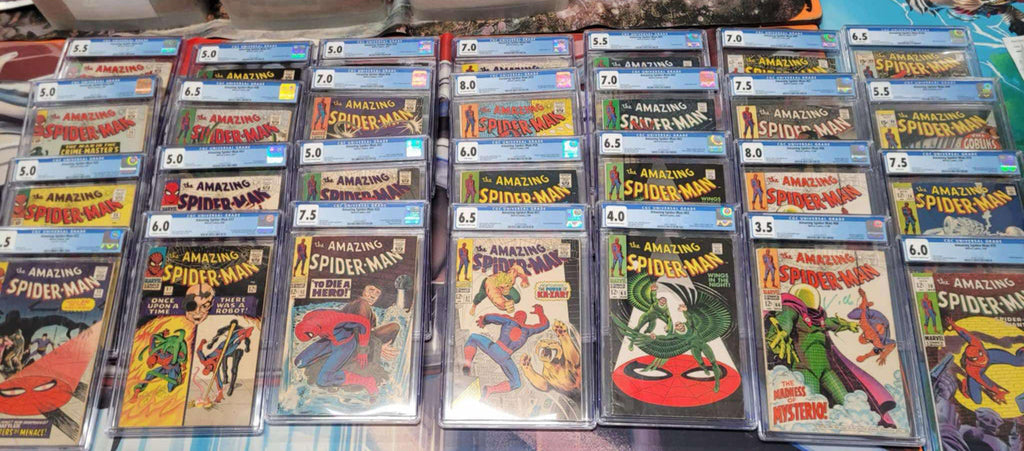
A new back issue collection available starting Saturday, March 8 at 10 AM. Eight plus boxes of new back issues! Highlights include CGC graded and ungraded early Amazing Spider-Man, a near complete run of TMNT (Mirage) and more! This collection will be available in store and the following week select comics will be added online. Visit early for best selection! Watch for future emails and Facebook posts for more reveals. See below for a sneak peak! See the collection in person. Collection drops Saturday, March 8, 10 AM. L.A. Mood Comics and Games100 Kellogg Lane, Suite 5, London ON N5W0B4
New Star Wars Comic for Fans Only
By Dan Brown Although it’s well-made, Star Wars: A New Legacy No. 1 will likely appeal mostly to diehard fans of the interstellar epic. If you’re a devotee of characters like Valance, Black Krrsantan and Doctor Aphra, this is the comic for you. The presence of heroes from the movies – Luke Skywalker, Princess Leia, Han Solo – is felt here, but those old favourites aren’t actually part of the action. Instead, this comic contains a trio of tales which were created as vehicles for minor players in Marvel’s Star Wars universe. As Marvel begins a new phase of its Star Wars offerings, they’ve been promoted. Some members of this introductory issue’s cast have a long history. Valance, for instance, originated way back in 1978 in Star Wars No. 16. He was introduced as a self-loathing cyborg, which seemed to be a Marvel specialty back then – the publisher also had Deathlok on its roster in those days. This was years before Star Wars fans got a peek under Darth Vader’s helmet in The Empire Strikes Back. However, there’s no sign of Jaxxon, the giant green alien rabbit, who has gone from being a bad joke to beloved by fans. Hey, if people today can openly express their love for Jar-Jar Binks, then anything’s possible. Marvel got the rights to print Star Wars comics when the original movie debuted in 1977. It was an astute move, as some observers credit that title alone for keeping the company solvent in a financially precarious era. It’s hard to believe now, but over the decades the space fantasy’s appeal faded, so Dark Horse Comics eventually became the official headquarters for Star Wars comics. When Disney brought Marvel under its corporate umbrella, the licence soon reverted back to the House of Ideas. In the first section of A New Legacy, Valance appears on the trail of Doctor Aphra.For years, I wanted to see a Disney+ series featuring Aphra, but my prediction that the gonk droid would get a show before the rogue archeologist seems less and less like hyperbole as Aphra continues to go unloved by the Star Wars brain trust. Even one of her sidekicks, the wookiee called Black Krrsantan, made the leap to the small screen in the Book of Boba Fett without Aphra. She also appears in the back-of-the-book section in a story that inverts the old saying about letting the wookiee win at holographic chess. It turns out that advice doesn’t apply when one of the big, shaggy aliens is playing against a murder robot: “Let the droid win.” Sandwiched between those two stories is a narrative about the Empire’s Scar Squadron, who are also known as Task Force 99. This tale has a slight flavour of the Wild Bunch in that these stormtroopers are men out of time – they embody everything Imperial at a moment when the Rebellion is on the rise. They can’t understand why the crowds that used to cheer them want to rise up at the urging of rebel scum they consider terrorists. “We bring order, while all they have to offer this galaxy is chaos,” their sergeant laments in his inner monologue. This means the white-armoured soldiers – who operate on the outer rim of the outer rim – are on their way to becoming like the U.S. commander in Vietnam who famously said, “It became necessary to destroy the town to save it.” These grunts are on their way to setting fire to the universe so they can preserve it.Every Star Wars buff has their own favourite obscure characters from the vast universe created by George Lucas. If the one’s I’ve mentioned here are among yours, then you’ll enjoy A New Legacy. If not, you’ll want to give it a miss. Dan Brown has covered pop culture for more than 32 years as a journalist and also moderates L.A. Mood’s monthly graphic-novel group.
New Volume Of Public Domain Deepens, Enriches Tale Of Competing Creators
By Dan Brown Out this month, the second volume of Chip Zdarsky’s Public Domain graphic novel is a rare thing. It’s a sophomore collection that enriches the storyline of an ongoing comic series, putting the characters in new and surprising situations. Subtitled Build Something New, it grabbed my attention, then left me wanting more.If you haven’t checked it out, Public Domain tells the story of two aging comic creators.One, the writer, is lionized by fans of pop culture who adore him at comic conventions. The other, the artist, is held in high regard by comic purists but got shafted after helping to create an enduring character that has spawned a multimedia empire, including big-screen adaptations. If that sounds like Stan Lee and Jack Kirby to you, that’s because it’s supposed to. Here the Lee figure is the crusty Jerry Jasper and the Kirby equivalent is Syd Dallas. The launching point for the first volume, collecting the initial four issues of Public Domain, was something like, “What if Jack Kirby had got legal control of the characters he drew for Marvel Comics in the 1960s?” Like Lee, Jasper’s talents as a scribe are questionable and his true talent is self-promotion. Like Kirby, Dallas was an influential artist but doesn’t get enough props for the pioneering work he did back in the day. A superhero named the Domain is the duo’s most famous creation. When the series begins, the Domain is the centrepiece of the Singular Comics empire, which includes any number of slick, special-effects driven motion pictures. The face of the actor who plays him is plastered on billboards, buses, you name it. The fact Dallas is forgotten except by the most diehard fans doesn’t sit well with his two sons. After a legal knife fight, Dallas gets the rights to produce Domain comics back, and having missed most of their childhood because he was metaphorically chained to the drawing table, Dallas wants to make the return of his Domain to the printed page a family affair. This leads to a situation that would have delighted many real-life comic fans: Both creators can publish their own versions of the character. In Build Something New, the reader sees the beginnings of a fresh battle, as the former partners prepare to go head-to-head. The second volume goes way beyond the initial premise. The story deepens, broadens, and gets even richer. As in the first Public Domain anthology, there are many twists, almost every one unanticipated by me – which I love. Zdarksy, a Canadian artist/writer, is firing on all cylinders here. His art is economical. His dialogue is lively. The established characters are well on their way to being fully fleshed out, so he introduces interesting new ones. Part of this volume takes place in the 1980s, and those segments had a melancholy-yet-energetic feel that, for whatever reason, reminded me of the flashbacks in the landmark DC series, Watchmen. And even though Public Domain was inspired by actual comics history, Zdarsky keeps the industry in-jokes to a minimum. If you’re at all interested in stories about the people behind the superheroes you love, you should read this new graphic novel. In fact, do yourself a favour: Get BOTH volumes of this engrossing series – the one just published and the previous collection as well. You’ll thank me. Dan Brown has covered pop culture for more than 32 years as a journalist and also moderates L.A. Mood’s monthly graphic-novel group.

The United States Wages War on Canada – in the Pages of Comic Books
By Dan BrownCanada and the United States have gone to war only once. Starting in 1812, before Canada was even Canada. But in the realm of pop culture, there have been any number of battles between the True North and its superpower neighbour. There’s Michael Moore’s only fiction film, the comedy Canadian Bacon.There are the pulpy Richard Rohmer novels Ultimatum and Exxoneration from the 1970s. And there are graphic novels such as Little Bird. The focus of this column is on another comic book, We Stand on Guard. In these tense political times, you might want to check it out. Published in trade-paperback form in 2017, We Stand on Guard was a six-issue Image Comics series picturing the armed resistance to a U.S. takeover of our home and native land. It’s packed with all kinds of references only diehard Canucks will get – for example, the action starts in the future in the year 2112. What a rush. And what name do the resistance guerillas give their small band of freedom fighters? Why, the Two-Four of course. Written by veteran hand Brian K. Vaughan, Steve Kroce supplied the art and Matt Hollingsworth the colours. The most dominant colour in the book is white, as much of the action takes place in Canada’s north at an abandoned mine the rebels have turned into their hidden base of operations. The official reason for the American military venturing north is to avenge a surprise attack on Washington, D.C. The real reason? America, dried out from climate change, needs new sources of water to refresh the parched dust bowl the American heartland has become. I love the look of Kroce’s near-future Canada. One of the reasons the graphic novel packs a real punch is the mechanical-versus-organic theme running through the book: Massive hovering metallic war machines face off against the plucky Canadians, who even have a trained coywolf on their side. The invading soldiers also have an N-word they use to refer to people here: Nucks, the shortened form of “Canuck.” There are no superpowered beings coming to Canada’s rescue in We Stand on Guard, it’s ordinary folks who must answer the call. But there are Superman references, which call attention to the fact this is a comic book – the Americans would never declare war on our country in the real world, would they?I hate to say it, but on Sunday, American President Donald Trump confirmed in an interview with Fox News before the Super Bowl that he is serious about his intention to make Canada the 51st state. I don’t even like trade wars, let alone real ones. The problem is, these conflicts often lead to unintended consequences that none of us can anticipate. When pre-Confederation Canada squared off against the U.S. during the War of 1812, the end result was a White House in flames. No one saw that coming. So I hope the friction between our two nations can be worked out soon – and without any violence. Dan Brown has covered pop culture for more than 32 years as a journalist and also moderates L.A. Mood’s monthly graphic-novel group.
Dav Pilkey Proves My Theory About Childhood Crimes
By Dan Brown I have a theory. It goes like this: All the things we got punished for as kids, are the same things that make us successful as adults. Dav Pilkey is certainly proof of that. (It’s pronounced “Dave.”) Who’s he? He’s the guy who failed at childhood but is an astonishing success as a grownup. And the things that got him in trouble when he was younger are the same attributes behind his outrageous triumphs now that he’s older. Pilkey is in the news this week because a movie he inspired, Dog Man, is the top-earning film in theatres right now. Pilkey drew and wrote the comic series upon which the animated Dog Man motion picture is based. It features a dog-headed police officer and was popular enough to seize the No. 1 spot at the weekend box office. Pilkey has also created many other comics series, including the Captain Underpants books, which you may have heard of. But the adults in his life weren’t always encouraging. In fact, his fantastic creativity is the reason why as a young learner, Pilkey’s desk was placed outside the classroom – in the school corridor away from other students. “When Dav Pilkey was a kid, he was diagnosed with ADHD and dyslexia,” the author’s note in one of his books explains, “Dav was so disruptive in class that his teachers made him sit out in the hallway every day.” However, he was not deterred: “Luckily, Dav loved to draw and make up stories. He spent his time in the hallway creating his own original comic books – the very first adventures of Dog Man and Captain Underpants.” At least one of his teachers tried to put a stop to this. “In the second grade, Dav’s teacher ripped up his comics and told him he couldn’t spend the rest of his life making silly books. Fortunately, Dav was not a very good listener.”And thus a comic empire was born. Pilkey’s other characters include Big Dog and Little Dog, Dragon, Cat Kid and Super Diaper Baby. I don’t know about you, but the unnamed Grade 2 teacher from Pilkey’s past calls to my mind these Pink Floyd lyrics: “When we grew up and went to schoolThere were certain teachers whoWould hurt the children in any way they couldBy pouring their derision upon anything we didExposing every weakness, however carefully hidden by the kid” I know there are many supportive adults out there, but the ones at Pilkey’s school aimed to crush his spirit; all they actually accomplished was to guarantee he would become one of pop culture’s best-known and most successful creators. Almost every other author working today would love to have his track record. Nor does my theory apply just to the creator of Dog Man. Not to make this about myself, but I feel like I was treated the same way by a few of my teachers – even if my desk never got permanently moved out to the hall. When report card time came around, mine were filled with comments from teachers that went something like this:“Daniel spends his time in class socializing and talking too much with the other children.”“Daniel would rather read his comic books than the class-assigned readings.”“Daniel doesn’t care enough about his school work and prefers to draw superheroes.” You can probably guess where I’m going with this. Eventually, I graduated from elementary and high school. Then, years later, my job path took me into journalism, a career in which I’m required to strike up conversations with the people around me all the time. For decades, I’ve made my living talking to strangers. Turns out all that socializing was good practice. As a kid, I read Marvel comics like Fantastic Four and the Uncanny X-Men. Now I write about the entertainment industry and report on the latest superhero blockbusters because those throwaway comics of my school years have moved to the centre of the cultural discourse, a development my teachers didn’t see coming. And as I look back on all the sketching I did in elementary school, I realize that was when I started developing the observational skills that would serve me so well as a reporter. So, parents, take note. If your child has their nose stuck in a book all the time, that habit will likely pay off down the road. It will open doors you can’t even see from this point in their life. They may very well wind up a writer like me. Or, if your son’s or daughter’s favourite thing to do is play hockey, you may have a future athlete or coach on your hands. If your progeny seem to have an unhealthy interest in bugs and animals, they may one day turn out to be a scientist or veterinarian. You get the idea. Look, I don’t know what your kids like to do. But I do know there’s a more-than-fair chance that what seems like a silly pursuit could one day turn out to be more than just a childish fixation; it just might become their life’s work. Dan Brown has covered pop culture for more than 32 years as a journalist and also moderates L.A. Mood’s monthly graphic-novel group.
It’s 1975 All Over Again
By Dan Brown There’s a calendar from 1975 on my wall. Each month has a Marvel superhero on it like Spider-Man, the Hulk, Thor and Captain America. With this apparent antique pinned to the wall,, it’s easy for me to imagine I’ve travelled back in time to the era of Gerald Ford, Archie Bunker, bell-bottom jeans, and the fall of Saigon. To be clear, the calendar I’m talking about is actually a re-issue of the Mighty Marvel Calendar from 1975. As it turns out, some marketing genius figured out that 2025 and 1975 share the same calendar dates. I'm guessing the question then became, “Why not just put out the old one again?” The resulting calendar is a slick piece of work, fashioned from sturdy cardstock and bound with a plastic spiral. (Yes, I do have a calendar fetish, I always buy several different ones for home and office.)I say it’s brilliant marketing because it represents a huge potential return on a minimal investment. Marvel already owns all the art, plus the characters featured each month have only become more popular in the intervening decades. As well, 1970s nostalgia is all the rage these days. Aided by the Mighty Marvel Calendar for 1975/2025, let’s imagine it is January 50 years ago, shall we? So what was going on back then? Here in the Forest City, Jane Bigelow was the first female mayor of London. Our nation’s economy was reeling from an ongoing energy crisis.Nicknamed “gas guzzlers,” cars were the size of boats. Compact, fuel-efficient vehicles looked to be a growth industry, yet these Japanese imports were still the subject of ridicule. In the early months of 1975, there was talk of how the motion-picture adaptation of Peter Benchley’s best-selling Jaws paperback had turned into a troubled production. Besides, who went to movies in the summer anyways? Speaking of pulpy sensations, people could still not believe that a crime family had been portrayed on the silver screen as people with regular personalities in The Godfather and its 1974 sequel. It was almost like these movies were saying criminals have a lot in common with ordinary human beings, a shocking concept. A string of dystopian sci-fi flicks mirrored the zeitgeist – when people in 1975 looked into the future, it wasn’t a pretty picture. The Star Trek animated Saturday-morning cartoon from the early 1970s hadn’t done much to spread Gene Roddenberry’s idea of a utopian future society. On the radio in early 1975, you didn’t hear Elvis Presley much anymore. The airwaves belonged to acts like Fleetwood Mac, ABBA, the born-again Bob Dylan and an upstart by the name of Bruce Springsteen. Could he be the future of rock and roll? As for comics, well, they were for kids – though creators like Will Eisner insisted comic books should be taken seriously as a form of literature, even with their cheap paper and splotchy colours. About this time in January of 1975, DC jacked the price of individual comic books up to a quarter from 20 cents. That summer, Marvel would offer a new team of Uncanny X-Men to readers, including a short Canadian mutant with metal for bones who had originally been the villain in a Hulk storyline. In the letters columns of those bygone Marvel comics, readers made their desire known: Somehow, sometime, someway, Marvel heroes had to make the jump to the big screen.Why, one correspondent even argued, Charlton Heston would make a perfect Magneto.Do you miss the 1970s? Do you wish you had been alive back then? Let me know in the comment box below! Dan Brown has covered pop culture for more than 32 years as a journalist and also moderates L.A. Mood’s monthly graphic-novel group.