Read Local, Shop Local, Attend Local Cons
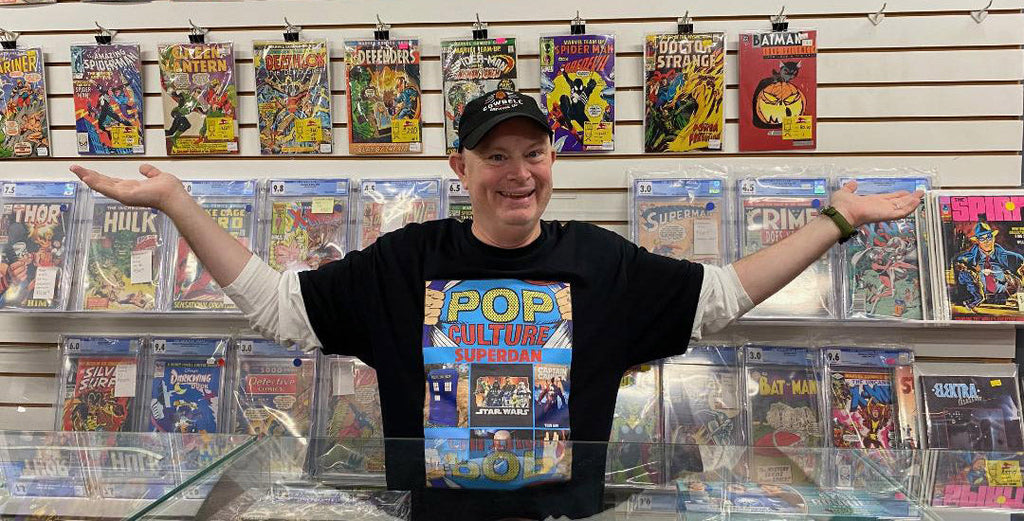
By Dan Brown I’ll be honest with you: I don’t know how the Trump tariffs are going to affect the price of comics, if at all. But if you’re looking for ways to put your comic-book dollars back into the local economy, be it Southwestern Ontario or Canada, here are a few ideas for how to do so. For starters, you can patronize local comics stores like L.A. Mood, which employs Londoners and supports the local pop-culture ecosystem by hosting events like Godzilla Day. The Forest City has always been blessed with more than its share of places where you can pick up your favourite comic titles, and the same goes for all of Southwestern Ontario. Here’s a fun road trip idea for when the warm weather arrives: Make it your goal to visit all the comic stores in this corner of Canada, which will mean travelling to such communities as Sarnia, Windsor, Chatham, Kitchener, and Guelph. I did so a few summers back and it was a blast! Along the same lines, when convention season starts back up, you don’t need to go all the way to San Diego (or even Toronto) to hang out with other comic enthusiasts.London has cons aplenty, including Forest City Comicon – which this year moves to a new date (November 2) and venue (the Lamplighter Inn). Other shows to keep in mind include the Chatham Kent Expo, which happens April 26 and 27. I realize bigger cons get bigger names. That doesn’t necessarily make for a better experience, though. For example, almost every DC or Marvel panel I’ve attended at Fan Expo in previous years can be summed up in one sentence: “Our company has such cool stories coming out soon, but if we told you the details it would spoil them.” The difference at a smaller event is the friendlier vibe, which is much warmer. There is no substitute for meeting comic fans or cosplayers in your own backyard! And what’s that, you say you also want to read local at this moment in our country’s history? It’s easy to make that happen by throwing your support behind specific creators and publishers. There are guys like Byron’s Derek Laufman, the graphic novelist responsible for Bot 9, RuinWorld, and Crimson Fall. Fans can buy his books and art directly from his website. Laufman also has a Patreon page, which offers exclusive first looks at the projects he is working on. Other Forest City creators to check out include Diana Tamblyn, A Jaye and Alison Williams, Scott MacDougall and D.S. Barrick (who publish under the banner of River Donkey Adventures), Sam Maggs, and don’t forget Bryan Lee O’Malley. Among the cartoonists with connections to the wider Southwestern Ontario scene are Jeff Lemire, Seth, Scott Chantler, and Joe Ollmann. Or perhaps you want to support Canadian publishing houses. Done. There’s always Drawn & Quarterly in Montreal, the East Coast’s Conundrum Press, and Chapterhouse Comics (the publisher of Captain Canuck). They all do compelling work. If you don’t like my ideas and you need more suggestions, just consult with the staff at your comic-store or the nearest librarian. When it comes to comics, and pop culture in general, our dominion punches way above its weight. So if you have any other suggestions of other creators to support, or different ways to keep your pop-culture dollars circulating close to home, I would love to hear all about them in the comment box below! Dan Brown has covered pop culture for more than 32 years as a journalist and also moderates L.A. Mood’s monthly graphic-novel group.
Movie Mentors Inspired Me
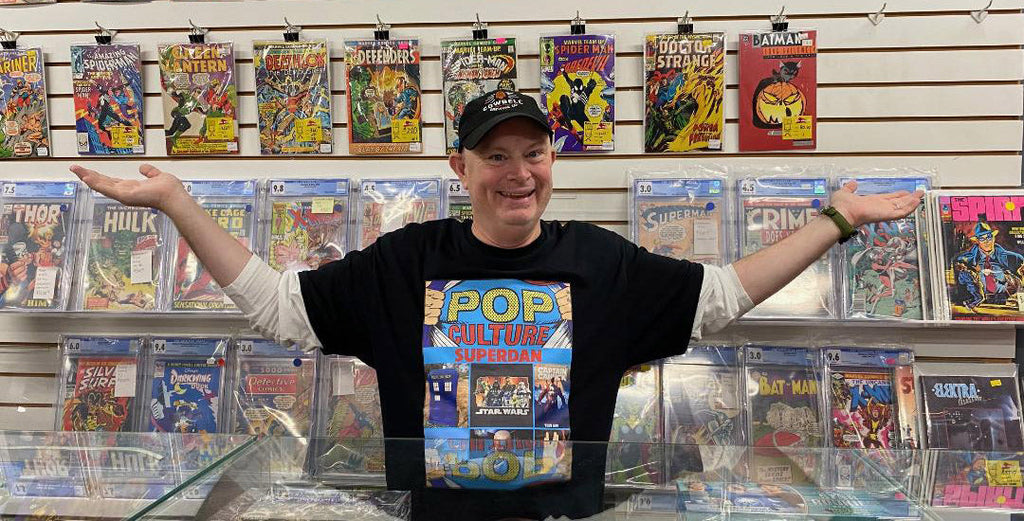
NOTE: Dan Brown’s column will now be appearing twice a week on the website of L.A. Mood Comics & Games; on Tuesdays, he’ll write about graphic novels, and on Thursdays he will cover other pop-culture topics.By Dan Brown It’s the movies that made me the mentor I am today. If it wasn’t for motion pictures like To Sir, With Love, The Empire Strikes Back, and Stand and Deliver, I’m not sure I would be one. It was the movie mentors – Sir, Yoda, Jaime Escalante – who showed me how I could inspire young people. Those characters also provided proof of how rewarding mentorship could be not just for the young person, but the mentor, too. Some background: In my day job, I work as the editorial-support manager for the Western Gazette, the student-owned and-run newspaper here in London. What does that mean, exactly? I like to think of it in these terms: Each new academic year, a recent grad serves as editor-in-chief. I, on the other hand, am the paper’s “mentor-in-chief.” (I could, and will, write a column another day about how I love the Gazette’s mentoring culture, every student gets in on helping newsroom newbies.) I’m also a journalism instructor at the same university, so have served as a mentor to students I meet through my classes. But my interest in mentoring started decades ago, long before I got my current position and long before I began teaching at Ontario universities. I was still a student in grade school. The original spark might very well have been when I watched Sidney Poitier’s To Sir, With Love for the first time, likely on afternoon TV in the 1970s one summer. It might have been Channel 10 or Global or even TVOntario that aired it. As you may recall, Poitier plays an engineer who can’t get a role in his own industry, so he turns to teaching as his Plan B, winding up tutoring a bunch of tough kids in 1966 East London. The unruly group of working-class teens initially gets the better of their teacher. In a fit of desperation he decides to throw out the curriculum so he can impose his own structure on the class, which allows him to school the motley crew about the facts of life they will need to survive. Gradually, they warm to his brand of tough love, and just as the students start to fall in love with him, he returns the affection. All that and a heartbreaker of a song by Lulu! It still brings tears to my eyes. Skip ahead a couple years. When The Empire Strikes Back comes out in 1980, George Lucas replaces acclaimed actor Alec Guinness (who played Ben Kenobi in the original Star Wars) with a green muppet as the new spokesman for the Force in Luke’s training scenes on the swamp planet Dagobah. To this day, I still ponder Yoda’s lessons. Is there really only a “do or do not” and no “try”? Isn’t that a tad harsh? When Yoda uttered the word “unlearn” it blew my mind. I knew what learning was, I was doing it at Valleyview Public School, but “unlearning” opened up all kinds of possibilities I had never thought about before. My favourite scene in all of Star Wars comes from that sequence, when Yoda describes the nature of the Force to a maturing Luke and tells him people are “luminous beings,” not just crude flesh and blood. Stirring stuff. As a teen, I would be riveted by Edwards James Olmos’s turn as real-life calculus teacher Jaime Escalante. His determination to help a class of young Latinos in L.A. reach their potential was inspiring. I marveled when he told them the Mayas invented the concept of zero, adding “You burros have math in your blood.” Olmos says he asks only one thing of his students: A desire to learn: “If you don’t have the ganas, I will give it to you because I’m an expert.” Math was never my thing. But I could see how he lit the fires in the eyes of his students.And there were others: Ben Kenobi himself, Joe Clark (as played by Morgan Freeman in Lean on Me), Robin Williams in Dead Poet’s Society (it was the book, not the movie, which introduced me to Miss Jean Brodie when I was a student at a British high school for a year). By the way, it wasn’t apparent to me until years after I became an instructor at Western that what I was doing was mentoring. One day, after helping a student from one of my classes, I got an email that said, “You’re a great mentor.” I had never thought of it in that way before. So that made it official. Dan Brown has covered pop culture for more than 32 years as a journalist and also moderates L.A. Mood’s monthly graphic-novel group.
Captain Canuck is the Right Hero, Right Now
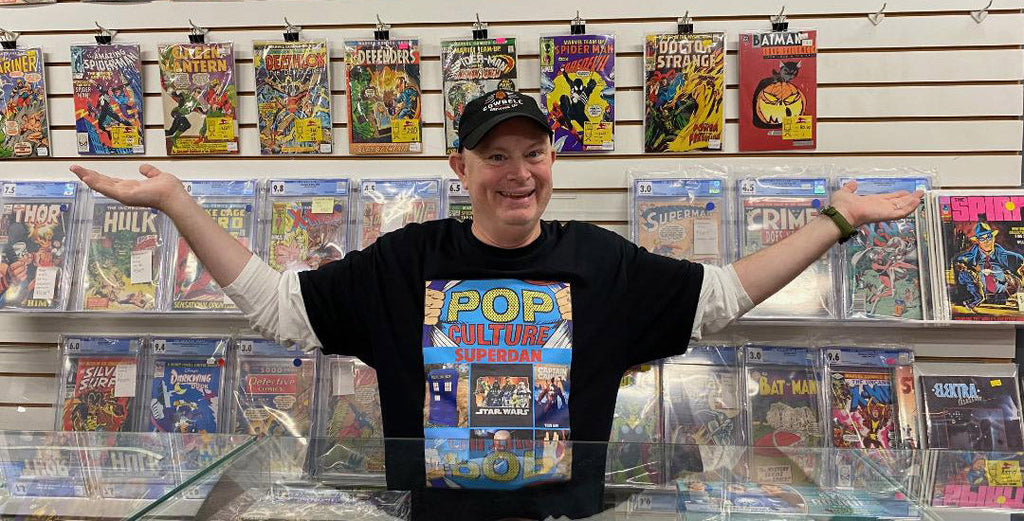
By Dan Brown This is my love letter to Captain Canuck, who in 2025 celebrates 50 years of battling aliens, evil businessmen, radiated monsters, neo-Nazis, and street-level crooks in the True North. First appearing in 1975, Canuck has had a sporadic publishing history in the decades since but that didn’t stop the superhero from making a deep impression on me, as well as an entire generation of young comic fans in Canada. I came on board when issue No. 4 showed up on the spinner rack in the variety store at Westown Plaza Mall (now Cherryhill Village) on Oxford Street. That would have been 1979. Captain Canuck co-creator Richard Comely, who still appears at fan gatherings (most recently Toronto Comicon last weekend), has said the red-and-white-costumed do-gooder filled a niche that Marvel and DC weren’t addressing back then. When I close my eyes and think about the Canuck of my childhood, what jumps out at me is . . . the colour. Captain Canuck popped off the page. It was the first comic I had found in which the skin of white characters wasn’t a flat pink; it was pink mottled with all kinds of purples and reds. And I wasn’t a kid who read comics for the colouring or quality paper. Yes, I was also a fan of Wolverine over in the pages of the Uncanny X-Men. But there was something about Canuck. Perhaps it was his modest powers – Tom Evans, struck by an alien ray, gains the strength of two, count ’em two, mortal men. Logan may have been an unstoppable killing machine, but Canuck was a real Canadian in that he was much more modest and realistic. I grasped that, even as a kid. Even the odd touches wormed their way into my imagination. When Canuck is imprisoned by the underlings of the dastardly Mr. Gold in that fourth issue, he does what any superhero would do: He prays to God for help. In the ensuing panels, he spots a loose brick in the cell he’s housed in, and targets it to gain back his freedom. I also loved the science-fiction look to the whole thing. Captain Canuck took place in the futuristic world of the 1990s, when Canada has fulfilled Wilfrid Laurier’s prediction that it would own the 20th century by becoming the most important country on the planet How important was Captain Canuck? So much so, his series was the only one I got a subscription to, that’s how much I loved the George Freeman-drawn action. I couldn’t chance missing even one issue. Smarter people than me have pointed out how Canuck seems to have a sense of occasion, with his 50th birthday coming at this particular moment in our nation’s history, when the U.S. president has been musing aloud about his wish for Canada to become part of the United States. Comely has seized on the revulsion many Canadians are feeling right now, offering a variant cover with Canuck telling Donald Trump firmly to back off – not by smashing him in the mouth, just forcefully squeezing his arm. Another cover on offer at Toronto on the weekend by Ty Templeton goes a step further, showing a reluctant Canuck giving a solid punch to Uncle Sam. “Please don’t make me fight you!!” he pleads as he lays out the star-spangled symbol of the American people. Since those early days, there have been several different versions of Canuck. The character got stranded in the past just as the series went on hiatus, leaving us diehards moping about the fate of our favourite homegrown hero for decades. But he came back, keeping the faith with his now grown-up fans who still remember the glory days. Captain Canuck had originally appeared in the Me Decade in the afterglow of Canada’s year-long centennial celebrations. The hardscrabble 1970s, a decade of disillusion, brought Canadians back to Earth. Canuck captured our hearts with his essential decency – even in the future time of 1993, Canadians were still the envy of the world, fighting for decency, using their influence to forward the cause of goodness. So maybe his 50th anniversary is coming at just the right moment in the history of our dominion. Perhaps everyone here and abroad needs a reminder of all the good things Canada has brought, and continues to bring, into this world. That’s why Captain Canuck is always the right hero at the right time. Dan Brown has covered pop culture for more than 32 years as a journalist and also moderates L.A. Mood’s monthly graphic-novel group.
The Time is Right for an SNL Network
NOTE: Dan Brown’s column will now be appearing twice a week on the website of L.A. Mood Comics & Games; on Tuesdays, he’ll write about graphic novels, and on Thursdays he will cover other pop-culture topics. The Time is Right for an SNL NetworkBy Dan Brown How much SNL is too much SNL? I know I can’t be the only one who was wondering that a few weeks ago. You may have noticed in February how, over the span of a few days, the U.S. network NBC pulled out all the stops to mark Saturday Night Live’s 50th season on the air. And I mean all the stops. The celebrations included:*A re-broadcast of the comedy show’s first episode from 1975.*A four-hour live anniversary special.*A three-hour concert special featuring former musical guests from SNL history*A three-hour documentary directed by Questlove on SNL’s musical impact*A four-part docu-series called Beyond Saturday Night focused on the show’s cast of comedy performers. The only thing missing was a documentary about all the comedy catchphrases the show has generated, from “You look mahvelous!” to “Isn’t that special?” to “Party on!” I kid. You would have to be an SNL fan of the highest order to make the time to watch all of that programming. I’m not, although I did make it through the re-airing of the inaugural episode, as well as the overlong anniversary broadcast. That’s enough SNL for me. Created by Canada’s own Lorne Michaels, who still serves as executive producer, SNL is as close as it comes to an institution on television – even if the truth is there have been more sketches that were misfires than hits over the last five decades. If SNL was a pro baseball player, it would have a handful of home runs yet a surprisingly low batting average. Legend has it Michaels was turned down by the CBC before he took his idea for a late-night variety show to New York all those years ago. NBC may have gone over the top last month because of the threat now posed by streaming services like Netflix to its bottom line. The hours and hours of content NBC commissioned will also be used to draw eyeballs to Peacock, its own streamer. But instead of feeding the streaming beast, why not just create an old-fashioned specialty network out of all that old content? Yes, I know SNL has a YouTube channel, but it’s mostly there to generate viral videos from current episodes. And I realize I’m not a very subtle thinker, but hear me out. Think of it: The SNL Channel. There are 50 years of programming to draw monologues, comedy sketches and musical interludes from. That’s more than 900 episodes, with each running 90 minutes. There’s 24 hours a day of programming right there. Nor does it take much brain power to imagine how they could supplement all those episodes with other comedic content. For starters, an SNL Channel could also run movies starring characters that were invented on Saturday Night Live. That’s everything from the Blues Brothers to the Wayne’s World movies to Coneheads. You could bolster those with other movies starring SNL cast members playing non-SNL characters – for example, Dan Aykroyd alum did a memorable turn in Driving Miss Daisy that was nominated for an Academy Award.. Or extend the concept to all the other projects Lorne Michaels has also served as executive producer on, which opens up episodes of shows like Kids in the Hall and Late Night With Conan O’Brien. The new network could likewise feature movies starring famous hosts, like 16-timer Steve Martin and 10-time host Tom Hanks. Heck, you could also include last year’s Saturday Night, the Jason Reitman comedy/drama about how the first episode was put together. And that’s not even taking into account new programming that could feature former SNL cast members. There’s enough comedic infrastructure that’s been built up around SNL over the last 50 years to support new productions, and I’m sure there are folks like Kate MacKinnon, Kyle Mooney and Vanessa Bayer who would have ideas for interesting shows. Admit it: This isn’t the worst pitch for a new channel you’ve ever heard! Dan Brown has covered pop culture for more than 32 years as a journalist and also moderates L.A. Mood’s monthly graphic-novel group.
GNG Discusses the Morality of Beneath the Trees Where Nobody Sees
By Dan Brown SPOILER WARNING: This column contains plot details about Patrick Horvath’s Beneath the Trees Where Nobody Sees, so if you value surprise, stop reading now. Here’s the rundown on the latest meeting of the L.A. Mood Graphic-Novel Group, which took place on Saturday, March 8. The book: Patrick Horvath’s Beneath the Trees Where Nobody Sees, which publishing house IDW describes as Dexter meets Richard Scarry’s Busy, Busy Town. It’s set in Woodbrook, a community of anthropomorphic animals who do all the things humans do, including serial killing. The main character is Sam, a bear who runs a hardware store and is hiding a dark secret about what she does on visits to a nearby big city. Her double life is threatened when one of Woodbrook’s residents meets a grisly end. The discussion: Most members of the group liked the book, although some had reservations about its morality. I was heartened that Beneath the Trees does not portray Sam as a genius because I’m sick of the “charming serial killer with a high IQ” trope that happens in so much pop culture when the reality is many of them are of average intelligence. Hannibal Lecter is not your typical serial slayer, yet that idea is pervasive. Some of the members of GNG were unsettled with the juxtaposition of cute animals doing human things while also being savage to their fellow creatures. This is definitely not a story for kids! The cuddly animals are tool users, with some of those tools being instruments of bloody death. One of the main points of our discussion was how Horvath has animal characters who are like humans, but additional animal characters who are animalistic animals. For example, near the climax of the story Sam, who walks on two legs and wears clothes, meets two “wild” bears in a forest who are fighting over a deer. She attempts to communicate with one of them. Is Horvath saying human beings are nothing more than animals? Is he saying some people Mccan use their reasoning faculty, but not others? We pondered those questions.In another part of the graphic novel, a pig character peers into a butcher-shop window, where a pig’s head is displayed. On a subway, an upright dog holds another dog on all fours on a leash Horvath inserts these images but leaves the reader to interpret their meaning.We also discussed the degree to which order, or rules, can be placed on savagery. The wartime treaty the Geneva Convention came up – is there a point to putting a moral structure on war, when the whole goal is to impose cruelty on the enemy until they submit? One thing we didn’t spend much time on was the difference between the rural and urban settings in Beneath the Trees. The ending of Beneath the Trees is also challenging because the reader sees that order is restored to Woodbrook. But is that a good thing? Is it really a storybook “happy ending,” or does the conclusion promote a nihilistic view of morality? We agreed the book was a good pick for GNG. Further reading; If you’re interested in reading a graphic novel about a real serial killer, GNG covered the Jeff Jensen and Jonathan Case book Green River Killer: A True Detective Story a number of years ago. It’s about Gary Ridgway, a man of average IQ who has the most confirmed murders of any real-life serial killer. L.A. Mood’s Graphic-Novel Group meets the second Saturday of each month. Next month’s book is the graphic-novel adaptation of Cormac McCarthy’s post-apocalyptic novel The Road, with illustrations by Manu Larcenet. We’ll be meeting April 12 at the gaming tables in the store at 11 a.m. At 11:30 a.m., Byron graphic novelist Derek Laufman will be coming for a visit to talk about his new project, Crimson Fall. All are welcome to join the discussion! Dan Brown has covered pop culture for more than 32 years as a journalist and also moderates L.A. Mood’s monthly graphic-novel group.
Gene Hackman’s Lex Luthor Makes Me Despair for the New Fantastic Four Movie
My purpose here isn’t to praise Gene Hackman’s acting skills, which were superlative, it’s to explain why his turn as Superman’s nemesis makes me itchy about the upcoming Fantastic Four movie. You likely heard Hackman had died. Since the news broke last week that his body had been discovered, there has been much discussion online about his greatest performance. Some argue he was at his peak in Hoosiers. Others say his most impressive turn came in The French Connection or Unforgiven or The Royal Tenenbaums. There’s so much to choose from. But for comic fans of a certain vintage, Gene Hackman will always be Lex Luthor.Starting in 1978, he played the crafty villain in three of the Superman movies that featured Christopher Reeves in the title role. Hackman brought a special blend of arrogance and charm to his version of the criminal mastermind, chewing scenery in a way that communicated to us young nerds that he was having a ton of fun inhabiting the bald bad guy. Wait, I just told you a lie. Yes, Lex Luthor is bald. But not when Hackman played him. And even though I wasn’t the biggest DC fan in the world, I understood enough of the Superman mythos to know that in the comics, Luthor had no hair. Heck, in some continuities Lex hates Supes because he blames the Kryptonian immigrant for his lack of locks. Hackman may have been an Oscar-calibre actor, but 10-year-old me just could not get past the hair. For whatever reason – perhaps the Superman producers wouldn’t pay him enough to shave his entire head – Hackman kept his own hair in those films. My educated guess is he didn’t want to go hairless, and since he was a big star his wishes were accommodated. What does this have to do with The Fantastic Four: First Steps, which is slated to land in theatres on July 25? Well, Hackman isn’t the only one with the requisite star power to avoid the barber’s blade. You can draw a line directly from Hackman to Pedro Pascal, who plays Mister Fantastic in the FF film. In the trailers and publicity photos we’ve seen so far, Pascal appears with his moustache intact. I fear the folks at Marvel Studios are humouring the Chilean-born actor by not demanding he shave. Granted, it’s a great moustache. For Pascal the celebrity. Not for Reed Richards the cerebral hero. As any fan of the Fantastic Four comics know, the FF leader is clean-shaven – with flecks of grey in the hair above his ears. That’s been his look, more or less, since the Marvel Age was launched with the publication of Fantastic Four No. 1 in 1961. It’s true in a handful of stories Reed is pictured with a beard. He has never, however, been one to rock a 1970s-style stache, no matter which artist is drawing him. Reed is a serious guy, not given to vanity, which is why in all the big-screen adaptations to date, he is free of facial hair. So you can see the problem: Hackman set a precedent that Pascal is following, and it’s got me worried I won’t be able to see past the whiskers when July rolls around. I agree bringing Pascal into the Marvel fold was a good idea. And who knows, there’s so much we don’t know about the FF movie. Maybe the stache disappears at some point in the film. Or perhaps this is a Sonic the Hedgehog situation and the production team will remove the facial hair using CGI before First Steps is released because fans like me are upset. If the producers want a really cool way to get rid of it, have Reed’s brother-in-law, the Human Torch, laser off the moustache the same way he gave the Submariner a shave and haircut way back in Fantastic Four No. 4. Or have Galactus blast it off. Or maybe it comes off when the FF joins the main Marvel Cinematic Universe, as is rumoured. There’s no question both Gene Hackman and Pedro Pascal ooze charm on the big screen. But just as I could not accept a Lex Luthor with a full head of hair back then, I won’t accept a Mister Fantastic with a bushy moustache this summer. No matter how much the Marvel brain trust needs for the FF movie to be a winner at the box office. Dan Brown has covered pop culture for more than 32 years as a journalist and also moderates L.A. Mood’s monthly graphic-novel group.