
What’s with All the Facsimile Editions?
By Dan Brown Comic reprints have been around a long time – in fact, if I recall my industry history correctly, the first comic books were stapled editions of reprinted newspaper funnies. What’s relatively new are facsimile comic editions. They’ve been around a few years and in their current form they reproduce historically significant issues – like, say, the first appearance of the Punisher in Marvel’s Amazing Spider-Man No. 129 – on glossy paper. The other difference is the context. Unlike anthologies of collected issues, facsimiles editions also reproduce the front and back covers, ads, letter columns, and other bumpf that accompanied the original story. I guess the selling point would be, if you want to experience a particular comic as it appeared in, for example, 1974, then this is the closest you’re going to get to it. I'm all for them, just so long as they don’t alter or “correct” any of the content as it appeared originally. I was heartened to see, for instance, that a facsimile of Marvel’s Star Wars No. 1, which came out ahead of the movie’s release in 1977, faithfully reproduces the odd colour scheme of the comic as it was. So the front depicts Princess Leia as a redhead and Darth Vader’s armour as green. Just like the original weird cover. There would have been no outcry at the time because moviegoers didn’t know any better, with the film’s theatrical debut months off. The adaptation, like the unseen motion picture, was called simply Star Wars, not Episode IV or A New Hope or anything else George Lucas dreamed up after the saga took off. I’m sure the collector market has a lot to do with the proliferation of facsimiles. It’s impossible for most comic fans to buy a copy of Fantastic Four No. 1, for instance, so this is a cheap way to see what the fuss was all about. I own many anthologies and collections, and I will concede they lack something – the ads in comics, especially, were a big part of the reading experience when I first became a fan in the 1970s. Where else can you see ads for weight-GAIN formulas? “Too skinny?” one spot blares in AMS No. 129. In another notice. Charles Atlas promises to make any weakling into a man, and such novelties as X-ray glasses, joy buzzers and stink loads for smokes (“guaranteed to stop cigarette moochers”) were on offer. The colourful adverts of that era also urged readers to take up fishing, eat Slim Jims and snack on Hostess Twinkies. The 1970s being an age of self-improvement when everyone was scrounging for a buck, you could train by mail to be a cartoonist, veterinary assistant, hypnotist or karate master. And if you did respond to any of the offers, “No salesman will call.” Naturally. Likewise, the letters page was a big part of what made comics special. At a time when there was no global instant-communications device, seeing what other fans had to say gave me new ways of thinking about my favourite heroes. Back then, the letters column was the hub that joined individual readers to the larger Marvel or DC fan community, confirming for me that other kids were moved by the same characters and plots. Perhaps the appropriate way to describe facsimile issues is that they are the equivalent of watching YouTube videos of old TV shows with the commercials included. The only misleading bit is the paper itself. Facsimile editions are printed on glossy stock and the borders surrounding the panels on each page are a blinding white. Even with freshly printed comics back in the day, the newsprint was one splotchy shade of brown or another, and aged rapidly. These things were not built to last. So enthusiasts in 2025 will miss one out on one very important comic experience from the past: Inhaling the sweet, musty scent that comics made with cheap paper give off as they decay over the years. It may be my favourite smell. If I could bottle it, I would. Dan Brown has covered pop culture for more than 32 years as a journalist and also moderates L.A. Mood’s monthly graphic-novel group.
Pop Culture Like Star Trek Used to be Disposable Fluff
By Dan Brown When I say “Star Trek,” I mean the old TV show that featured William Shatner as Captain Kirk and Leonard Nimoy as Mister Spock. I don’t mean the Next Generation or Voyager or Upper Decks or Strange New Worlds or anything else. And if you’ve seen a Star Trek rerun in the last few years, you’ll have noticed the special effects stand up remarkably well. Although it was made on a shoestring budget in the late 1960s for an audience that had low expectations of science-fiction television, those shots of the Enterprise look crisp. But here’s the thing: Those aren’t the original effects. When you see the Enterprise floating in space, fighting a battle, or high above a planet’s surface, those images were inserted into the original episodes in a remastering process that dates back only to 2006. So the Trekkies who fell in love with the series in the 1960s did so without the attraction of modern special effects. My purpose here isn’t to argue which version is better. Nor is it to speculate if Star Trek creator Gene Roddenberry would have approved of the new effects (he died in 1991). What I want to point out is how the revised Star Trek episodes represent a new attitude toward pop culture. What would surprise Roddenberry if he were alive is how long-lived his show has been. When the program originally aired from 1966 to 1969, TV didn’t have a great reputation. The medium was derided as “the boob tube” because the dominant perception was that the small screen appealed to those who weren’t all that bright. Consequently, Star Trek – which many consider classic stuff today – was just as disposable as any other show on the air at the time. In other words, despite embodying enduring social and political themes, individual episodes weren’t built to last. It didn’t matter back then if the show would hold up to repeated viewings, and I’m guessing the idea people would still be watching Star Trek in the year 2025 would have startled network executives. Nor is Star Trek the only example of pop culture that was created as ephemera that has far outlasted its creator’s intentions. Star Wars (by which I mean the movie with that title that came out in 1977) was made at a moment when few moviegoers were willing to pay to see a particular film multiple times. After all, a child’s ticket went for a whopping $1.50! Who could afford that in the hardscrabble Seventies, no matter how much you loved a film? As you likely know, several new coats of digital paint have been applied to Star Wars in the interim. There were versions with enhanced sound effects, then versions with enhanced visual effects, and on and on. They may have even released a 3D Star Wars for all I know. It doesn’t stop there. There are also updated editions – with outtakes put back in – of novels like George Orwell’s Nineteen Eighty-Four and Stephe King’s ’Salem’s Lot. Albums such as Bob Marley’s Legend have likewise been retouched. The important thing to note here is our feelings about pop culture like the original Star Trek series have changed: What was once a throwaway indulgence meant only for a moment’s pleasure is now taken seriously, even expected to transcend its time. Heck, there are even such journalists as Rob Salkowitz who specialize in writing about pop culture! That didn’t used to happen. Expectations have risen dramatically. You could even argue it’s pop culture like Star Trek and Star Wars that is partly responsible for creating an audience that wants more out of its TV, movies, music and so on, than a momentary distraction. Me, I prefer the “original” versions of things that were released back in the day. To my eyes, the first Star Wars motion picture had a certain low-budget charm so I didn’t need a new, “better” one. But I’m glad it’s still around, even in a modified form, to light the fire of imagination in the minds of a new generation of pop-culture enthusiasts who have higher expectations than I ever did. Dan Brown has covered pop culture for more than 32 years as a journalist and also moderates L.A. Mood’s monthly graphic-novel group.
Pop Culture Like Star Trek Used to be Disposable Fluff
By Dan Brown When I say “Star Trek,” I mean the old TV show that featured William Shatner as Captain Kirk and Leonard Nimoy as Mister Spock. I don’t mean the Next Generation or Voyager or Upper Decks or Strange New Worlds or anything else. And if you’ve seen a Star Trek rerun in the last few years, you’ll have noticed the special effects stand up remarkably well. Although it was made on a shoestring budget in the late 1960s for an audience that had low expectations of science-fiction television, those shots of the Enterprise look crisp. But here’s the thing: Those aren’t the original effects. When you see the Enterprise floating in space, fighting a battle, or high above a planet’s surface, those images were inserted into the original episodes in a remastering process that dates back only to 2006. So the Trekkies who fell in love with the series in the 1960s did so without the attraction of modern special effects. My purpose here isn’t to argue which version is better. Nor is it to speculate if Star Trek creator Gene Roddenberry would have approved of the new effects (he died in 1991). What I want to point out is how the revised Star Trek episodes represent a new attitude toward pop culture. What would surprise Roddenberry if he were alive is how long-lived his show has been. When the program originally aired from 1966 to 1969, TV didn’t have a great reputation. The medium was derided as “the boob tube” because the dominant perception was that the small screen appealed to those who weren’t all that bright. Consequently, Star Trek – which many consider classic stuff today – was just as disposable as any other show on the air at the time. In other words, despite embodying enduring social and political themes, individual episodes weren’t built to last. It didn’t matter back then if the show would hold up to repeated viewings, and I’m guessing the idea people would still be watching Star Trek in the year 2025 would have startled network executives. Nor is Star Trek the only example of pop culture that was created as ephemera that has far outlasted its creator’s intentions. Star Wars (by which I mean the movie with that title that came out in 1977) was made at a moment when few moviegoers were willing to pay to see a particular film multiple times. After all, a child’s ticket went for a whopping $1.50! Who could afford that in the hardscrabble Seventies, no matter how much you loved a film? As you likely know, several new coats of digital paint have been applied to Star Wars in the interim. There were versions with enhanced sound effects, then versions with enhanced visual effects, and on and on. They may have even released a 3D Star Wars for all I know. It doesn’t stop there. There are also updated editions – with outtakes put back in – of novels like George Orwell’s Nineteen Eighty-Four and Stephe King’s ’Salem’s Lot. Albums such as Bob Marley’s Legend have likewise been retouched. The important thing to note here is our feelings about pop culture like the original Star Trek series have changed: What was once a throwaway indulgence meant only for a moment’s pleasure is now taken seriously, even expected to transcend its time. Heck, there are even such journalists as Rob Salkowitz who specialize in writing about pop culture! That didn’t used to happen. Expectations have risen dramatically. You could even argue it’s pop culture like Star Trek and Star Wars that is partly responsible for creating an audience that wants more out of its TV, movies, music and so on, than a momentary distraction. Me, I prefer the “original” versions of things that were released back in the day. To my eyes, the first Star Wars motion picture had a certain low-budget charm so I didn’t need a new, “better” one. But I’m glad it’s still around, even in a modified form, to light the fire of imagination in the minds of a new generation of pop-culture enthusiasts who have higher expectations than I ever did. Dan Brown has covered pop culture for more than 32 years as a journalist and also moderates L.A. Mood’s monthly graphic-novel group.
Here’s a Bunch of Mini-Reviews
By Dan Brown Here’s the lowdown on a stack of comics I bought recently. There’s no logic to the choices, other than each cover struck my fancy while I was browsing the new-releases wall at L.A. Mood. Fantastic Four No. 29: Perhaps I have a case here to sue Marvel for bait-and-switch. I picked this one based on the cover, which promises an out-of-continuity tale answering the question, “What if . . . Mickey & friends became the Fantastic Four?” I was intrigued by the idea of Goofy switching places with the ever-loving Thing. As it turns out, it was a variant cover. Instead, I got a Ryan North/Cory Smith joint titled The Dream Team about Doctor Doom taking over . . . everything. This looks to be Marvel’s event series this summer, One World Under Doom, and I applaud the House of Ideas for taking this one on, if only because they are going to get so much blowback from Trump fans claiming it’s a metaphor for the current situation in the U.S. The FF goes to bat for the downtrodden . . . who in this case are vampires left over from the previous event series. Doctor Doom & Rocket Raccoon No. 1: I love the movie Rocket more than the comic Rocket, so in my mind I read his dialogue in Bradley Cooper’s voice. I haven’t read a J. Michael Straczynski-penned story in a long time, and this one is long on philosophy, short on action. Doom partners with the genetically engineered rodent to help him delve into the origins of . . . everything. Essentially, the Latverian ruler wants to travel back in time to a time before time. That is, before the Big Bang. I give Doom props for recognizing that a lowly raccoon is almost his mental equal. And one page features a Jack Kirby-esque collage, which is a bonus. What do they discover in preshistory? “The purpose of the universe is to understand the purpose of the universe.” It’s one of them paradoxes. Godzilla vs. Fantastic Four No. 1: This is easily the best-illustrated issue among my purchases, featuring John Romita Jr. art based on a Ryan North script. Marvel takes the existing Marvel continuity and fuses it with the Toho storyline, as happened with the original Marvel series about the fire-breathing unfrozen dinosaur. Reed even tips his hat to Dr. Daisuke Serizawa’s oxygen destroyer in the opening panels. One cool concept in this issue sees Godzilla foe King Ghidorah taking on the power cosmic in his role of herald of Galactus. And yes, it’s all leading up to an eventual battle between the Tokyo-demolisher and the world-devourer. Godzilla Heist No. 1: If you’re a fan of Godzila, this is truly an awesome time to be alive because you can read about him in more than one company’s comics. This IDW-published series reads sort of like what would happen if Quentin Tarantino directed a kaiju flick. As powerful as Godzilla is, here his rampages are just a massive distraction for a ring of human thieves who, naturally, don’t know which one of them might betray the others.The story begins with the big G destroying a casino, which is certainly one way to make sure the authorities don’t pay attention to your scheme to plunder their treasures. Godzilla vs. Chicago One Shot: As part of the Godzilla vs. America series, local creators get a stab at fitting Godzilla into their own community’s neighbourhoods, politics, and culture. Also part of IDW’s current offerings, it’s really just an excuse to pay tribute to old-school comic sound effects such as:Dong donk!Zang!Zong!Choom!Fwomp! Fwooosh! Shreeonk!What can I say? I know what I like. Daring the Sun No. 2 by Forest City creator Scott Brian Woods: Called Crash Down, this tale of an astronaut traveling through the heart of a sun is “inspired by imagination comics of the past, science fiction, and a deep love of old-school adventure, sci-fi fantasy space operas.” The Kirby Crackle on the opening splash page jumped out at me, and the drawing on the back cover shows the pilot in a Flash Gordon-esque outfit with an old-school raygun. Somehow, he is connected to a warrior named Vala, who fends off dinosaur-like aliens in a barren landscape. If you like classic George Lucas intercutting, you will love the structure of this piece, ending naturally with a cliffhanger. Moon Girl and Devil Dinosaur 10th Anniversary Special No. 1: I don’t know how, exactly, Lunell Lafayette got a hold of the ultimate nullifier, but it’s one of the items she brings to her surprise 10th birthday party in New York. A back-of-the-book story flashes forward to when Moon Girl has grown into Moon Woman, and she visits Earth from the orbiting satellite. Senior Marvel Editor Mark Paniciccia says the series has lasted a decade because “it’s inspired young readers to embrace their individuality and believe in their potential.” Or maybe they just really like to groove on the blood-red T-Rex who is Moon Girl’s constant companion. What comics or graphic novels have you been reading lately? I’d love to hear about it in the comment box below! Dan Brown has covered pop culture for more than 32 years as a journalist and also moderates L.A. Mood’s monthly graphic-novel group.
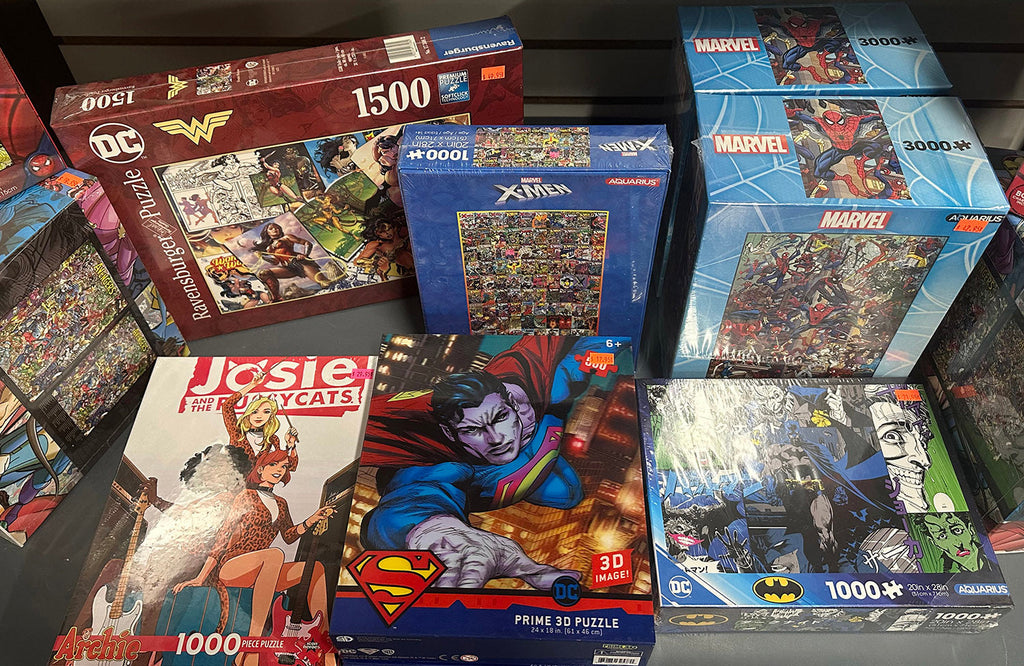
Puzzle Sale
Save 40% Offon All Jigsaw PuzzlesIn Store or Online! (April 25 - May 4) Save on modern comic, Harry Potter, and Star Wars puzzles, to classic scenic Cobble Hills puzzles. Are you still puzzled? Come in the store or order online to save. Set your calendar and be prepared to take advantage of this sale.
Live from London, it’s Saturday Night, mate!
By Dan Brown Although he mostly stays out of the spotlight, there’s one thing we know for sure about Saturday Night Live executive producer Lorne Michaels: He loves to put his name on other TV shows and movies. How else to explain the news last week that Michaels will be the executive producer for a British version of the sketch-comedy program starting next year? Even in our modern global communications environment, it’s going to be hard for Michaels to, you know, actually produce a TV show while living on another continent. Maybe the Canadian funnyman plans to jet over there to launch SNL UK in person. In the past, though, he has never strayed far from the NBC studio at 30 Rockefeller Plaza where the program he founded in 1975 is still broadcast weekly. Despite all of the side projects, including movie adaptations like Coneheads, It’s Pat and MacGruber, SNL is his baby and he’s protective of it. You would be, too, after 50 years on the air. Which doesn’t stop him from attaching his name to everything from last year’s Mean Girls reboot to a Nate Bargatze comedy special to the cult classic series Portlandia. In 1993, Michaels famously did Conan O’Brien a solid when the ginger comedy writer took over Late Night, loaning his on-screen credit to the incipient talk show to help give the untested O’Brien an extra push. Was Michaels actually involved on a nightly basis? Not really, but even back then he was a draw all on his own. Despite the majority of SNL sketches failing over the years, Michaels is viewed today as having as close as it comes in the entertainment industry to a golden touch. We Canadians remember how he was involved . . . somehow . . . when Kids in the Hall broke through around the same time as Conan’s show. But the question in front of us is: Does Michaels have enough influence to make a British-based SNL a hit? According to the Associated Press, the new show is being made in association with Sky Studios, and will feature an all-British cast using the same format – celebrity host, musical guest, parody news segment. It looks like it will be broadcast from London. Unseen by me, French, Japanese, and Italian iterations of SNL have failed quickly – strangely, a Korean version of SNL is still going strong. Longtime TV watchers will note that historically, it’s British shows that get remade for the American viewing public, not the other way around. It’s also worth noting that when the American version of SNL pokes fun at, say, the British Royal Family, those jokes fall flat – unless you happen to be a British subject living here in the colonies. Yanks just don’t know enough about British culture, as Canadians do, to appreciate the humour in those comedic jabs. Perhaps the Saturday Night Live brand, as opposed to Michaels’ own personal pedigree, has enough resonance abroad to ensure the spinoff stays on the air, once launched. Viewers across the pond have wide-ranging tastes – they are the ones who made shows like Spitting Image, Monty Python’s Flying Circus, the Young Ones, and The Office cultural touchstones. Surely American politics will be a staple every week, but do Brits really want one of their own mocking Donald Trump? I’ve seen the This Hour Has 22 Minutes Trump parodies, and they are not as funny as those that come live from New York every weekend. If it does come and go like the other foreign SNL versions, you can rest assured Michaels will not suffer. There have been rumbles about him retiring (I can’t see it happening), but the safe money is riding on many more years or even decades of Michaels slapping his imprimatur on TV shows, comedy specials and movies. A few of them may even be worth watching. Dan Brown has covered pop culture for more than 32 years as a journalist and also moderates L.A. Mood’s monthly graphic-novel group.