GNG Assembles to Talk Mister X
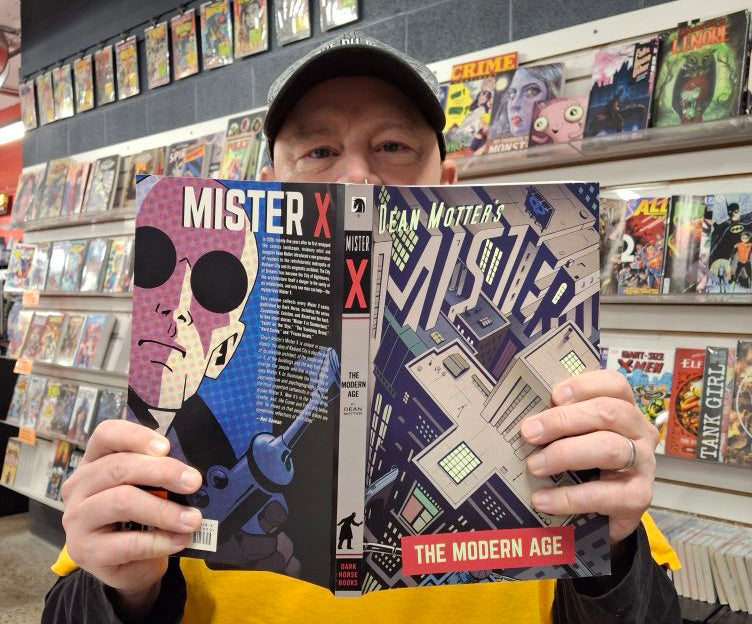
By Dan Brown SPOILER WARNING: This column contains plot details from Dean Motter’s Mister X: The Modern Age, so stop reading right now if you value surprise! Here’s the lowdown on the most recent meeting of the L.A. Mood Graphic-Novel Group, which was held Saturday, June 14. The book: Dean Motter’s Mister X: The Modern Age, which collects all of the Mister X stories published by Dark Horse Comics. The discussion: The full range of opinions was represented around the table. There were people, like me, who love the book. There were others who felt meh – who didn’t give the book a thumb up or down, but a sideways thumb. And there were some who didn’t even feel motivated enough to finish reading the 360-page tome. Gord Mood, L.A. Mood’s co-owner, argued for including Mister X on the 2025 reading list at our January pitch meeting. He is among those who love it. Gord also brought some examples of Motter’s early work from Media 5 when he was a student at Fanshawe College. (Late Town Crier Bill Paul published that sci-fi fan publication.) I knew very little about the character beforehand. Knowing it had been praised for blending film noir, Art Deco and German Expressionism, I was expecting something ponderous and pretentious. Wrong! In my view, it’s an amazing graphic novel. DC can only wish that Batman were as cool as Mister X! It takes place in Radiant City, where it always seems to be 4 a.m. Its nickname is Somnopolis, because of the large number of residents who can’t sleep. The title character is possibly one of the original architects who founded Radiant City, it’s never made clear. The closest he gets to revealing his identity is when he states, “I want to fix my city. I want it to run as designed.” The problem? The city’s architecture is driving its residents insane. None of this, of course, is meant to be taken literally – which Gord’s business partner Carol Vandenberg touched on when she mentioned the humour of the book. The key, for me, was to not take anything in the book at face value. I appreciated how Mister X is a riot of invention. Some members of the group pointed out the many references in the story. For example, one robot who shows up is an homage to Gort from The Day The Earth Stood Still. 1984 is referenced, as well as CanCon icon Nash the Slash. The characters have the clipped speech of detectives in films from the 1940s: “You’re the man without a name,” an interrogator tells Mister X. “That’s what I’m called,” the mystery man replies. Even better, Motter adds his own creative touches, elevating The Modern Age to a level above a mashup. Mister X is an insomnalin addict, meaning if he doesn’t feed his habit, and falls asleep, he will automatically die. There are insomnatoriums on each block. Zombycillin is a drug that can bring the dead to life. Pscychetecture describes the style of buildings in Radiant City and how they torture the human mind. Further reading: Instead of reading, I would say watch Blade Runner or episodes from Batman: The Animated Series, as well as Tim Burton’s 1989 Batman movie. L.A. Mood’s Graphic-Novel Group meets the second Saturday of each month. Next month’s selection is Roaming, by cousin creators Jilliam and Mariko Tamaki. We continue our streak of Canadian books established in recent months! We’ll reconvene July 12 at the gaming tables in the store at 11 a.m. All are invited to come join the discussion! Dan Brown has covered pop culture for more than 32 years as a journalist and also moderates L.A. Mood’s monthly graphic-novel group.
Boyd’s New Graphic Memoir is so Groovy
By Dan Brown. If you’re a child of the 1970s, you’re going to love D. Boyd’s Denniveniquity. This new graphic memoir covers the years 1977 to 1980 in the comic creator’s life growing up in Saint John. Boyd, now a Montrealer, captures the Me Decade better than any other artist, on par with filmmaker Richard Linklater – the guy who directed Dazed and Confused. The book begins when button-nosed Dawn is in Grade 7. She has a crush on movie star Gene Wilder and has seen Star Wars three times. Her favourite band is Trooper. Boys like to grab her developing breasts – “WONKA WONKA!!” one yells as he assaults her in the school hallway. Her mother is relentlessly negative. “You’re too young to look so matronly,” she chides. “Boys are only going to want one thing from you.” The book follows Dawn as she navigates each new grade. There are moments of glee, as when classmate Robbie Allen calls her on the phone at home. And moments of frustration: “Isn’t there anything I’m good at?” she wonders after failing to master downhill skiing. Denniveniquity rewards close reading. Each panel is carefully crafted to reinforce the feel of the era in which Dawn grows up. If, like me, the first full decade you lived through was the 1970s, this book is going to be a thrill. Boyd packs each panel with detail. There’s an April Wine T-shirt. A scene at a Trooper concert (there’s also a discussion of the proper way to pronounce lead singer Ra McGuire’s first name). Keen-eyed readers will also spot a reference to Meco’s galactic funk on the back of a newspaper page. Farrah Fawcett-Majors gets a mention, as do TV shows like Soap and Grizzly Adams, and the Hamilton band Teenage Head. It was the decade of faux wood panelling on station wagons, Participaction, KMart, Joe Clark, Jimmy Carter, the Amityville Horror, and Fotonovels. In one explosive splash panel, as the New Year’s countdown approaches and 1980 beckons, Dawn sees the pop culture of her childhood flash before her eyes. “Wow, the ’70s are over,” she marvels. “That was most of my childhood.” And, of course, Dawn gets drunk for the first time by invading her parents’ liquor cabinet in the basement bar. Nor can her young mind understand the unwritten rules of friendship and dating. “Whatever I like about him seems to be the same thing I hate about him,” she says of her on-again, off-again boyfriend Nick. But more than getting the specifics of the 1970s in Canada right, Denniveniquity nails the sensation of how time passes for a young person. Boyd pulls this off by omitting clunky transitions, just as the developing brain does. She glides effortlessly from one scene to the next, and the reader never feels something is missing. It all makes sense. The only other comic creator who was able to do the same as masterfully is Gilbert Hernandez with his childhood recollections in Marble Season. Denniveniquity covers some of the same ground as Boyd’s 2019 book Chicken Rising, but don’t let that deter you. It is also published by the East Coast’s Conundrum Press. I give it my highest recommendation. This book belongs in the same conversation as Jillian and Mariko Tamaki’s This One Summer, Michel Rabagliati’s Paul Moves Out, and Seth’s ongoing Nothing Lasts in Palookaville. With Jeff Lemire’s new autobiography looming in July, this is shaping up to be a landmark year for graphic memoirs by Canadian comic creators! Dan Brown has covered pop culture for more than 32 years as a journalist and also moderates L.A. Mood’s monthly graphic-novel group.
GNG Meets to Talk About Toronto Coming-of-age Memoir
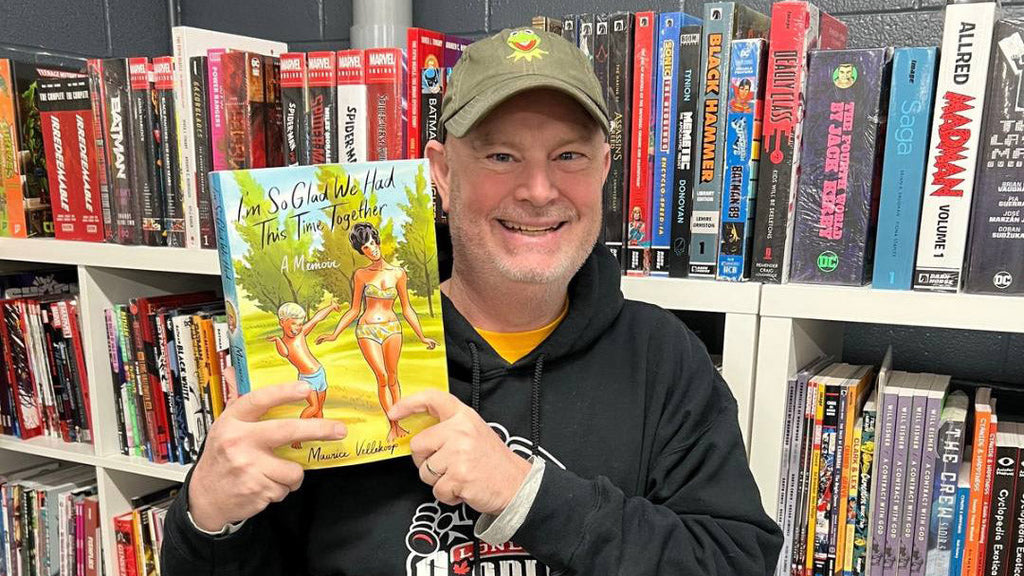
By Dan Brown SPOILER WARNING: This column contains plot details from Maurice Vellekoop’s I’m So Glad We Had This Time Together, so if you value surprise, stop reading now! Here’s the rundown on the most recent meeting of the L.A. Mood Graphic-Novel Group, which took place Saturday, May 10. The book: I’m So Glad We Had This Time Together by Toronto graphic artist Maurice Vellekoop. The discussion: The book we all read falls squarely into the Canadian school of graphic memoirs – for some reason, homegrown creators are really good at telling their own origin stories. In fact, they are the best in the world. In this particular case, Vellekoop puts the focus on his own upbringing as the son of religious Dutch immigrants who settled in Toronto. L.A. Mood Comics & Games co-owner Carol Vandenberg pitched the book in January for our 2025 reading list as she, too, is the child of a Dutch immigrant family. Carol said she recognized a bit of her experience in the book’s details, like Vellekoop’s mother making clothes for her children and his childhood home being decorated with Rembrandt and Vermeer paintings. It was the Walt Disney movie Fantasia that sparked Vellekoop’s imagination as a child. He attended a screening with his father, who is a central figure in the artist’s story. One moment his dad is spanking him, the next spoiling him. Talk about mixed messages! During our opening lightning round – everyone around the table gets two minutes to share their initial thoughts – almost every group member said they enjoyed or appreciated the book. We did talk about the graphic nature of the story – there are a number of sex scenes as Vellekoop embarks on his voyage of self-discovery. We briefly discussed how much of a creator’s personal life the reader ought to see, with some members noting how Vellekoop wanted to be transparent about his identity. One central paradox runs through the whole story: According to their religious beliefs, his parents indicate it’s fine for Vellekoop to be gay, but he can’t get into heaven if he ever acts on his sexuality. Naturally, this contradiction messes him up. Later in life, Vellekoop goes into therapy. After a number of tries, he finds a therapist who helps him make sense of his feelings about his mother and father. Vellekoop is more than up to the challenge of making the process of therapy – therapist and client sitting and talking – visually interesting for the reader. In the hands of a lesser artist, those sections of the book might not have been as compelling. One of the devices he uses is what I would call “the devil and angel on his shoulders.” Vellekoop gives the two conflicting voices in his head a physical form as clouds of emotion, and finally – at the moment of his biggest breakthrough in therapy – they dive back into his head. Another element group members mentioned liking is the memoir’s depiction of Toronto over the years. In one party scene in the 1980s, for instance, I spotted one of my former Ryerson journalism profs – Vellekoop did not skimp on any details. He got the look and feel of different eras in Toronto history right. Further reading: Check out Seth’s It’s A Good Life If You Don’t Weaken, Michel Rabagliati’s Paul Moves Out, and Jeff Lemire’s next book, which will be released on July 15, is called 10,000 Ink Stains: A Memoir. L.A. Mood’s Graphic-Novel Group meets the second Saturday of every month. Next month’s selection is Dean Motter’s Mister X: The Modern Age. We are on a roll with Canadian books in recent months! We’ll reconvene June 14 at the gaming tables in the store at 11 a.m. All are welcome to join the discussion! Dan Brown has covered pop culture for more than 32 years as a journalist and also moderates L.A. Mood’s monthly graphic-novel group.
GNG Discusses The Road, as Well as New Instalment of Crimson Fall
By Dan Brown SPOILER WARNING: This column contains plot details about the graphic-novel adaptation of The Road, so if you value surprise, stop reading now. It also contains information about Derek Laufman’s The Shore Tower, so the same warning applies. Here’s the rundown on the latest meeting of the L.A. Mood Graphic-Novel Group, which took place Saturday, April 12. The books: Manu Larcenet’s adaptation of the Cormac McCarthy’s novel The Road. Later, Byron graphic novelist Derek Laufman joined us to discuss his latest book, Crimson Fall: The Shore Tower. The Road is a post-apocalyptic tale of a father and son eking out a bleak existence in a shattered American landscape choked with clouds of ash. The Shore Tower continues the monster-hunter adventures of an unlikely duo in a medieval world. The discussion: We begin our meetings with a lighting round. Each person around the table has two minutes to outline their initial thoughts. Then we follow up with a deeper discussion of the ideas raised at the outset. I kicked off the meeting by saying if the point of The Road was to depress the reader, then it worked on me. I appreciate the detailed art by French cartoonist Larcenet, however I could not get past such a dark depiction of human nature. The story takes place after some kind of apocalypse. The survivors must scrounge to live, so this is a society devouring itself. Literally. The bad guys become cannibals to survive. At one point in their journey, the father and son discover a kind of storehouse full of living humans with parts missing – they are being kept as a source of food. So if you’re looking for an uplifting story, a fable about the human spirit overcoming adversity, this isn’t it. There is a slight note of hopefulness at the end of the book, but not every member of the group read the conclusion the way I did. We also discussed the symbolism of the road itself, which is a relic from the previous civilization that looms large in the story. The father character is compelled to keep himself and his son walking, never settling in any safe haven for long. Even though Larcenet’s illustrations are amazingly detailed, the art couldn’t save the book for me. It’s too far from my own view of human nature. Halfway through our hour-long meeting, Byron comic creator Derek Laufman, who has worked with such companies as Marvel and Hasbro, sat down with us to talk about his latest project, Crimson Fall: The Shore Tower. It shows what happens when a knight and priest, at the behest of a local ruler, head to an island cloaked in mystery to find out why the lighthouse isn’t working. The book is pretty straightforward, although there is at least one big twist. Laufman described how, even though the finished product follows a straight line, he spent months trying to make a more complicated version of the story work in his imagination. After months of thinking, he couldn’t pull it off, so he went with a streamlined premise – although some of the elements from that earlier version are still present. Laufman talked about the joys of working on his own intellectual property, as opposed to illustrating characters like Spider-Man (one time, Laufman even designed the Marvel Christmas card!). He also explained how the leads in Crimson Fall are really the two halves of one persona – half is wise and thoughtful, the other impatient and action-driven. Further reading; I don’t think I’ll be picking up the original novel version of The Road, or checking out the motion picture starring Viggo Mortensen. But I do recommend the prose novel Lucifer’s Hammer by Larry Niven and Jerry Pournelle – like The Road, it takes place in a crumbling post-apocalyptic society in which some people have reverted to cannibalism, but there’s an equally powerful group of survivors fighting to restore order and technology. That’s more like it. As far as Laufman’s work goes, he has several other titles worth ordering: RuinWorld, the Witch of Wickerson, Bot 9. I would recommend any of these if you are a parent whose child is interested in fun adventure stories. The language used in his Crimson Fall books, on the other hand, is decidedly adult. L.A. Mood’s Graphic-Novel Group meets the second Saturday of each month. Next month’s selection is Maurice Vellekoop’s memoir of growing up gay in Toronto as part of a strict Dutch family, I’m So Glad We Had This Time Together. We’ll be meeting May 10 at the gaming tables in the store at 11 a.m. All are welcome to join the discussion! Dan Brown has covered pop culture for more than 32 years as a journalist and also moderates L.A. Mood’s monthly graphic-novel group.
New Volume Of Public Domain Deepens, Enriches Tale Of Competing Creators
By Dan Brown Out this month, the second volume of Chip Zdarsky’s Public Domain graphic novel is a rare thing. It’s a sophomore collection that enriches the storyline of an ongoing comic series, putting the characters in new and surprising situations. Subtitled Build Something New, it grabbed my attention, then left me wanting more.If you haven’t checked it out, Public Domain tells the story of two aging comic creators.One, the writer, is lionized by fans of pop culture who adore him at comic conventions. The other, the artist, is held in high regard by comic purists but got shafted after helping to create an enduring character that has spawned a multimedia empire, including big-screen adaptations. If that sounds like Stan Lee and Jack Kirby to you, that’s because it’s supposed to. Here the Lee figure is the crusty Jerry Jasper and the Kirby equivalent is Syd Dallas. The launching point for the first volume, collecting the initial four issues of Public Domain, was something like, “What if Jack Kirby had got legal control of the characters he drew for Marvel Comics in the 1960s?” Like Lee, Jasper’s talents as a scribe are questionable and his true talent is self-promotion. Like Kirby, Dallas was an influential artist but doesn’t get enough props for the pioneering work he did back in the day. A superhero named the Domain is the duo’s most famous creation. When the series begins, the Domain is the centrepiece of the Singular Comics empire, which includes any number of slick, special-effects driven motion pictures. The face of the actor who plays him is plastered on billboards, buses, you name it. The fact Dallas is forgotten except by the most diehard fans doesn’t sit well with his two sons. After a legal knife fight, Dallas gets the rights to produce Domain comics back, and having missed most of their childhood because he was metaphorically chained to the drawing table, Dallas wants to make the return of his Domain to the printed page a family affair. This leads to a situation that would have delighted many real-life comic fans: Both creators can publish their own versions of the character. In Build Something New, the reader sees the beginnings of a fresh battle, as the former partners prepare to go head-to-head. The second volume goes way beyond the initial premise. The story deepens, broadens, and gets even richer. As in the first Public Domain anthology, there are many twists, almost every one unanticipated by me – which I love. Zdarksy, a Canadian artist/writer, is firing on all cylinders here. His art is economical. His dialogue is lively. The established characters are well on their way to being fully fleshed out, so he introduces interesting new ones. Part of this volume takes place in the 1980s, and those segments had a melancholy-yet-energetic feel that, for whatever reason, reminded me of the flashbacks in the landmark DC series, Watchmen. And even though Public Domain was inspired by actual comics history, Zdarsky keeps the industry in-jokes to a minimum. If you’re at all interested in stories about the people behind the superheroes you love, you should read this new graphic novel. In fact, do yourself a favour: Get BOTH volumes of this engrossing series – the one just published and the previous collection as well. You’ll thank me. Dan Brown has covered pop culture for more than 32 years as a journalist and also moderates L.A. Mood’s monthly graphic-novel group.
Dan Brown's Graphic-novel Gift Guide
By Dan BrownThe holidays are looming, and you’ve been racking your brains for ideas of what gifts to get your family and friends, but coming up short.Well, you’ve come to the right place.We are now at the point where there is a graphic novel for everyone on your list, so please consider the following suggestions as you do your Christmas shopping.For your husband/boyfriend: Any Tintin adventure by HergeFor your wife/girlfriend: Jillian Tamaki’s Super Mutant Magic AcademyFor your dad: Giant by MikaelFor your mom: Any collection of Peanuts comic strips by Charles SchulzFor your brother: Essex County by Jeff LemireFor your sister: Jonathan Dyck’s ShelterbeltsFor your young son: Any Geronimo Stilton graphic novel by Elisabetta DamiFor your young daughter: The Bad Guys Book 1 by Aaron BlabeyFor your best friend: Petals by Gustavo BorgesFor the Marvel fan in your life: Origins of Marvel Comics (the 2024 Deluxe Edition)For the DC fan: Irredeemable by Mark Waid, Peter Krause and Diego BarretoFor the person in your life who loves superhero movies: Robot Dreams by Sara VaronFor the person who hates superhero movies: Ghost World by Daniel ClowesFor the music fan in your life: Leonard Cohen: On a Wire by Philippe Girard For the history buff in your life: Fax From Sarajevo by Joe KubertFor the hockey fan in your life: Essex County by Jeff LemireFor the journalist in your life: Ten Days in a Mad-House: A Graphic Adaptation by Brad RiccaFor the photographer in your life: Weegee from Wauter Mannaert and Max de Radigues For the comics historian in your life: Brian Doherty’s Dirty Pictures (it’s prose)For the lover of newspaper cartoons: Joe Ollmann’s Fictional FatherFor the fan of CanCon: Are You Willing to Die for the Cause? by Chris Oliveros For the grad student in your life: Any of the Wendy titles from Walter ScottFor the theatre lover: Kill Shakespeare by Conor McCreery, Anthony Del Col and Andy Belanger For the lover of literature: Slaughterhouse-Five: The Graphic Novel adapted by Ryan North and Albert MonteysFor the fan of the 1970s: Mimi Pond’s Over EasyFor the fan of the 1980s: Duran Duran, Imelda Marcos and Me by Lorina MapaFor the fan of AI: The Wild Robot by Peter BrownFor the deep thinker in your life: Leslie Stein’s I Know You RiderFor the Muppet fan in your life: A Tale of Sand from Jim Henson and Ramon PerezFor the comics newbie: Either The Dark Knight Returns (Frank Miller) Watchmen (Alan Moore and Dave Gibbons) or The Complete Maus (Art Spiegelman)For just about everyone: Oh, the Places You’ll Go! by Dr. SeussIf you have any of your own gift suggestions, I’d love to hear them in the comment box below! Alternatively, what titles are you asking Santa Claus to leave under your tree? Dan Brown has covered pop culture for more than 32 years as a journalist and also moderates L.A. Mood’s monthly graphic-novel group.