
Slow is the New Fast
By Dan Brown In our fast-paced world, doing things slowly is not just a luxury, it’s also the ultimate power move. You’ve probably noticed we live at a moment in human history when it feels as though everyone on the planet is rushing around with their hair on fire. Just look at online retailers (think Amazon) or delivery services (like Skip the Dishes), that promise faster and faster service. Then there’s the employers who don’t want slowpokes. Bosses prize workers who can move like lighting. They hire employees who can keep to a schedule by meeting tight deadlines. In 2025, no one wants a slow hand, as the Pointer Sisters once did. “I wanna go fast,” singer Demi Lovato pleads on her comeback single, out now. Everyone everywhere wants to move quickly, to get to the next thing before too much time has elapsed. Making the most of your day no longer means savouring each moment, but packing as many moments as you can into each hour, minute, second. No one has time to waste. So is it any surprise those who move at a slower pace stand out? The first place I noticed it was on the road. Driving around London, I would get stuck behind cars that were going painfully slowly. Usually, these vehicles travelling slower than the minimum speed limit were pimped-out machines. It didn’t take long for it to hit me: Clearly, going slow is the cool thing to do. Cool people don’t rush. (Another place you’ll see this principle at work is in Grand Bend with the cars that cruise the Strip at a snail’s pace.) If you want another illustration of this truth, check out any speech on YouTube by former U.S. president Barack Obama. His trademark style was to speak deliberately, with lots of pauses. What he was saying without saying it out loud was: “I’m no fast-talker like other politicians. I choose every word carefully. I’m no fool.” He was trying to make people hang on his every syllable. Understanding Obama’s message required an attention span. He was no influencer on Tik Tok. Going slowly in today’s fast-food, fast-everything world is a power move because being slow on purpose projects a message. It says, “I’m not in a hurry, like all the normies. I’m not a slave to the clock. I’m too important to rush around. I’m not shackled to a schedule, I’ll arrive when I arrive.” People who have the superpower of being slow are above common concerns the rest of us share. They don’t have to be at the party on time, or – heaven forfend — early. Is there a bigger faux pas than arriving before all the other guests? The slow among us are our modern-day Ferris Buellers. If you recall, Bueller struck a blow against the tyranny of the clock in 1986 by goofing off for an entire school day. "Life moves pretty fast,” he said. “If you don't stop and look around once in a while, you could miss it." I don’t know about you, but I would love just one extra day to do nothing in particular, not having to worry about using my time efficiently. If it’s true life is a race to the grave, then not hurrying is also a way of resisting mortality itself. The heavy-metal group Blue Oyster Cult tapped into that idea in their 1981 song Burnin’ For You, which is partly a meditation on time: Time is the essenceTime is the seasonTime ain't no reasonGot no time to slowTime everlastingTime to play B-sidesTime ain't on my sideTime I'll never knowHaving time to burn to indulge such silly impulses as actually listening to B-sides is the ultimate luxury today. And now, if you’ll excuse me, I really should get going. I’m on a tight deadline. Dan Brown has covered pop culture for more than 33 years as a journalist and also moderates L.A. Mood’s monthly graphic-novel group.
Same Great Cosplay, New Venue for Forest City Comicon
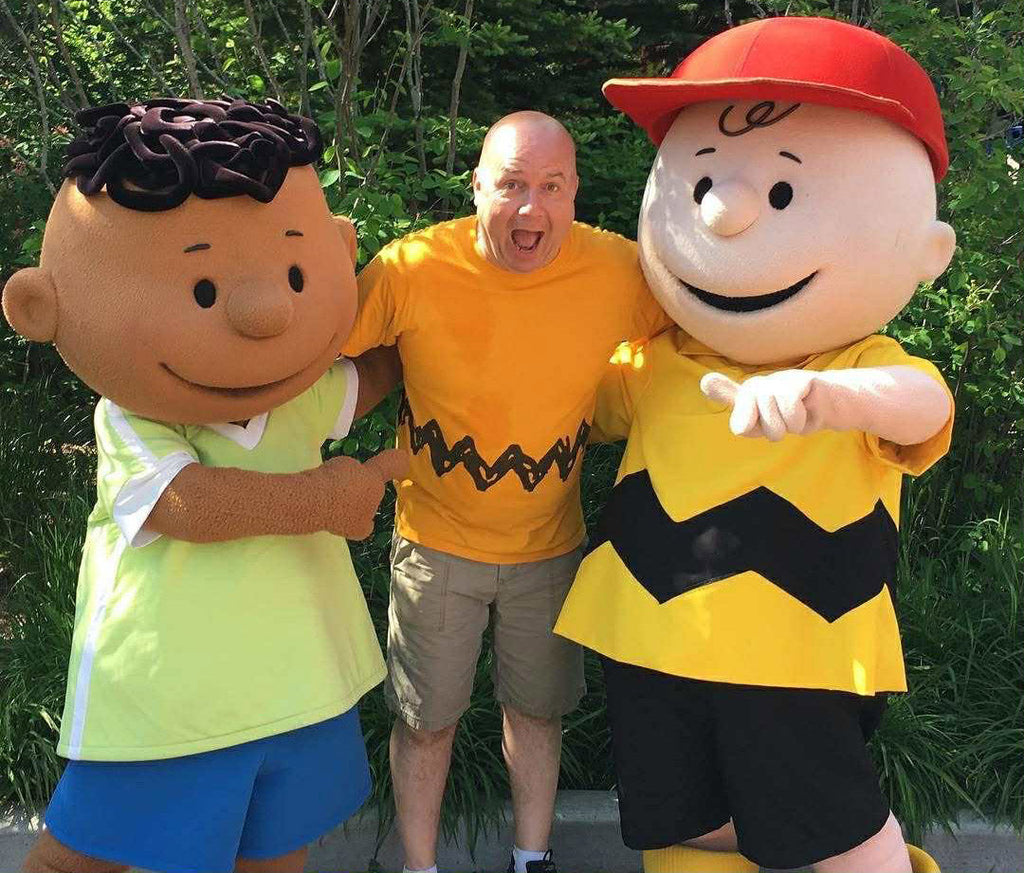
By Dan Brown No, that’s not me in the photo above – it’s another bald, middle-aged white nerd. The guy in the sawtooth Charlie Brown shirt is Ian Tyson. Like me, he’s a huge fan of pop culture, including such superheroes as Superman – Tyson has already seen this summer’s movie about the Man of Steel five times! Tyson is also. one of the key organizers for Forest City Comicon. If you attend the annual celebration of all things geeky this Sunday, you’ll likely see him hosting panel discussions. The timing for F3C this year – two days after Halloween – is no accident, he tells me via Facebook message. “It’s one of the reasons we chose this particular weekend at (Best Western Lamplighter Inn), with the notion being this Halloween, keep your costume on,” he explained. “I think Halloween has turned into more than just a day. It’s a whole weekend. So why not continue the celebration right into Sunday?” Forest City Comicon has always had a thriving cosplay scene. Tyson isn’t sure the exact reason. “We have a lot of great connections with our board to the cosplay community and that may certainly play a part in it. (The con) draws out really great creators and artists and people who just make incredible costumes,” he added, noting the afternoon cosplay contest attracts “everybody from the masterful ones to the little kids that are trying it out for the first time.” One outfit that stands out in his memory is from 2017, when one attendee dressed up as DC’s Hawkgirl. “She stood on stage and extended the (retractable) wings to their full span, which was significant!” Tyson recalled. “It was really incredible.” Tyson has been involved with every Forest City Comicon since it launched in 2014 at Centennial Hall. With the shift to the Lamplighter, this Sunday will be the first F3C to be held outside of downtown London. “The event features special guests, costumes, artists, exhibitors, board games, video-game tournaments, panel presentations, and more,” Tourism London boasts of the one-day show. “We’re very excited at the prospects of what’s gonna happen this year at the Lamplighter. I think the vibe will be lighter and more fun. It’s warm. It feels like summertime in there, and it’s just a great space,” Tyson said. “I think that we truly have something for everyone, and have put a really great show together this year.” Something that has been a staple of past editions of Forest City Comicon is to bring in not only actors, but also celebrity guests other than those with familiar faces. Sure, there have been performers like 2017’s Billy Boyd, who played Pippin the Hobbit in the Lord of the Rings movies. But also part of the meat-and-potatoes for Forest City Comicon have been the talented individuals who fill out the crew and cast of motion pictures and TV franchises, like voice actor Billy West, who came to London in 2016. This Sunday will see a visit by David Barclay, the puppeteer who helped bring Star Wars characters such as Yoda the Jedi Master and Jabba the Hutt to life. Barclay is also known for “all things Muppet,” Tyson says. Oh yeah, and Cocaine Bear is coming, too! That would be Alan Henry, the motion-capture artist who played the titular coked-out beast two years ago. He’s also played King Kong, as well as characters in the Marvel, DC, Avatar, Lord of the Rings, and Minecraft universes. “From our experience doing these cons, motion-capture actors are fantastic guests that have great stories,” Tyson said, adding mo-cap performers “have stories to tell. They have been on the sets of these big things that we love, major projects, and been there doing the heavy lifting.” “Plus, what I have found is they all very much seem to be fans of the work they are doing. They are into it and they love meeting fans of that work, too. It makes for great back-and-forth interactions. They are just good people and are a lot of fun.” You will also see me at Forest City Comicon on Sunday. But don’t worry, folks, I won’t feed the Cocaine Bear! Dan Brown has covered pop culture for more than 33 years as a journalist and also moderates L.A. Mood’s monthly graphic-novel group.
Every Jerk in Hollywood Has One
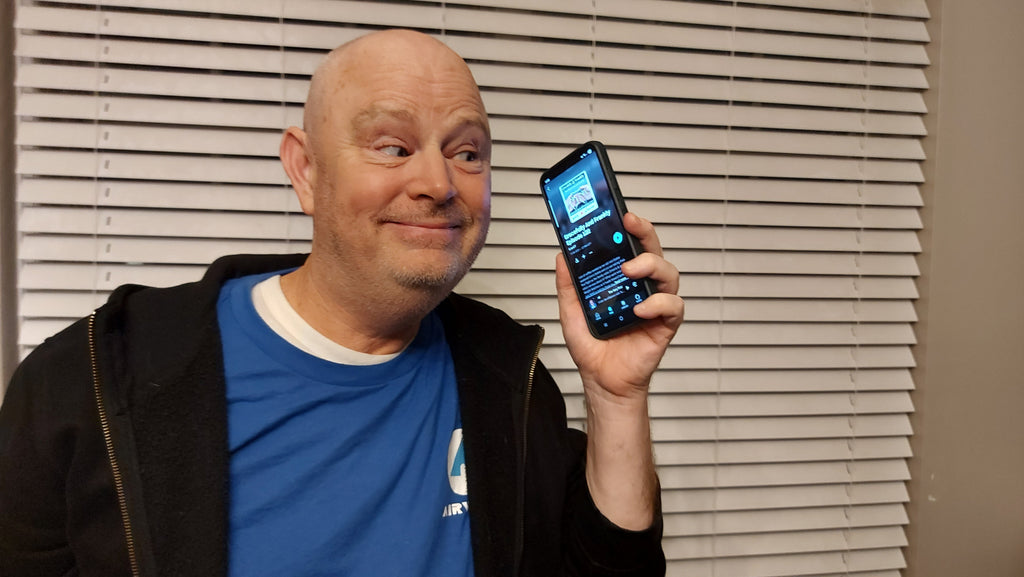
By Dan Brown If you’re a celebrity, and you really want to stand out from the crowd, there’s one sure way to set yourself apart. Don’t launch a podcast. That’s because, at this point in the evolution of podcasting, EVERYBODY in the entertainment industry has one. Former U.S. First Lady Michelle Obama has a podcast. Bowen Yang from Saturday Night Live has a podcast. So does Taylor Swift’s husband-to-be. Conan O’Brien has one, as do Oprah Winfrey, Amy Poehler, and Julia Louis-Dreyfus. Movie star Kate Hudson has a podcast, as well as Anderson Cooper, Anna Faris, David Tenant, Woody Harrelson, Ellen Pompeo, and Ricki Lake. They are so ubiquitous, even reality star Snooki from Jersey Shore has a podcast. Yes, Snooki. So at this point, those entertainers who don’t have a weekly show on YouTube are in the outnumbered minority. Why would you want to be just another jerk with a podcast anyway? I guess the easy money is the lure. Just be your A-list self, tell all of your old boring stories, and get ready for the dollars to come rolling in. I realize it’s not that easy, but that seems to be the dream for many stars. Celebrity podcasts in 2025 are like blogs were in about 2007. At that time, everyone in the media felt like they had to have a blog. I was once the new-media expert at a legacy-media outlet and I would have journalists coming up to me saying, “Should I have a blog?” not “I really want to blog.” And when they discovered blogging wasn’t easy, and building an audience required a lot of effort, they would abandon their blogs after about three days. The celebrity incursion into the podcasting world must also really burn people who are native podcasters – who actually put in the hours to make their podcast a success without the benefit of a well-known name. There is one good aspect to this flood of celebrities, though. It makes the podcasts that are truly special stand out all that much more. I’m talking about such shows as Under the Influence, which examines advertising culture, and Gracefully and Frankly, aimed at women of a certain age – queenagers. These are both pods I listen to regularly and they aren’t built on the fame of their hosts, but the quality of their content. They’re fun and educational. These podcasts are worth a listen because they have engaging hosts who are talented broadcasters and thought-provoking conversationalists. Not because they met Tom Cruise at a party once. How out of control has the explosion of celeb podcasts become? Yes, dear reader, even I had a podcast once. And I’m a nobody! Dan Brown has covered pop culture for more than 33 years as a journalist and also moderates L.A. Mood’s monthly graphic-novel group.
New Star Wars Series Aimed at Fans
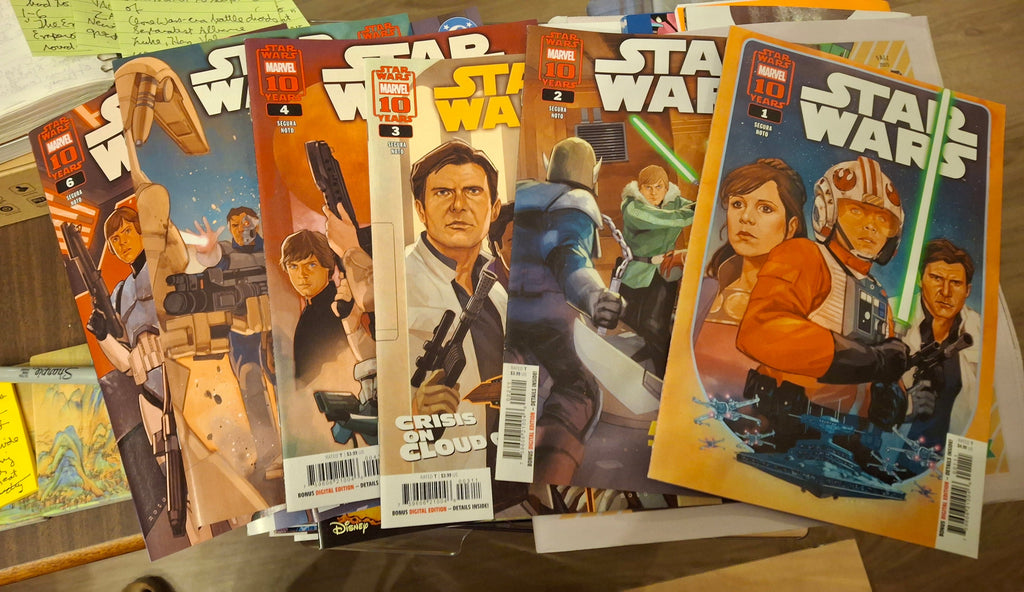
By Dan Brown Dedicated fans will get the most of out Marvel’s ongoing Star Wars title featuring Luke Skywalker, Han Solo, and Princess Leia. I would say I’m a fan of Star Wars, the Empire Strikes Back, and the first third of Return of the Jedi, so I enjoyed it just fine. This series – I looked at the first six issues – takes place in the timeline after the end of Return of the Jedi, with the Empire in tatters and our plucky bunch of heroes attempting to bolster the fledgling New Republic. There are all the usual trappings: blasters firing, lightsabres slicing, spaceships exploding, treaties being negotiated. (No one gets choked, though, which happens a lot in those original movies.) What will jump out at fans is how characters show up who have never been featured in a Star Wars movie. So the story – which revolves around Princess Leia wooing a system of planets to join her incipient interstellar government – has Solo teaming up with Valance, a bounty hunter who made his debut in Star Wars comics way back in 1978. Shades of Darth Vader, he was a self-loathing cyborg. Here, after he and Solo escape from a tight spot, the pair of rogues enjoy drinks at an alien-infested tavern. This is when Valance gives the Corellian a hard time for becoming part of the rebel establishment. “Things are different now, Valance. I can’t just hop in the (Millennium) Falcon and fly off on an adventure whenever I like,” the one-time smuggler and now married man explains. “The old days are gone.” What will also stand out for longtime fans is how the characters actually resemble the actors who portrayed them in the original trilogy — so Solo looks like Harrison Ford, Skywalker like Mark Hamill, and so on. Back in the day, the licence Marvel had with Lucasfilm stipulated that they couldn’t do this, in case George Lucas ever needed to re-cast any of the roles. What fans of those original comics got were bland, anonymous characters who had roughly the same hairstyle as the ensemble that made the movies such a sensation. It’s unclear how much of the interregnum between Return of the Jedi and The Force Awakens will be covered in the new series. And that’s part of the problem: Because there is so much plot infrastructure already in place, there’s only so many directions writer Alex Segura and artist Phil Noto can go. The result: The creative team is constrained in bringing real change to the existing universe (these comics are billed as canon, though). They can’t kill off a main character, for instance. Still, Luke does get to Force-shove some baddies out his way and fire up his laser sword. Solo does get to shoot his way back to his hunk of junk spaceship through a crowd of villains. And Leia does get hot-headed during some palace intrigue. If that sounds like fun, this is the series for you. By the way, I’m also a fan of the Last Jedi, the Mandalorian, Rogue One, Andor, and the standalone Solo movie. Now there’s an idea – since Solo: A Star Wars Story is unlikely to ever get a sequel on the big screen, why not have a comic series that details what happens to Han and Chewie in the decade before they meet Luke and Ben Kenobi on Tatooine? That would be something I could really get behind! Dan Brown has covered pop culture for more than 33 years as a journalist and also moderates L.A. Mood’s monthly graphic-novel group.

Goodbye to the Library Pub
By Dan Brown I wish I could go back in time to step into the Library Pub for the first time again. As a twentysomething journalism student at Ryerson University, what was I thinking as I stepped through the door on Toronto’s Dundas Street and walked up the stairs to the venerable pub? Did I know then how the Library Pub would become an unofficial headquarters for our class, how I would spend so much time there in the following two years, how it would loom so large in my memories? I ask these questions because the Library Pub, which was the dive of choice for many a generation of Rye High journalism students, will soon be no more. As of Nov. 15, the family that has owned the Imperial Pub (which is the downstairs part) is closing the whole business. The building is to be razed to make room for more housing for Toronto Metropolitan University students – the same school I went to in the 1990s, only with a different name. Located maybe three blocks from the j-school, the Library was where our class walked briskly on Oct. 3, 1995 when we heard the O.J. Simpson verdict was about to come down. We grabbed some glasses of draft, snuggled into the wide and worn leather couches, then asked the bar staff to switch the wide-screen TV to CNN. It was not the verdict I had expected. It was also where we went for a pitcher or two of Rickard’s Red after every occasion, like our final TV broadcast class. The old-school jukebox had maybe a hundred jazz songs on it and every one of them was Frank Sinatra’s Summer Wind. I bought many glasses of beer for my classmates, one of whom I am friends with to this day. In fact, she was the best “man” at my wedding. Journalism school was a shared experience, and that bar room is also where we bonded, complaining about our instructors and dreaming of how we would fix journalism while we played pool. We also watched episodes of The Simpsons, which was then in its glory days. In one episode it was revealed that Sideshow Bob’s real name is Robert Onderdonk Terwilliger, which was strange because we had a Rob Onderdonk in our class, too. And yes, I was told by my classmates that this conversation did take place on more than one occasion when I was missing from class: – Where’s Dan?– He’s at the Library.– Wow, he’s always at the Library, he studies so much.Along with many of my peers, I went on to a long career in journalism. My classmates became sports columnists and movie-magazine editors and freelance reporters. I spent almost a decade in Toronto all told before following my passion for journalism back to Southwestern Ontario. Now I mentor students who are roughly the same age I was in my prime drinking days. I haven’t been to the Library Pub in years, perhaps even decades, so I would be the first to admit: What I’m writing is really a tribute to the Library as it was back then, to the Library Pub of my mind – although I’m told it never changed much. I will also admit that some bars never get immortalized like this. In fact, this column belongs to the subgenre of articles about watering holes that get written for no better reason than they matter to journalists, like McSorley’s Wonderful Saloon (the New Yorker), the Wheat Sheaf Tavern (the Globe and Mail) and the Bucket of Blood/Victoria Tavern (the London Free Press). You can call me guilty of the same journalistic crime. Dan Brown has covered pop culture for more than 33 years as a journalist and also moderates L.A. Mood’s monthly graphic-novel group.

Are Comics At A Turning Point?
By Dan Brown Two comics-related announcements jumped out at me last week. They are both about the current state of the industry. What to make of them? I honestly don’t know. At this point, I’ve got more questions than answers. So I’m going to lay the two statements out for you, along with some thoughts, in hopes some kind of meaning will emerge. The first was a speech delivered by DC Comics President Jim Lee to comic-store owners at New York Comic Con, in which he said the company will never use artificial intelligence, so long as he’s the boss. “DC Comics will not support AI-generated storytelling or artwork. Not now, not ever, as long as I am in charge,” he promised the crowd. “Because what we do and why we do it is rooted in our humanity. It's that fragile, beautiful connection between imagination and emotion that fuels our media, the stuff that makes our universe come alive. It's the imperfect mind, the creative risk, the hand-drawn gesture that no algorithm can replicate.” “And when I draw, I make mistakes, a lot of them. But that's the point. The smudge, the rough line, the hesitation. That's me in the work. That's my journey. That's what makes it come alive. It's the product of true effort, of inspiration, and perspiration. Fans know this. They sense this.” “They can feel when something was made with care, when it cost the artist time, energy, heart, and effort. People have an instinctive reaction to what feels authentic. We recoil from what feels fake. That's why human creativity matters. AI doesn't dream. It doesn't feel. It doesn't make art. It aggregates it. Our job as creators, as storytellers, and as publishers is to make people feel something real. That's why we create, and that's why we're still here." That’s about as passionate a defence of the human element in comics-making I’ve ever heard. And, cards on the table, I have no interest in reading comics or graphic novels that aren’t created by human hands. But what if that’s what the market wants? What if young fans, who don’t have the same sentimental connection to comics history that I and my peers share, demand AI comics? Doesn’t DC have an obligation to serve the needs of those readers? I ask because, for instance, there’s an entire segment of fandom that don’t want to read about characters like Batman – they want to be Batman, which they can do via online gaming. I’m not sure those fans care who (or what) is rendering their favourite characters. The second thing I noticed last week was a social-media post (I saw it on Facebook) from legendary comic writer Gail Simone, who has penned stories featuring heroes from Superman to Batgirl to Deadpool to her own creator-owned characters. “It's been a really weird time for comics, there's no question about that,” she wrote.“But I've spoken with the very biggest of wigs at three of the top five publishers in the last six weeks and they all said the same thing: Comic sales are up, a lot.” “One also said there is a definite trend towards specifically physical things, particularly a subset, newish physical things, that people want to purchase. The message seems to be that different formats and variants and specialty items are growing in sales in a big way, while digital sales remain flat. It is honestly the most excited I have seen these companies in years.” “This is going on through the pandemic and the election and inflation and tariffs and the distribution nightmare that retailers have to deal with. All those challenges, and comics are up and rising. I'm talking physical sales from U.S. publishers. In spite of all that stuff. And several companies have produced some genuine banging hits requiring multiple printings.” “Not everything is rosey, but I think that's pretty exciting. I know there are caveats but without strong sales, nothing else matters, nothing is fixable without people getting the books. There's a lot of people who wouldn't give up . . . creators, publishers, retailers, and I'm thankful because you guys, I love this artform more than just about anything. But it all starts with readers. SO THANK YOU, READERS!” Simone’s comments echo news coming out of the same gathering where Lee spoke, New York Comic Con. A report by Heidi MacDonald of Publishers Weekly quoted numbers showing sales are up by 27 per cent at many comic shops in the U.S. “despite looming threats from tariffs, recessions, book bans, and the turmoil generated by the Diamond Comic Distributors bankruptcy.” That all sounds like good news to me. And maybe an indication AI may not be as much of a threat as some think. Dan Brown has covered pop culture for more than 33 years as a journalist and also moderates L.A. Mood’s monthly graphic-novel group.